Climate & Energy

Writing on electric vehicles, the grid, decarbonization, and climate solutions.

A Second Age of Sail

The Pyxis Ocean's maiden journey, from China to Brazil, will provide the first real-world test of the WindWings - and an opportunity to assess whether a return to the traditional way of propelling ships could be the way forward for moving cargo at sea.Folded down when the ship is in port, the wings are opened out when it is in open water. They stand 123ft (37.5m) tall and are built of the same material as wind turbines, to make them durable.Enabling a vessel to be blown along by the wind, rather than rely solely on its engine, could hopefully eventually reduce a cargo ship's lifetime emissions by 30%.

Pioneering wind-powered cargo ship sets sail - BBC News

It's truly awesome how we are going to enter a second age of sail and return to using the power of the wind on the ocean again.

Related: The Great Machines - Vacationing in the Age of Climate Solutions part 3 · Japan to Create the World's Largest Floating Wind Turbine | PCMag · BBC - the Elements

Rooftop Solar for the win

Photo by Cindy Shebley on Pexels.com

Rooftop solar was overlooked. Now it's closing a New England power plant.

New England ISO spent the time to deeply model the actual impacts of rooftop solar, and what actual hour by hour needs for extreme weather events in the winter were, and found that roof top solar and regional wind provided a lot more power to the grid during those times than they had expected.

Classically folks just assume Solar is minimal in the winter. But it turns out that it still generates power. And that power matters a lot in a extreme weather event.

I really wish that NYISO would do a similar modeling exercise. They are making the same claims that the grid can't handle the next few years that New England ISO was making. I have a feeling the results would be very similar, and we'd find that things are going to be fine, and roof top solar is a key reason.

Related: The 2017 Eclipse Impact on the Grid · First Photograph of Extra Solar Planet · Getting to a Zero Carbon Grid

The Heat Pumps of Maine - Vacationing in the Age of Climate Solutions Part 2

In Bar Harbor we stayed in a Inn outside of town, largely because it had both an indoor and outdoor pool and my daughter has gotten into swimming this year. That seemed to weather proof us for some activities.

The room had a pretty standard through wall AC unit, which was loud (clearly not going to last much longer), but is what we had. After the first night I really thought to myself, this would be the perfect use for mini splits. Individual controls per unit, super quiet, and it could also do heat in the colder months.

Already ahead of me

When we walked around downtown later in the day, we found another Inn was totally on it.

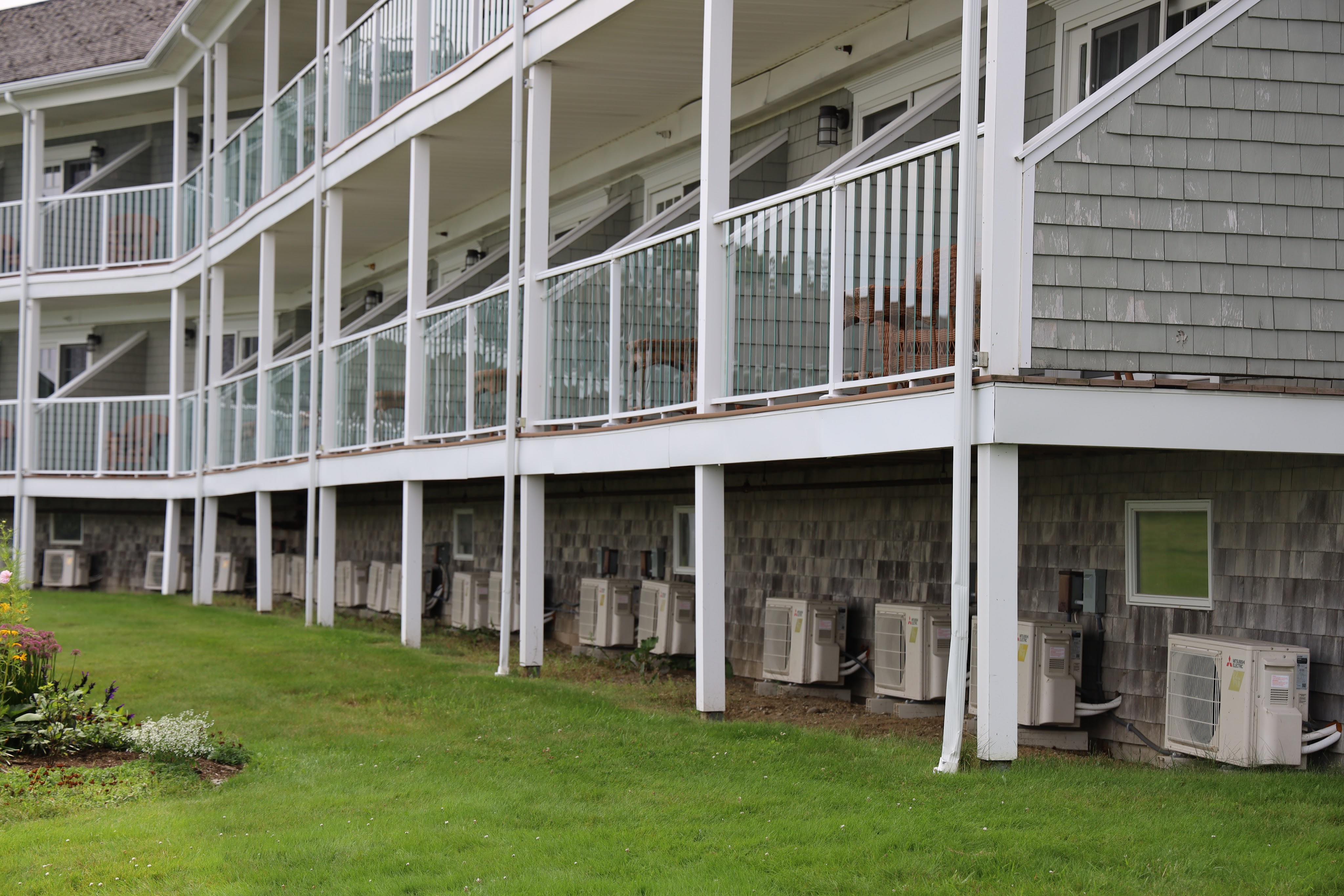
Look at all those heat pumps in this high end Inn. I wished for their quiet comfort at night. As we walked further along we saw how truly all in they had gone.

Every room in this Inn had their own mini split. These looked to be the Mitsubishi units that work down to -15F, so these are enough to provide the heat for those rooms as well in the winter months.

Main Heat Pump Policy

In 2019 Maine set a target of installing 100,000 by 2025. Just a week before we left on our trip it was announced that Maine had just passed 104,000, so upped the target to 175,000 by 2027.

Maine, like upstate New York, relies on Fuel Oil to heat a lot of homes. Fuel oil has the advantage of being easy to move in trucks (it's a liquid) and energy dense. It has the disadvantage of being Diesel fuel, so being terrible on carbon pollution, particulate pollution, and cost. Between Covid bounce back, and the war in Ukraine, fuel oil prices jumped from $2/gallon to $5/gallon over the course of 2 years. So there were always huge climate reasons to get off fuel oil, but the economics kicked into high gear with an equivalent of a $200 / ton carbon price being applied over the last couple of years.

The fossil fuel industry would have you believe that heat pumps don't work in the cold. This myth is so pervasive I've had to knock it down myself on social media. The problem is saying heat pumps don't work in the cold because 1980s heat pumps in the south didn't, is like saying phones don't have working internet. That was true 20 years ago. But a lot has changed.

Heat Pumps Everywhere

As we drove out of Bar Harbor we noticed heat pumps on the outside of buildings everywhere, and Heat Pump installer businesses as we passed.

Heat pumps are my new indicator of progress on the climate crisis. Every single one directly replaces fossil fuels, both by being more efficient than in window AC, and actually providing heat. Maine's huge embrace of this technology is such a big win for the climate, and warms my heart to see it.

Related: 8 months in with Geothermal Heating & Cooling · No Coal this Christmas Season - Personal Climate Action you can take now · My Climate Summer

Bar Harbor Bus Network: Vacationing in the age of Climate Solutions part 1

10 years ago my wife and I had taken a 2 week road trip through Nova Scotia, New Brunswick, and Maine. During that trip we stayed at Fundy National Park in a Yurt. And we definitely wanted to come back.

In 10 years, a bunch of things changed, and a bunch stayed the same. we did this trip in our Subaru Outback which was only a year old last time, and ended up exactly the same Yurt as last time. But we're now a family of 3, and I've been involved in climate organizing with Citizens Climate Lobby for the last 6 years. That meant that everything I saw now was through climate colored glasses. Some things really surprised me during the trip, and got me excited. This will be a multi part piece to keep things bite sized.

Parking in Bar Harbor

I've been to Bar Harbor and Acadia twice before (1999 and 2014), and one memory I've got is the cars and the parking are a mess. That had generally turned me off of it as a town.

Our first day in town was a Puffin Tour departing at 9:30am. We had a ~2 mile walk into town from the Hotel, which we did instead of trying to figure out parking. As we walked past the various parking meters it was clear I'd need to install yet another app (I'm now up to 7 parking apps on my phone), and it would run at least $4/hr ($6/hr closer in). Plus finding parking. I did not look forward to this. But at least I didn't have my car now.

The Puffin tour was awesome. That's a whole other post. But here is my favorite shot.

Bar Harbor has a bus network

After the morning puffin tour, and afternoon walking around, our legs were tired. It was close to 2 miles back to the hotel. But I kept seeing these buses go around. I wondered how they worked. Google to the rescue.

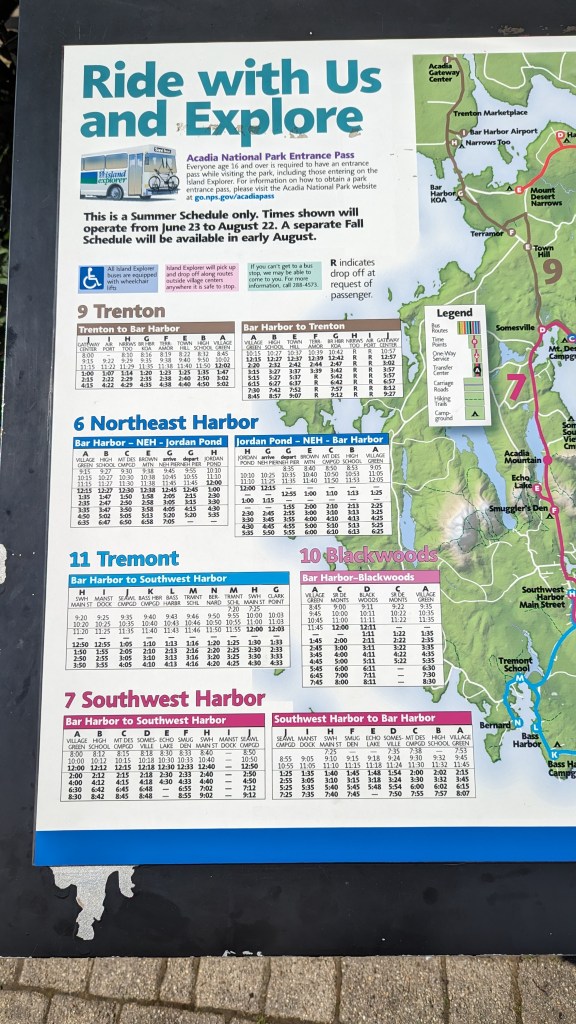
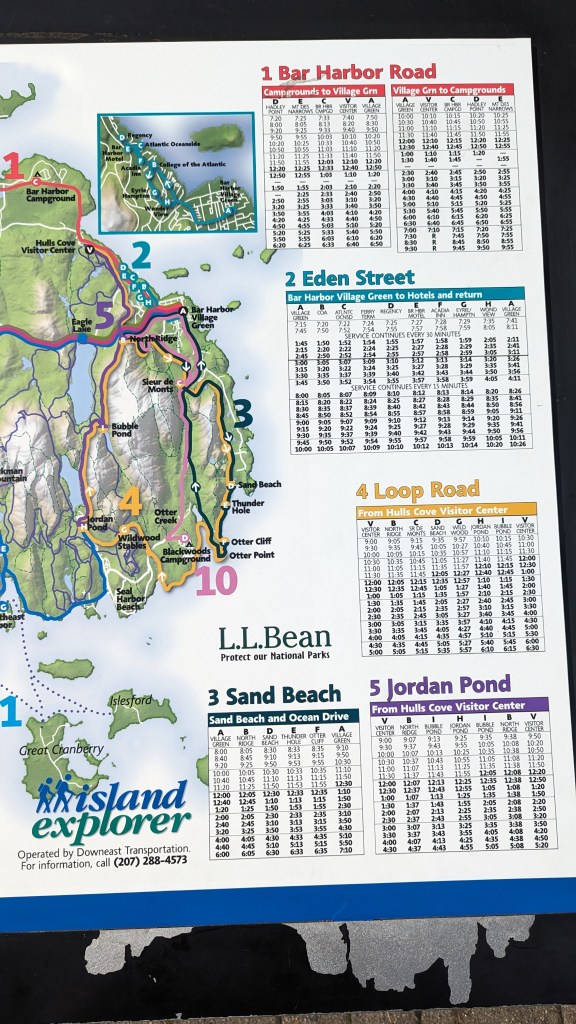
But map and time table

Bus map and time table

Look at that glorious bus route map!

The Island Explorer is a free bus network on Desert Island. It serves both Acadia National Park, as well as the larger parts of Bar Harbor. From where our hotel was to the village green there was a bus every 15 minutes until 10pm. There were buses every 30 minutes through large parts of the park. They are propane instead of diesel, which means they are far less polluting (hopefully the next round will upgrade to electric).

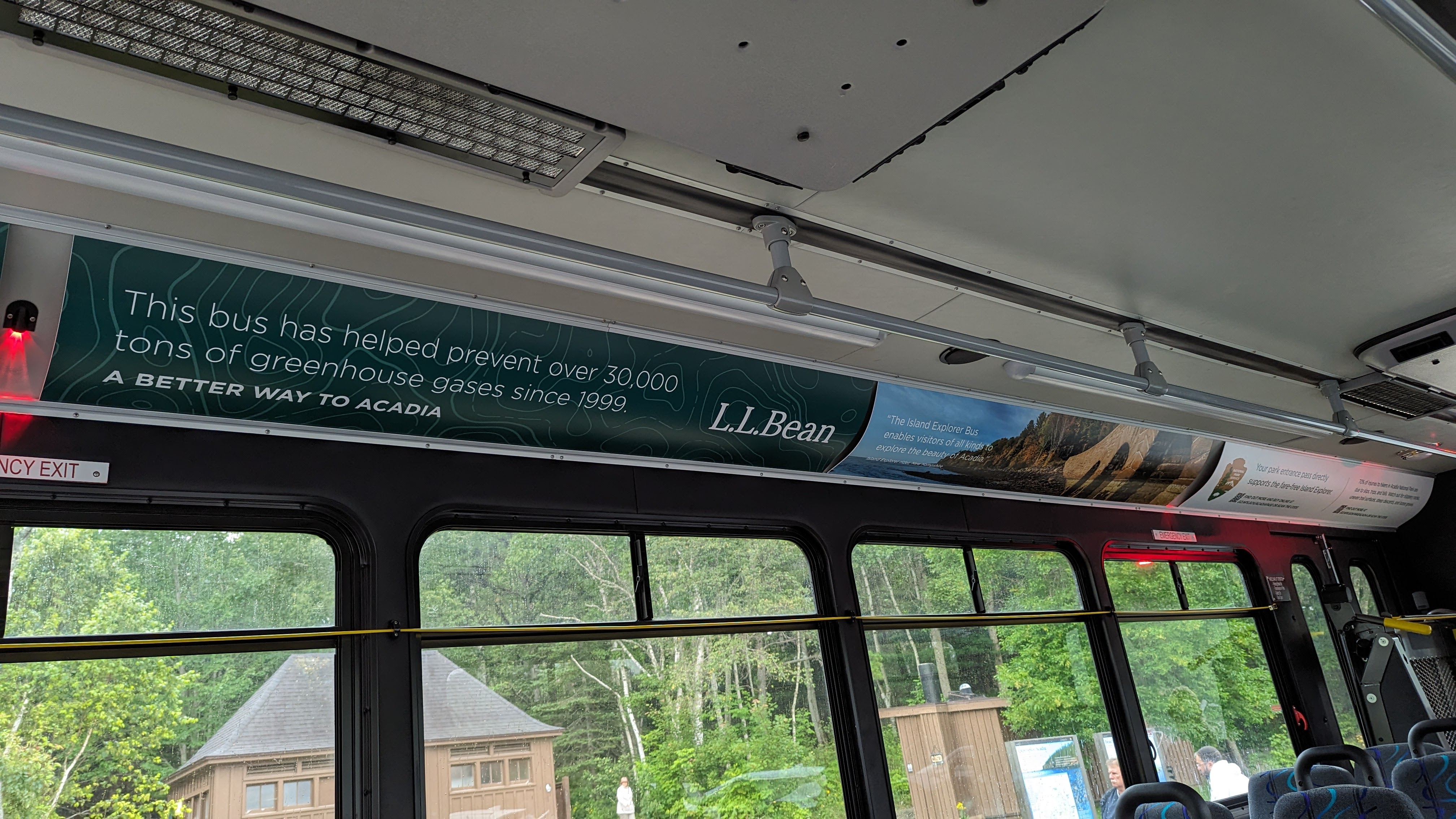
Thanks LL Bean for helping drive public transit!

Once we figured out this bus network, we were sold. And basically didn't use our car for most of the time in Bar Harbor. All excursions into Acadia were by Bus.

The bus network serves a ton of purposes. First off, it gets a bunch of cars out of the down town with the 15 minute bus to the nearby hotels (8 of them, stopping at their door, 30 minutes for the full loop). To me this immediately changed my ability to relax, because nothing stresses me out quite like trying to find parking. We were so free on this vacation by being able to leave the car at our hotel.

The bus network equally keeps cars out of the park, which has plenty of traffic and parking challenges of it's own.

It also lets you do more interesting hikes. Because you don't have to do loops, you can hike from one bus stop to the next, pick up the bus and go home. We didn't take advantage of that on this trip, but I can totally see doing that in the future.

The buses also have bike racks on the front and back, so they can take about 6 bikes with each one as well. Acadia has this massive carriage road network for biking, so a future trip is definitely going to include our bikes for that.

Bus Network as Destination Feature

Yes, Bar Harbor is a tourist town, with tourist money coming in. The buses are paid for from a combo of Acadia pass fees and LL Bean sponsorship.

But here is the thing, the Bus Network makes Bar Harbor a better place to vacation. A more relaxing one. One where I want to go back and spend another week because of the freedom those buses give me. I'm already planning our next trip.

And it turns out, we don't only need to have nice things on vacation. We could do this, have more buses, right at home. And eliminate a lot of driving and parking in the process.

Related: USB Passthrough with VMWare and Ubuntu 7.10 · Pidgin, Network Manager, Dbus, Ruby, oh my! · I'm so over gas cars - Vacationing in an Age of Climate Solutions part 4

What Climate Change Is Already Doing to Children's Brains | Time

The understanding that climate change and air pollution affect the developing brain has grown exponentially in the last 20 years. Research has now linked prenatal as well as postnatal air pollution exposure to reduced IQ and other cognitive problems, developmental disorders such as ADHD and autism, depression and anxiety, and even structural changes in the brains of children. Research has also shown how climate-related displacement results in disruption of education and mental health problems such as post-traumatic stress disorder, anxiety, and depression in children. These conditions often persist, affecting health and brain function in adulthood. They also add to the list of harms that have been more widely recognized as being related to climate change and air pollution: heat-related illness, drowning and physical trauma from severe storms and floods, premature birth and low birth weight, asthma, and other respiratory disease.

What Climate Change Is Already Doing to Children's Brains | Time

As we learn more about the health impacts of climate change, it's clear how much worse this is than we thought previously.

Related: Climate Giving · A Climate Change Primer at ARS Technica · Climate change goes to court

Japan to Create the World's Largest Floating Wind Turbine | PCMag

Osaka University in Japan is beginning a joint research project with civil engineering company Toda to develop the world's largest floating wind turbine.

As Nikkei Asia reports, the goal is to have an experimental wind turbine capable of outputting 15 megawatts. In order to achieve such high output, the blade span of the new turbine is expected to be roughly 200 meters, making it about three times larger than existing wind turbines.

Japan to Create the World's Largest Floating Wind Turbine | PCMag

The US East coast is unique in having a huge shelf to do offshore wind on, that's easy to attach to. To really get Wind powers' full potential, floating solutions like this are needed, as there are so many more places in the world that can work.

Japan is in a current energy bind as well, they have very little land, their power system is largely Coal and Natural Gas, all of which they import. Nuclear was out of favor the last two decades, which has made the current LNG price spikes hugely expensive for the country. Floating wind is a bet they need to pay off, because otherwise it's very unclear how they meet their climate goals.

I also wonder if their reliance on Coal is one of the reasons the Japanese Government has been so luke warm on EVs, because they don't really have any way to grow their electricity grid effectively.

Related: The Great Machines - Vacationing in the Age of Climate Solutions part 3 · Hacking Windmills · Doctor Who Floating Tardis

The Politics of Clean Energy is changing

Analysts say there’s a lesson in that: The new jobs at these green factories may function as a political game-changer. “That may be an implicit long-term strategy for the Democrats: With domestic manufacturing likely in traditional Republican districts, the partisan split may soften on renewables,” Timothy Fox, an analyst at ClearView Energy Partners, told me.

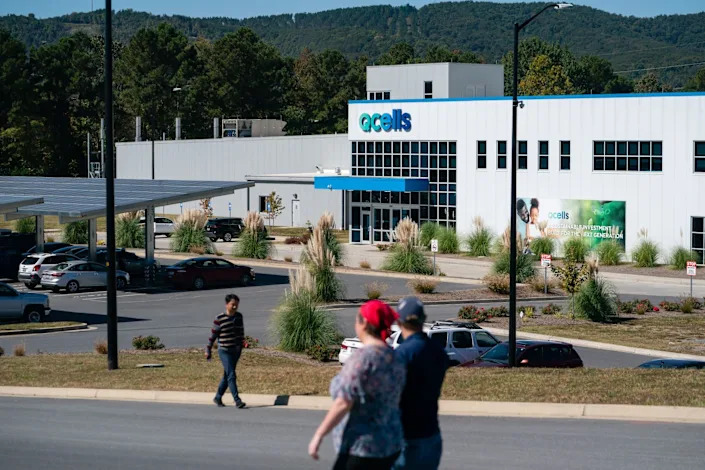
Some Republicans in Georgia also see these factories as politically beneficial. Governor Brian Kemp, in his successful campaign for re-election, touted a surge in green jobs across the Peach State. There’s a battery plant so massive that it stretches half-a-mile along a freeway northeast of Atlanta — and more facilities are on the way. Hyundai Motor Co., for instance, just started building a $5.5 billion electric-vehicle plant near Savannah.

Green Factories Are Changing Minds in More Conservative US States

This was one of the most important things the IRA will do, change the politics around clean energy. Clean energy production is going to be the jobs on the ground that people see in lots of parts of the country that were left behind.

That is going to change the politics of future climate legislation, and what is possible. We might even see this in the 118th Congress coming up with a razor thin Republican majority.

Related: No Coal this Christmas Season - Personal Climate Action you can take now · NY project will use high-tech sensors to get more clean energy on to grid · Saving you money with my refigerator

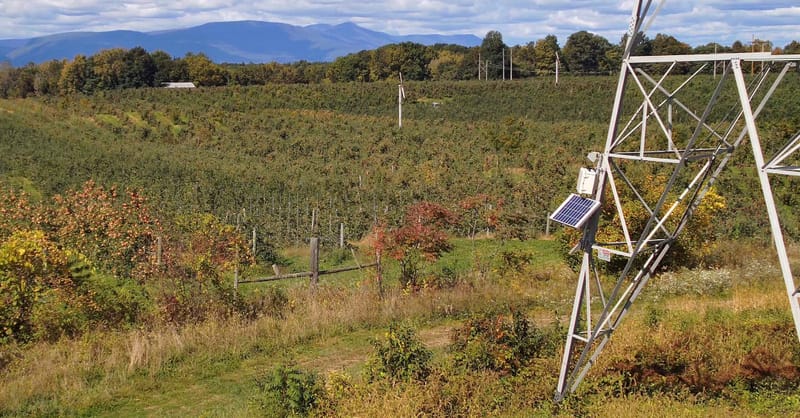
NY project will use high-tech sensors to get more clean energy on to grid

Weather conditions affect how much power can be carried on transmission lines, and high-tech DLR sensors attached to transmission lines give grid operators like National Grid real-world information on weather and thus on the carrying capacity of lines. In simple terms, colder air temperatures and higher wind speeds cool down power lines, giving them more capacity to carry energy — conveniently enough, at the same times when high winds are increasing wind-farm power output.

Traditional ​“static” line ratings for transmission lines, in contrast, don’t capture these environmental factors, forcing grid operators to restrict power flows based on worst-case expectations.

This kind of real-time expansion of existing grid capacity could help overcome some major barriers to reaching New York state’s goal of getting 70 percent of its electricity from renewable resources by 2030, said LineVision CEO Hudson Gilmer.

Source: NY project will use high-tech sensors to get more clean energy onto…

This looks like it could add some pretty significant additional load onto existing wires quickly. As the NY load shifts from summer to winter with electrification, getting 20% extra capacity in the winter on transmission lines would be huge wins. Hope to see this more places.

Related: Getting to a Zero Carbon Grid · No Coal this Christmas Season - Personal Climate Action you can take now · Electricity Map

Work begins on 339-mile transmission line from Canada to NYC

CHPE is expecterd to deliver 1,250 megawatts of clean energy, or enough to power 1 million New York City homes — about 20% of the city's electric demands.Power cable lines will be installed underground and underwater for an estimated cost of $2.2 billion. The transmission line is expected to start full operations in the spring of 2026. It's expected to reduce carbon emissions by 37 million metric tons in its first 10 years.That's equivalent to removing about 500,000 cars off New York roads, Hochul said, adding it will significantly reduce the state's carbon footprint.

Work begins on 339-mile transmission line from Canada to NYC

When Indian Point was shut down it took 2 GW of power offline that powered a huge amount of NYC. That was replaced with more Natural Gas plants.

The completion of CHPE is going to reverse about 50% of that loss. The original completion date was 2025, so hopefully the delay doesn't get worse, as NYC needs this clean power as soon as possible.

Related: NY project will use high-tech sensors to get more clean energy on to grid · Getting to a Zero Carbon Grid · No Coal this Christmas Season - Personal Climate Action you can take now

Deconstruction of a bad study - EV fuel pricing

One of the current challenges in the field of Journalism is that there are currently 6 PR staff for every 1 Journalist, and the PR staff are much higher paid. Which means that a lot of reporting on more technical areas ends up being mostly taking an existing press release, doing an interview with the authors, and running it as a story. Especially for highly technical items (like studies / reports), the Journalists may not have the expertise to really pull them apart with a critical eye to ensure they hold water.

Such was with this Detroit Free Press Article - "Study compares electric vehicle charge costs vs. gas — and results were surprising":

Last year, Patrick Anderson went electric: He got a Porsche Taycan EV in dark blue.

Anderson, who is CEO of East Lansing-based economic consulting firm Anderson Economic Group, loves the zippy acceleration and "exciting" features the car offers. He also gets satisfaction in knowing that driving an EV benefits the environment, he said.

But Anderson's joy comes with a dark side.

"They are a wonderful driving experience. But at the same time, they're an enormous burden in time and in energy in finding chargers and getting them charged," Anderson said. "And you’re not really saving much in terms of charging costs ... you may be paying more.”

Costs to drive an EV compared with a gasoline car are detailed in a report Anderson Economic released Thursday called "Comparison: Real World Cost of Fueling EVs and ICE Vehicles."

This seemed really odd, because it goes in the face of a lot of existing studies which show how much cheaper EVs are. Enough so that I went into the study to figure out why.

Finding the Critical Assumption

The critical table in the study is here, where it shows EV cars cost more to fuel. Often by a factor of 2 (highligted in green). But the reasons why that math comes out like that is largely because of what's in red.
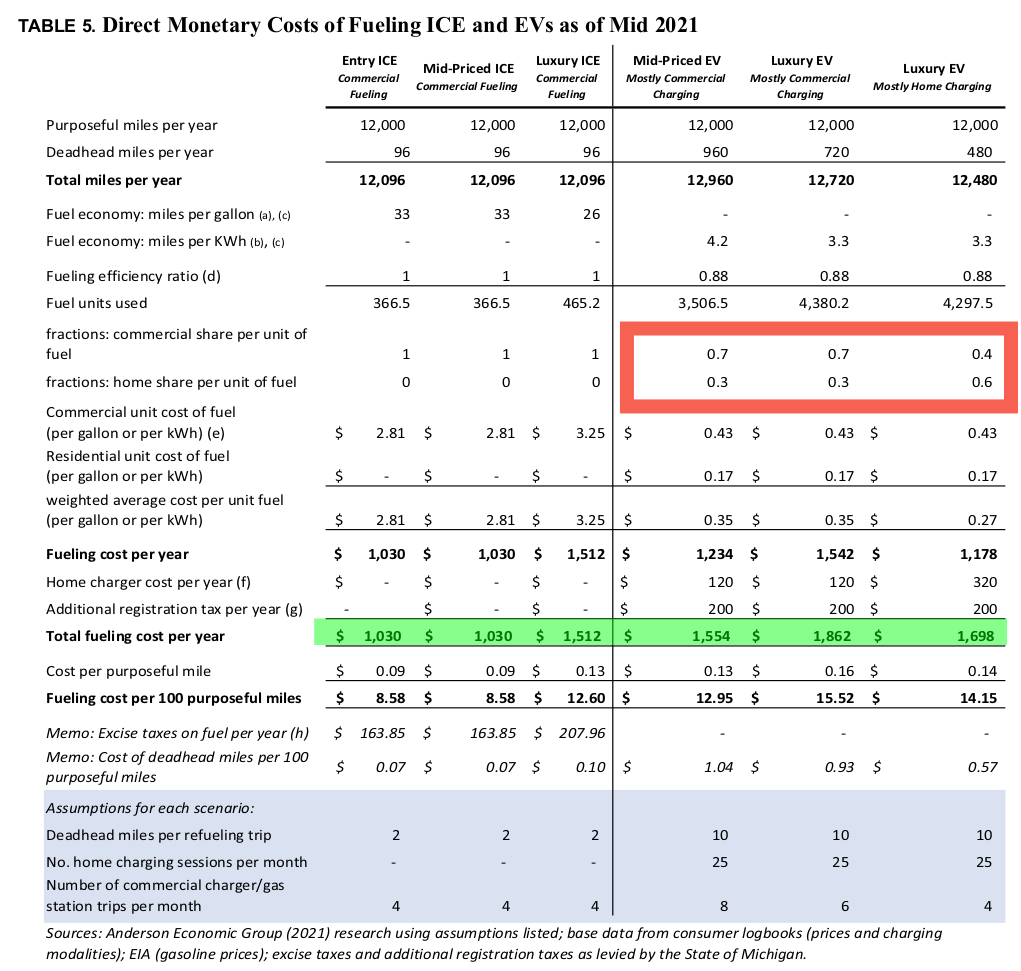
The key assumption of the study is that EVs will be charged outside the home for 70% of their electricity. And that electricity will cost 3x the residential rate. They create a single "mostly at home scenario" which still assumes that 40% of electricity comes from outside the home.

This is a pretty key assumption, that has no justification. The DOE typically assumes that more than 80% of charging happens at home. My own personal experience with 14,000 MWh of energy transfered to our 4 year old Chevy Bolt, is that at least 97% of our charging was at home. And all our charging out of home was actually at for pay L2 chargers which were the same energy price at home (largely at work and during a conference to Troy).

If you replicate this with those numbers, you find the EV costs are in line with their ICE cars. Which is still a surprising result. And that's where it's worth looking at all the other biases put into the study.

Lot's of other assumptions and biases

One other thing was strange on the initial assumption. EVs are divided into Mid Cost (Bolt, Model 3), and Luxury (Porche / Model S), however only the Luxury case showed a 60% at home charge case. That seems like a really big missing case. Why?

If it had been included, it would have broken the streak of every EV scenario coming out more expensive than every ICE scenario. Which seems to be the main goal of the study. This scenario is conspicuous in it's absence.

Let's look at other assumptions made and what bias they bring to the table:

  • 12,000 miles per year. The national average is closer to 14,000, and in the state of Michigan, it's closer to 15,000. As you increase the miles per year EVs cost less. 12,000 is a justifiable number, but it definitely biases towards ICE.
  • Per year state fee on EVs. These range from $0 - $200 depending on the state. $200 was chosen as the number, because that's the Michigan number. Even though mileage wasn't chosen for Michigan. Again biases towards ICE.
  • There is a whole set of "dead head" calculations which are used saying you have to drive around looking for chargers, and the number of times you have to go out to do this per month with an EV. Based on the listed fuel economy the number of trips is quite high. It suggests an average of 87 miles per Fast Charge added to a Bolt / Model 3 (which have 240 mile ranges) or 117 miles per Fast Charge for something like a Model S with 250 - 300 mile range. Which seems, odd. Also, even though all other numbers are averaged out to yearly numbers, for some reason the 60% at home scenario actually assumes charging only 100 miles per fast charge session.

Cost of Chargers

There is one good insight in that most EV chargers want to charge at home, and that does mean buying a Level 2 charger and having it installed. They estimate that cost at $1600 with professional installation. They don't include the 30% tax credit for doing so (which comes and goes, but again that's an ICE bias). $1600 is probably a little on the high side, I think it cost us more like $1200 all in. They also assume the lifespan of the charger is 5 years, and amortize it over that. That seems extremely low, and again is an ICE bias.

The really bonkers assumption they make though is that you have to buy a Level 1 charger. Those come as standard equipment with every EV. There is really no justification other than an ICE bias to put that in.

Cost of Fueling?

The study authors justify many of these items, as well as not including the costs for an ICE vehicle during this same 5 year window (scheduled maintenance, oil changes, breaks, transmission fluid, etc). They claim annual registration fees are fueling, as well as permanent home infrastructure like a charger.

And this is where it is really clear the point of the report was to generate a very specific result. If you squint hard, pile on some biases, and assume everyone is refueling EVs like ICE cars, you can create a scenario where one part of owning an EV is more expensive than an ICE car.

But, it will still be cheaper to own. Even in the flawed study. And once you start correcting for lots of the flaws, you end up with something that looks a lot like other analyses.

A Real Study would have been...

A real study would have been to note there are some extra costs for EVs outside of just home electricity, like home charging infrastructure, commercial fast charging costs, and state policy creating EV fees, and look at cross over points. Under what circumstances do these extra fees hurt EV adoption. What policies should be in place to less them.

For instance, the EV annual fee to replace missing gas tax only makes sense if you believe that every EV just causes the same damage to roads, with no other benefits. When every EV replacing an ICE car on the roads reduces fine particulate pollution (from both exhaust and break dust) which directly decreases health care costs for the state. There is a big case to be made that these fees should be eliminated on those grounds (or prevented from being passed in states where they don't yet exist).

What policies ensure homes are EV ready. What policies are needed to handle the economic problems of fast charging (which mostly is about how commercial power tariffs work). These are all good questions to ask. None of them were.

And this is why when you see a study or report come out from somewhere, don't assume it's correct out of the gate. Always bring a critical eye, especially to reports that claim to bring results that are very different from the existing literature.

In order to play with the data more, I built a google sheet that plugs in the existing study, and adds scenarios with higher rates of at home charging, and eliminates the per year EV fee. You can make a copy and adjust some of the inputs to see how it changes things. Though remember that even this is still an incomplete picture, as it doesn't include the maintenance costs.

Related: I'm so over gas cars - Vacationing in an Age of Climate Solutions part 4 · Power usage after going Geothermal and EV · Last Gas(p)