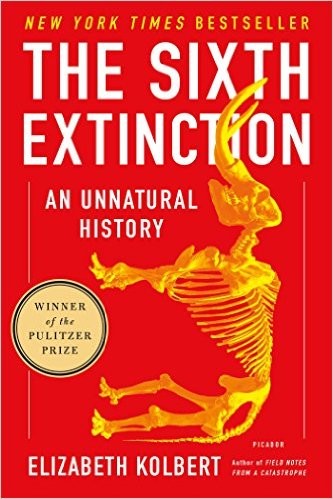
Over the holidays I finally got around to reading/listening to The Sixth Extinction. It was quite good, but the language was at a density level where I found listening to the audio book to be a lot easier than reading on my kindle. Fortunately for me, both copies were in our library, so after my ebook lend expired I switched to e-audiobook lend to finish it off.
The book uses the lens of a number of extinct or endangered species to look at humanity's impact on the world. And each species provides an opportunity to dig into a different part of science or the history of science around them.
The chapter on the Mastadon was fascinating. I never realized that the Mastadon, first discovered not that far from here in the Hudson Valley, was the trigger for the idea of species extinction. Unlike the Mamouth, whose teeth can be confused for that of an elephant's, the Mastadon has cone shaped teeth that can't be. It was odd enough that Thomas Jefferson believed these beasts were roaming the west, and were part of the reason he sent survey teams out. Eventually it would trigger the idea that species could go extinct, and start the process of reconstructing our past. But it's super cool this happened in our back yard.
I learned was that Ocean Acidification was kind of accidentally discovered to be a thing after picking through the remains of the failed Biosphere 2 project. It turns out their biosphere wasn't so good, so CO2 levels got up north of 1000 ppm, which drove the pH of the water quite acidic.
I discovered that I had a closer relationship to bat white-node syndrome than I realized, as Al Hicks was one of the state ecologists that first found it in NY. I met Al last year through at the regional Citizens' Climate Lobby conference, as he's also the Albany chapter lead.
And I really liked some of the visuals around the idea of a "new pangea". It's interesting to think about how global trade has effectively eliminated all the island barriers that we once had.
Definitely a recommended read. Going to be digesting some of it for a while.
What Citizens' Climate Lobby has Meant to Me
Over the past year and a half I've been volunteering with Citizens' Climate Lobby, a volunteer group with a laser focus on passing federal carbon pricing legislation in a bi-partisan manner. I got involved originally from a Communications perspective (handling monthly emails and social media), but then due to scheduling challenges with existing group leaders, ended up taking on the group leader mantle for our local chapter.
The Investment in Volunteers
Volunteers are being asked to do some pretty amazing things: self organize at a congressional district level; directly lobby their members of congress; reach out to members of the community can grow support; establish deep relationships with local media. How does an enthusiastic volunteer even do any of these things? Well, the national organization will walk you through it, with world class training.
This, hands down, is the thing I find most remarkable about the organization, it's investment in volunteers. Multiple nights a week, every week, there are training sessions running for volunteers. When you join on as a group leader you are signed up for a weekly emerging group leaders program, that's 12 weeks of 1 hour evening sessions going through the whole of the organization, the theory of change, the levers of political will, active listening. All interactive with other new group leaders, all with the ability to ask questions along the way.
After that there are skill building training sessions running at least once a week through Citizens' Climate University. And if you can't make the session live, it's all recorded and made available as a webcast and a podcast to catch up at your leisure.
I've volunteered in other contexts, and not seen this level of support and investment in volunteers elsewhere. The only time I saw this level of investment from a work perspective was when I was part of a Leadership Excellence program at IBM back in 2006.
These skills, like active listening, are not specific to the CCL policy goal. They just make you a more kind and effective human. Understanding where people are really coming from. Focusing on the fact that interactions with others don't need to be high stakes, it's ok to just connect on whatever common ground you can find. And, getting lots of time to practice. I've already noticed this changing, for the better, some long standing relationships.
Engaging in the Community
In the last year working with CCL has given me this nudge and excuse to reach out all over the community in ways I never did before. I sat down with a neighbor of 14 years, that I never knew lived here, who chairs our town's Conservation Advisory Committee. I reconnected with a college friend from 20 years ago who's now a local Rabi. I've got to sit down with members of local city councils, and our county legislature, with some amazing local non-profits and small businesses. I've gotten to know other volunteers in neighboring CCL chapters, and built new friends there. And a few of us are now working on a list of local craft brewers we're going to reach out to, which is going to make for an amazing 2019.
All these people have been here all along, but in circles I wasn't aware of or engaged with. And now, with this excuse to talk about climate change solutions, it was motivation to reach out and find them, and sit down for a chat. And out of it I've already made some amazing new friends with some really incredible people. Those relationships I will value for years to come.
Diving Deep on Climate and Policy
In the past year I've read economic modeling studies, climate assessments, and many a policy paper. I now have a much better understanding of what the Clean Air Act actually does, and how it does it. What the Clean Power Plan really was, and why it could only be so effective. How energy markets work, especially the electricity sector. What NY state's grid looks like, where we actually get our electricity from.
The part of my brain that consumes two books on React.js programming in a week to write a medium complexity application in a new technology, is loving diving in on all this industry specific knowledge. And understanding the complexity in these things also helps me understand what pathways are going to be effective to really decarbonize.
And the Successes
And, after a year that's been amazing and engaging on learning and process, we also had some great successes. The Energy Innovation and Carbon Dividends Act was introduced into both the US House and US Senate during then end of the 115th congress. Both with bi-partisan co-sponsors. Both will be back next year.
I have to admit, when I joined the group and really internalized the Carbon Fee & Dividend model, I wasn't really sure it would every happen. This isn't a papering over and declare victory proposal. This is nothing less than a complete transformation of our economy off fossil fuels, with 40% reduction in emissions in 12 years, and 90% reduction from 2015 levels by 2050. It's not just targeting the electricity sector, it's really going to transform the whole economy.
It just seemed too ambitious to make it to the Hill, but it still was the best idea on the table, so I was happy to push on it. And when the bill landed, I was on an Adrenalin rush for a week.
And the best part is how this mechanism is symbiotic to all kinds of other solutions. This accelerates every single solution in Drawdown. It will make a Green New Deal easier to accomplish, and more impactful should it happen. It's in line with the Paris agreement, and leaves the door open for lots more action to meet even more aggressive targets. And, because of the Dividend, it is something that doesn't leave anyone behind.
Next Steps
I'm extremely enthusiastic about CCL's work in 2019. A bill is a long way from a law, but you can't have a law without a bill. My work schedule is going to get a bit busier in the new year, but we've collected such an amazing group of volunteers locally, it's just an excuse to help folks grow more into roles and hand off some responsibilities. Both are good things to do.
If you are looking for a volunteer organization that is going to make a difference on Climate Change, and help you grow to become a better advocate for any issue, CCL is a great organization to be a part of. Introductory calls happen every Wednesday night. Our local chapter meets on the 2nd Thursday of the month at Beahive in Beacon, NY.
Come join us, make a new friend, and help slay the climate dragon.
8 months in with Geothermal Heating & Cooling
Last summer about this time we made a big decision. We were going to work with Dandelion (a new geothermal company in the area) and replace all our Fuel Oil based forced air heating and hot water system with a Geothermal system. Instead of burning oil to heat our home, we'd use 1000 feet of water pipe, going up and down a new 500 foot well to extract and compress heat from the earth.
How does Geothermal Heating work?
Once you get below 10 ft here in our corner of New York State, the ground temperature is about 50 degrees F. This is a giant renewable source where you can either extract heat (in the winter) or dump heat (in the summer), and it really doesn't budge the ground temp. A compressor is used in the furnace to turn this 50 degree ground loop heat into 90 degree air in the winter, or 42 degree air in the summer.
The compressor is where all the energy is consumed. However, moving heat is much more efficient than creating it, so heat pumps have efficiencies of over 100%. Typically ground source heat pumps will produce 4 - 5 units of heat for every 1 unit of electricity put in. For cooling it's even better.
By the numbers
In the winter of 2016-2017 we spent about $2000 on fuel oil and service contract for our old system. That was based on a fuel oil price of about $1.90 / gallon as part of a really good group buy. It was also a relatively warm winter.
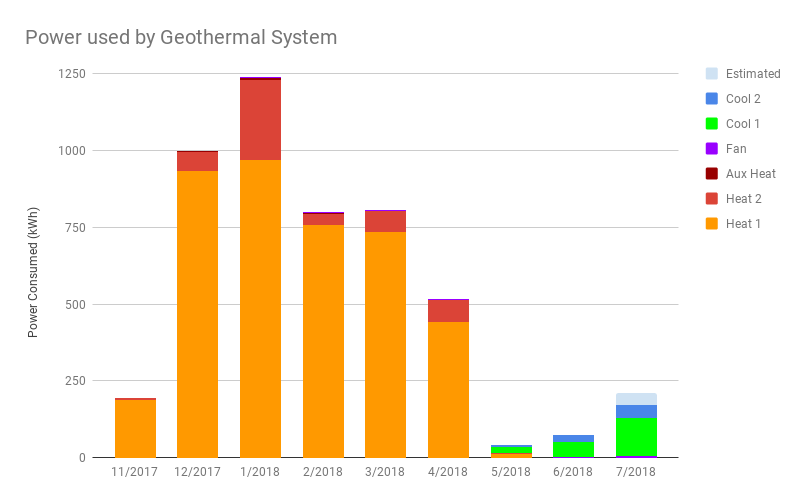
The new system went into place on Nov 22nd of 2017. Early in the heating season. This heating season included a 14 day cold snap starting at Christmas where it was 20 degrees below averages the whole time. Even with all of that our electricity add from the furnace was around $650 dollars for the winter (the Waterfurnace system we got has really detailed metrics in it that let me see it's energy use). There is a harder to account for hot water heating part of the equation, especially as we also got an Chevy Bolt EV this year. Also the year in oil would have been much more than the year before (both in use and cost). But suffice it to say, we come out way ahead on operating costs no matter how you slice it.
Our June and July bills from Central Hudson are less than last years, even though it's been a hotter summer, and we're also charging an EV. It looks like for the month of July we'll end up spending about $32 in electricity for cooling. Here is a graph of all the current number in kWh used.
What else we love about the system
There are lots of qualitative things we love about the system as well. First of it so much quieter. It has 2 stages on both heating and cooling, and stage 1 (the more efficient) runs with a low fan speed that means unless you are in the room adjacent to the furnace it's hard to know it's running. This lower fan speed also does a much better job of pushing the heat out to the edges of the house. The whole house got much more consistent.
Getting rid of the fuel oil system means we no longer have a fuel oil tank in our basement of indeterminate age rusting away in the corner. There is no whiff of oil smell at times. The primary risk of carbon monoxide and potential fires in the house is gone. And that 700 gallons of fuel oil we used the last year is no more, which is 3.5 tons of CO2 emissions not taking place (the CO2 from the increased electricity we used in the winter comes to about 0.7 tons).
We installed a whole house humidifier along with it, so now can keep the house comfortable in the winter without filling humidifiers through the house.
And lastly, our screened in porch got so much nicer. The old AC compressor was right outside it, and loud. Now it's in the basement and can't be heard outside.
We love it
While I knew on paper that a ground source heat pump like this would be great, having never experienced one before I had this niggling concern all the way through the process in the fall. What would it actually be like?
It's been amazing. At least once a week I have a moment about how great this new system is. The quiet, the comfort, the savings are all pretty amazing.
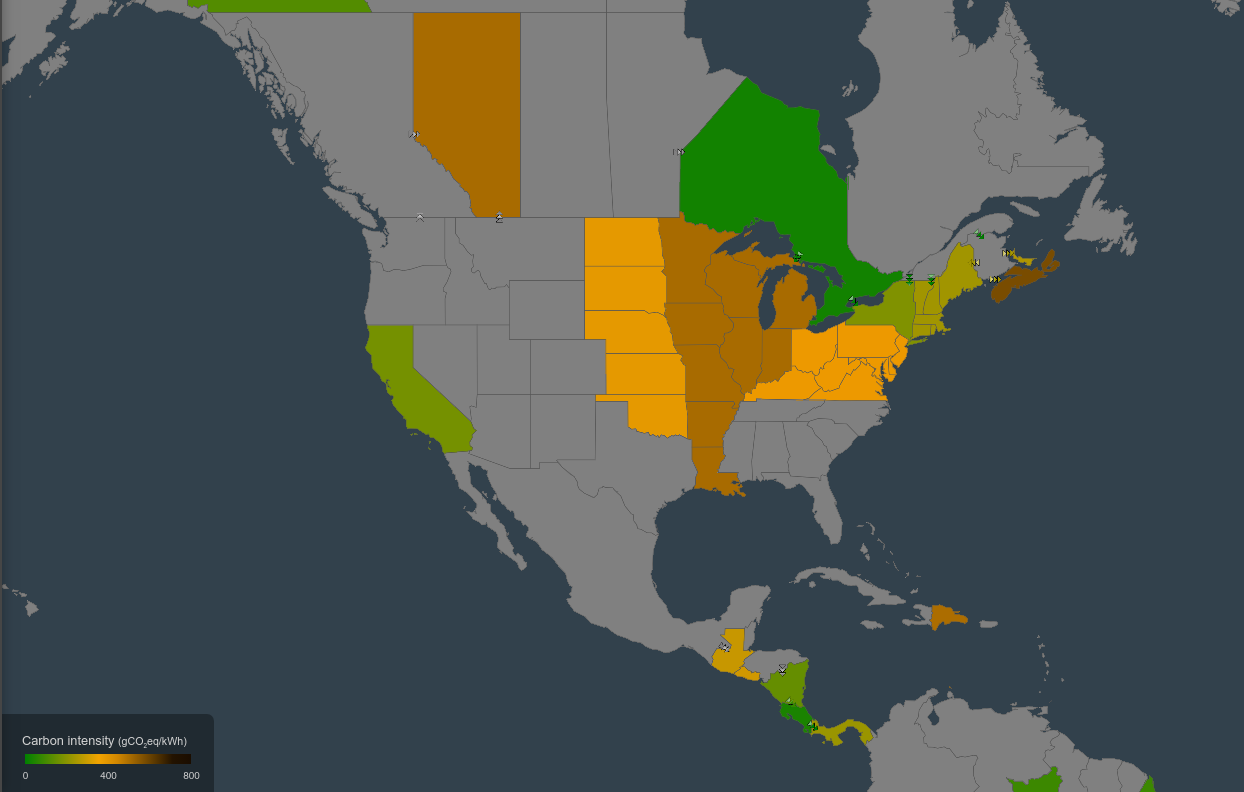
Electricity Map
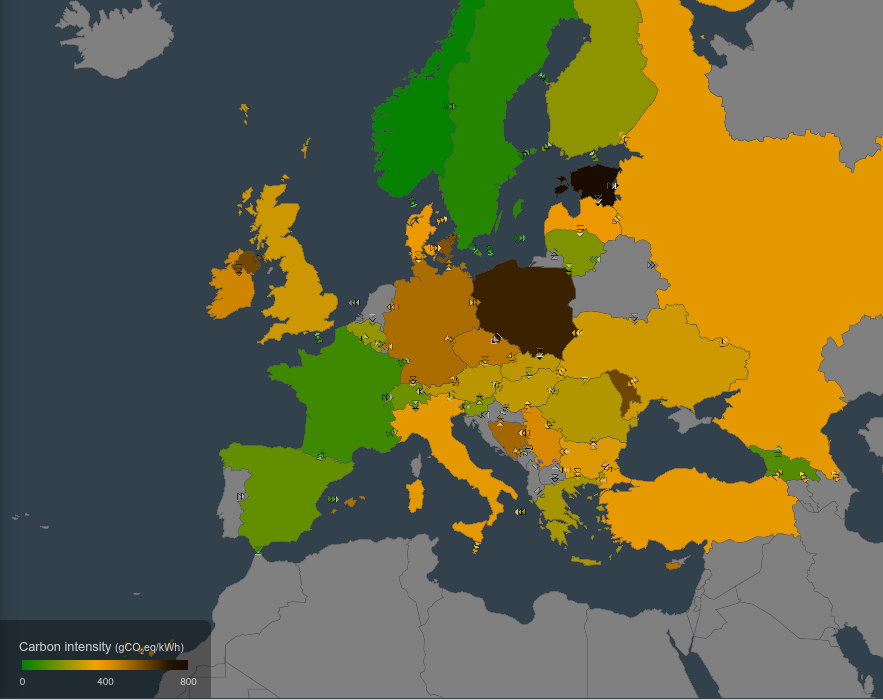
In looking for information related to my ny-power demo (which shows the realtime CO2 intensity on the New York power grid), I discovered Electricity Map. This is doing a similar thing, but at a global scale. It started primarily focused on Europe but is an open source project, and has contributions from all over the world. I helped recently on some accounting and references for the NY ISO region.
You'll notice a lot of the map is grey in the US. That's because while most of the public ISOs publish their real time data on the web, private power entities tend not to. It's a shame, because you can't get a complete picture.
What also is notable is how different the power profile looks like between different regions in the US.
It's also really interesting if you take a look at Europe
Germany is quite bad on it's CO2 profile compared to neighboring countries. That's because they've been turning back on coal plants and they shut down their nuclear facilities. Coal makes up a surprisingly high part of their grid now.
The entire map is interactive and a great way to explore how energy systems are working around the world.
Climate change goes to court
Alsup insisted that this tutorial was a purely educational opportunity, and his enjoyment of the session was obvious. (For the special occasion, he wore his “science tie” under his robes, printed with a graphic of the Solar System.) But the hearing could have impacts beyond the judge’s personal edification, Wentz says. “It’s a matter of public record, so you certainly could refer to it in a court of public opinion, or the court of law in the future,” she says. Now, Wentz says, there’s a formal declaration in the public record from a Chevron lawyer, stating once and for all: “It is extremely likely that human influence has been the dominant cause of the observed warming since the mid-20th century.”
Source: Chevron’s lawyer says climate change is real, and it’s your fault - The Verge This week Judge Alsup held a personal education session for himself on the upcoming case where several California Cities are suing the major fossil fuel companies under the assumption that they knew Climate Change was a real threat back in the 80s and 90s, and actively spread disinformation to sow doubt. This is one of many cases going forward under similar framing. What makes this one different is Alsup. He was the judge that handled the Oracle vs. Google case, where he taught himself programming to be sure he was getting it right. For this case, he had a 5 hour education session on every question he could imagine about climate change and geology. The whole article is amazing, and Alsup is really a treasure to have on the bench.
Power usage after going Geothermal and EV
In November 2017 we replaced our Fuel Oil Heating system with a Geothermal one from Dandelion and bought a Chevy Bolt EV, which we're using as the primary car in the house. That for us means about 1000 miles a month on it. Central Hudson never actually read our meter in January, so applied an estimated based on our old usage. We finally got a meter reading, so now have a 2 month power usage that I can compare to the last couple of years.
By the Numbers
4700 kWh. That seems like a lot, but I do have counters on both the furnace and the EV, which were ~2200 kWh and ~800 kWh respectively during this time period. Which leaves us at 1700 kWh for the rest of our load. That's compares to 1600 kWh last year, and 1500 kWh the year before. There is also new electric load in the hot water system, which seems to be running pretty efficiently getting dumped waste heat from the water furnace. This includes the stretch of time where we had a 14 day cold snap with 20 degree below average temperatures (ending with a record low). So while it's hard to compare to last year directly, it's pretty favorable. I'm sure that were we on oil we'd have had at least one tank fill during that window if not two, the oil trucks have been running pretty constant in the neighborhood. Opening the power bill had a momentary "oh wow". But then realizing we no longer have an oil bill, and we've only paid for 1 or 2 tanks of gas in the Subaru in this window puts the whole thing in perspective.
Getting to a Zero Carbon Grid
This talk by Jesse Jenkins at UPENN is one of the best looks at what doing deep decarbonization of the grid really looks like. Jenkins is a PhD candidate at MIT researching realistic paths to get our electricity sector down to zero carbon emissions.
Price vs. Value
He starts with the common and simple refrain we all have, which is that research investments in solar have driven down the cost below that of fossil fuels, that cross over point has happened, and renewables will just take off and take over.
But that's the wrong model. Because of the intermitency of Wind and Solar, after a certain saturation point the wholesale value of a new MWh of their energy keeps decreasing. This has already been seen in practice in energy markets with high penetration.
Sources of Energy
The biggest challenge is not all sources of energy are the same.
Jenkins bundles these into 3 categories. Renewables are great at Fuel savings, providing us a way not to burn some fuel. We also need a certain amount of fast burst on the grid, today this is done with Natural Gas Peaker plants, but demand hydro and energy storage fit that bill as well. In both of these categories we are making good progress on new technologies.
However, in the Flexible base camp, we are not. Today that's being provided by Natural Gas and Coal plants, and some aging Nuclear that's struggling to compete with so much cheap Natural Gas on the market.
How the mix changes under different limits
He did a series of simulations about what a price optimal grid looks like under different emissions limits given current price curves.
Under a relatively high emissions threshold the most cost efficient approach is about 40% renewables on the grid, some place for storage. The rest of the power comes from natural gas. 16% of solar power ends up being curtailed during the course of the year, which means you had to overbuild solar capacity to get there.
Crank down the emissions limit and you get more solar / wind, but you get a lot of curtailment. This is a 70% renewable grid. It's also got a ton of over build to deal with the curtailment.
But if you want to take the CO2 down further, things get interesting.
Because of the different between price and value, relatively high priced Nuclear makes a return (Nuclear is a stand in for any flexible base source, it's just the only one we current have in production that works in all 50 states). There still is a lot of overbuild on solar and wind, and huge amounts of curtailment. And if you go for basically zero carbon grid, you get something a little surprising.
Which is the share of renewables goes down. They are used more efficiently, there is less curtailment. These are "cost optimal" projections with emissions targets fixed. They represent the cheapest way to get to a goal.
The important take away is that we're in this very interesting point in our grid evolution where cheap Natural Gas is driving other zero carbon sources out of business because we aren't pricing Carbon (either through caps or direct fees). A 40 - 60% renewables grid can definitely emerge naturally in this market, but you are left with a lot of entrenched Natural Gas. Taking that last bit off the board with renewables is really expensive, which means taking that path is unlikely.
But 100% Renewables?
This is in contrast to the Mark Jacobson 100% renewables paper. Jenkins points out that there have really been two camps of study. One trying to demonstrate the technical ability to have 100% renewables, the other looking at realistic pathways to zero carbon grid. Proving that 100% renewables is technically possible is a good exercise, but it doesn't mean that it's feasible from a land management, transmission upgrade, and price of electricity option. However none of the studies looking at realistic paths landed on a 100% renewables option.
Jenkins did his simulation with the 100% renewables constraint, and this is what it looked like.
When you pull out the flexible base you end up with a requirement for a massive overbuild on solar to charge sources during the day. Much of the time you are dumping that energy because there is no place for it to go. You also require storage at a scale that we don't really know how to do.
Storage Reality Check
The Jacobson study (and others) make some assumptions about season storage of electricity of 12 - 14 weeks of storage.
What does that look like? Pumped hydro is currently the largest capacity, and most efficient way to store energy. Basically you pump water behind a dam when you have extra / cheap energy, then you release it back through the hydro facility when you need it. It's really straight forward tech, and we have some on our grid already. But scale matters.
The top 10 pumped hydro facilities combined provide us 43 minutes of grid power.
One of the larger facilities is in Washington state it is a reservoir 27 miles long, you can see it from space. It provides 3 1/2 minutes grid average power demand.
Pumped hydro storage is great, where the geography supports it. But the number of those places is small, and it's hard to see their build out increasing dramatically over time.
Does it have to be Nuclear?
No. All through Jenkins presentation Nuclear was a stand in for any zero carbon flexible base power source. It's just the only one we have working at scale right now. There other other potential technologies including burning fossil fuels but with carbon capture and storage, as well as engineered geothermal. Engineered Geothermal was something new to me. Geothermal electricity generation today is very geographically limited you need to find a place where you have a geologic hot spot, and an underground water reserve, that's turning that into steam you can run through generators. It's pretty rare in the US. Iceland gets about 25% of it's power this way, but it has pretty unique geology. However, the fracking technology that created the natural gas boom openned a door here. You can pump water down 2 miles into the earth and artificially create conditions to produce steam and harvest it. It does come with the same increase in seismic activity that we've seen in fracking, but there are thoughts on mitigation.
It's all trade offs
I think the most important take away is there is no silver bullet in this path forward. Everything has downsides. The land use requirements for solar and wind are big. In Jenkins home state of Massachusetts in order to get to 100% renewables it would take 7% of the land area. That number seems small, until you try to find it. On the ground you can see lots of people opposing build outs in their area (I saw a Solar project for our school district get scuttled in this way). In the North East we actually have a ton of existing zero carbon energy available in Hydro Quebec, that's trapped behind not having enough transmission capacity. Massachusetts just attempted to move forward with the Norther Pass Transmission project to replace shutting the Pilgrim Nuclear facility, but New Hampshire approval board unanimously voted against it. Vermont's shutdown of their Yankee Nuclear plant in 2014 caused a 2.9% increase in CO2 in the New England ISO region, as the power was replaced by natural gas. That's the wrong direction for us to be headed. The important thing about non perfect solutions is to keep as many options on the table, as long as you can. Future conditions might change in a way where some of these options become more appealing as we strive to get closer to a zero carbon grid. R&D is critical. That makes the recent 2018 budget with increased investment credits for Carbon Capture and Storage and small scale Nuclear pretty exciting from a policy perspective. These are keeping some future doors open.
Final Thoughts
Jenkins presentation was really excellent, I really look forward to seeing more of his work in the future, and for a wider exposure on the fact that the path to a zero carbon grid is not a straight line. Techniques that get us to a 50% clean grid don't work to get us past 80%. Managing that complex transition is important, and keeping all the options on the table is critical to getting there.
No Coal this Christmas Season - Personal Climate Action you can take now
"The best time to plant a tree was 20 years ago. The second best time is now."
Over the last year we've done a lot to our house to make it much less energy intensive, bought an electric car, and got involved in Citizens' Climate Lobby. The research for all of that created a big pile of links for me, which I've tried to summarize here, to really show how many different ways you can make an impact. This list is customized for New York, because that's where I live, and where I've done all my research. It would be great to see other folks build local guides for their areas as well, and I'd love to link to them.
Where Energy is Used
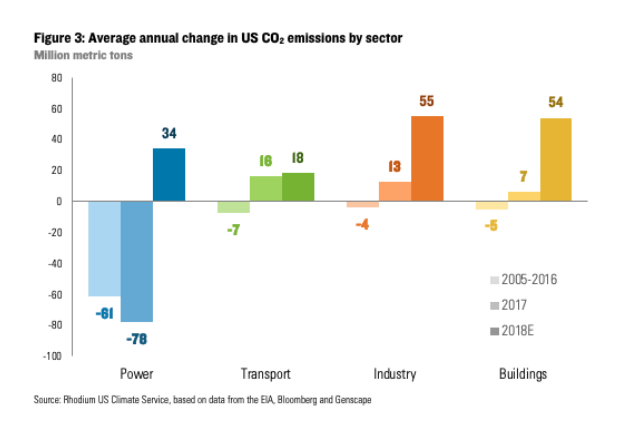
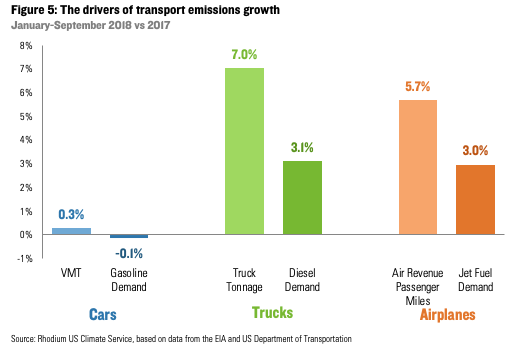
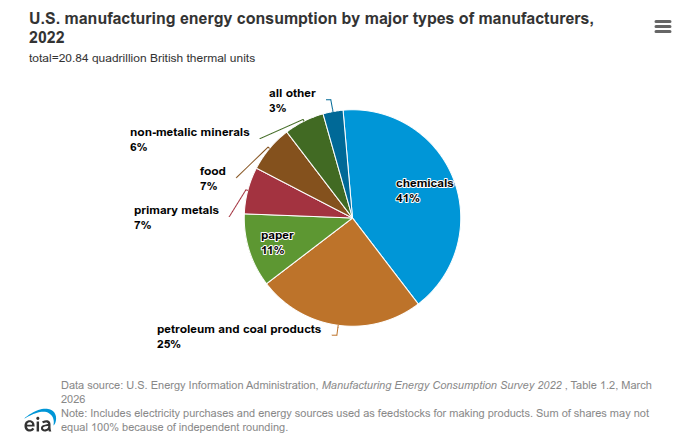
How do we use energy in the US? Because we measure electricity in kWh, gasoline / fuel oil in gallons, natural gas in cubic feet, sizing them all up and comparing them is hard. And we don't think about them as a single energy system. At a national level our energy is used by [1]:
- Buildings - 40%
- Residential - 20%
- Commercial - 20%
- Transportation - 28%
- Cars, Light Trucks, Motorcycles - 16.2%
- Other Trucks - 6.4%
- Planes - 2.2%
- Industry - 32%
- Petroleum Refining - 10%
- Chemical Production - 8.6%
- Paper Production - 3.5%
- Metals Production - 3%
The bits of this that always surprise me is that buildings are our key use of energy. Buildings are long term infrastructure. Our house was built in 1960, there are plenty of houses in our area build in 1900. Improving existing buildings is critical to making our infrastructure more efficient. Every improvement we've made over the last couple of years will live on beyond us in this home. The other thing that sticks out is that we use 10% of our energy budget in the US refining petroleum. Much of that to be burned in other parts of the system. Every time we prevent a gallon of gas from burning, we don't only save it's emissions, but the emissions that happened when it was refined.
Homes
Average Home Energy use in NY State
Get a home energy inspection
In NY, the NY State Energy Research and Development Agency has many programs to increase energy efficiency. One of the programs is subsidized home energy audits to give you a targeted plan about what the biggest impacts for saving energy in your home will be.
Air sealing and Attic Insulation
Our home was built in 1960, and insulated to the standard at the time (which was not much). A year ago we went forward on our energy audit recommendations and got our attic air sealed, and 8" of cellulose insulation put on top. The results were dramatic. Heating dropped about 15%, my home office (which is the far end of the HVAC), no longer needed a space heater, and summer cooling was also dramatically reduced. Get your energy inspection first, but realize that proper insulation in your home will dramatically, and immediately change the comfort level, and your energy use.
Replace your Oil Furnace with Geothermal
About 50% of homes in NY State heat with Fuel Oil. It is one of the dirtiest way to heat your home. If you live in the Hudson Valley or Albany regions, Dandelion is a new geothermal company offering package deals to replace your existing oil system with a ground source heat pump. They put a well or two in your front yard, put a sealed tube down it, then use the 50 degree earth and a compressor to heat your home. Heat pumps get about 4 units of heat for every unit of electricity they consume. Ours has been in for about a month, and so far we're in love. So much quieter, no whiffs of oil smoke, and much more even distribution of heat in the house (it runs the fan slower and longer). When I did the math, this was the single biggest climate impact we could make. This takes 700 gallons of fuel oil off the table. In comparison, we used about 500 gallons of gasoline in an average year between our cars.
- Learn more about geothermal heating.
- Get in touch with Dandelion to learn if this might work for you.
Replace your Oil Furnace with... anything else
Seriously, Fuel Oil is terrible for the environment. While Natural Gas and Propane are still fossil fuels, they emit a lot less both in creating them, and when they burn. If you can't go the full hog to something like a heat pump, changing from Oil to NG or Propane will reduce your emissions on heating to about 1/2 of what they were before.
Lighting
If you've not yet replaced all your lighting in your house with LEDs, do that now. They only use about 20% of the electricity of incandescent bulbs, are more efficient than even fluorescent, and last an incredibly long time (25 year lifespans are common). If you are a Central Hudson customer you can get 60W replacement bulbs for $1 each. Just do it. While lighting use is overall a pretty low part of your energy budget, it is also very actionable if you haven't done the conversion to LEDs yet. And, LED lights fit in christmas stockings.
- Read my LED lighting guide. (It's a little dated, but still good info)
- Purchace LEDs at Central Hudson's online store.
Electricity
The path to decarbonizing the economy is to electrify everything, while simultaneously making the electric grid less carbon intensive.
NY State's energy production is relatively low carbon, but if we are going to fully decarbonize we do need to reduce natural gas consumed for electricity as much as possible.
Choose a Green ESCO
NY State allows you to choose your energy producer (energy services company, or ESCO). There are a number of companies that provide you with energy from wind farms that they are building regionally. This typically mean a small rise in your energy costs, but that comes with supporting the build out of new renewables. Two good options in our area are:
- Green Mountain Energy - we've been using them for about 3 years
- Arcadia Power
Community Solar
NY State has new rules in place that allow for Community Solar in our area. These are small scale (2 Mega Watt or less) facilities that you can sign up and get your power from solar even if you can't put solar panels on your roof (you have bad site, or are a renter). Solarize Hudson Valley has sign up information for folks in the area. If you are in the Central Hudson power generation region, Nexamp is building a facility in Wappingers Falls. We've signed up, and starting in May of 2018, will be getting our power from solar.
- Read a really amazing analysis of current community solar options available in NY.
- Sign up with Solarize Hudson Valley to solarize your bill.
Carbon Offsets
If there is nothing on the list that works for you, but you still want to have an impact on reducing your carbon footprint, consider some kind of carbon offset. Carbon offset projects work to capture carbon, or reduce emissions from something like a landfill. We all share one atmosphere, so any way you reduce emissions helps.
The carbon offset market is a wildly confusing place as an individual. As a NY (or North East) resident, the Carbon Reduction Certificates from the Adirondack Counsil is great. Each certificate is used to buy 1 ton of CO2 off the Regional Greenhouse Gas Initiative annual carbon auction (a carbon trading system for power companies that 9 states have agreed to, and NJ and VA might be joining soon). The price for a ton of carbon on the RGGI is still pretty low, so left over proceeds go to their micro grants program which support local energy efficiency and emissions reduction.

- Purchase Carbon Certificates from Adirondack Counsil
Get Engaged
Right now, you need to do something extra, or out of the ordinary to have an impact on climate change. Citizens' Climate Lobby is a political action group looking to change that, by pricing carbon in the economy. A real price on carbon would make doing the efficient thing, also be doing the cheaper thing, which would make it the default choice in most situations. We've got a local chapter that meets in Beacon, NY once a month, and so if you want to flex your political muscles, as well as your economic ones, sign up and join us.
- Join the CCL NY18 mailing list
- Come to a CCL NY18 organizing meeting
It all maters
Every action you make matters. And the exciting fact is that there are so many things you can do now to have an impact (including many things not on this list). So take a minute this holiday season and think about how you can take a little bit of coal out of your own Christmas season.
Book Review: The Ends of the World
I'm going to open with, this book is flat out amazing. In school, or even through popular science journalism, we learn a bit about some key points of geologic time. But these are snap shots, Dinosaurs, Ice Ages, even Snow Ball Earth. Really interesting things on their own, but they all seem a little disjoint.
This book brings an incredible visual narrative through life on Earth, by looking at the 5 mass extinction events the planet has experienced. An extinction is only emotionally meaningful if you understand what is lost, so the author paints an incredible picture of the aliens worlds that were Earth in these previous eras. Worlds without life on land, worlds of giant insects, worlds of bus size armored carnivorous fish as apex predators. He does this by road tripping to the scientists and fossil sites where this story is being assembled, talking with experts along the way. A story as old and hidden in the fossil record needs lots of lines of evidence to point to answers, and the author does a great job of doing that, and pointing out what we seem to know, and what we've only got guesses on.
The story of life on earth is the story of carbon and climate. As volcanoes stirred up carbon from the deep, and life reclaimed it, died, and sunk it back into the Earth. When this cycle gets really out of whack, the climate goes nuts, and life is paused on planet Earth, and taken tens of thousands of years to get back on track. There are many points of reflection about how our current mining and burning of ancient sequestered carbon is impacting our world today.
There are also just incredible moments that make you sit and think. The death of the land based mega fauna, 12,000 years ago, in North America, that still leaves ecological holes.
But the menagerie lives on in evolutionary ghosts. In North America, the fleet-footed pronghorns of the American West run laughably faster than any of their existing predators. But then, their speed isn’t meant for existing predators. It might be a vestige of their need to escape constant, harrowing pursuits by American cheetahs—until a geological moment ago. The absence was palpable to me as I rode a train past New Mexico’s Kiowa National Grassland, an American Serengeti, windswept and empty except for a lone wandering pronghorn still running from ghosts. Other evolutionary shadows of the Pleistocene live on in the produce aisle. Seeds in fruit are designed to be eaten and dispersed by animals, but for the avocado this makes little sense. Their billiard ball–sized cores, if swallowed whole, would at the very least make for an agonizing few days of digestive transit. But the fruit makes a little more sense in a land populated by tree-foraging giants, like the sometimes dinosaur-proportioned ground sloths, who swallowed the seeds and hardly noticed them. The ground sloths disappeared a geological moment ago, but their curious fruit, the avocado, remains.
It will make me never quite look at an avocado the same way again. There are so many things I learned which made me reconsider my whole view of dinosaurs. Like Dimetrodon, the creature with a large sale on it's back for temperature regulation, is more closely related to mammals than dinosaurs. And without the 3rd mass extinction, we'd never have seen Dinosaurs, and mammals might have ruled the Earth much earlier. And that T-rex showed up really late on the scene, filling the niche that that much more successful Allosaurs held as apex predators for most of the Jurasic era (the Allosaurs all disappeare in a more minor great extinction). It's not often that you find a non fiction book that both reads fast, and dumps such an incredible amount of information on you. The jumping back and forth from road trip, chatting with scientists, facts, and painting pictures of the world that was, works really well. There is never a dull moment in it, and you come out the far end for a much greater appreciation for life on Earth in all its forms.
My Solar Eclipse Experience
They are right when they say there is nothing quite like a total solar eclipse. I had seen an annular eclipse in my senior year of high school as it cross over Vermont. Wandering out there with our physics teacher, looking through glasses, it was pretty cool, but it was nothing like the Sun going out.
Eclipse day for us was in Springfield, TN, as my friend's Nick and Heather were living there, and it was deep in the path of totality. We made plans to visit in May, booked our hotel then, and framed a trip around this so that we'd do four 8 hour driving days on our great eclipse road trip. Down through Cleveland to visit family, and up through Virginia on the way back to break up the drive.
On the way to Tennessee on Friday, my friend Jack was still sorting out his plans. He and his son were going to be sleeping in their car wherever they went. The weather where he was originally headed was looking dicey, and I said "well this is where we'll be, I make no promises, but I can offer you use of our hotel shower." Friday evening they decided they would join us. They arrived Sunday about 9am. In addition to bringing their wonderful selves, they had brought a solar filtered scope, a hydrogen alpha scope, and a camera rig to shoot the eclipse, and a shade tent.
We scouted a location at Nick and Heather's apartment, a flat grassy section near the apartment complex dog park. First contact was just shy of noon for us. We started setting up all the equipment at 10, were in a good state by 11.
Our setup area for the eclipse
All set up, shade tent, telescopes
First contact. The moment when you stare through those eclipse glasses and say: "wait, is that side just a little flat now? Maybe I'm imagining it. No, I really think it is. Yeah, that must be real." As the eclipse grows, your brain does this funny thing and enhances the boundary. The silhouette of the Sun seems to glow brighter than the Sun itself.
Eclipse glasses on!
After about 20 minutes, and our pacman shape ever growing, I realized we're never going to break for food (the original plan), we should bring it back down here. So I headed back upstairs with Nick, prepared a bit of our picnic food that we'd gotten the night before, and headed back provisions in hand.
A shade tent is a glorious thing when watching an eclipse on a 95 degree sunny day with few clouds. We would spend time inside the tent, drinking water, having a snack, then popping out to see how things were progressing.
Shade tent, and making new friends
With our little camp setup, folks from the complex started stopping by. Including a number of kids. Jack's a pro at the sidewalk astronomy outreach, we introduced people to the scopes, what they were looking at, and kept them pointed and in focus. One of the kids came back out with popsicles for everyone as a thank you for letting everyone see through those scopes.
Popsicle break
It was never going to get cold in Tennessee, but once we got past 75% coverage, the beating hot 95 turned into "a reasonable warm day to be outside". Maybe we dialed back to 80. The sky lost it's deep blue, and was just a muted version of itself. Everything was muted in an erie way that you can't quite describe.
As we closed in on second contact, a cloud creeped in over the Sun. It kept going away, coming back, going away, coming back, with lots of, "is that it?", "no". Then just before totality the cloud cleared, it went black, one of the neighbors yelled, "we're in!". Everyone took off their glasses. And we stared at a hole in the sky with the giant wispy corona spewing out from it.
Our eclipse, courtesy Jack Chastain
Pictures don't ever really capture what the eye sees. Most of them show a small ring around the Sun. But this was a sun flower. The corona extended at least the radius of the Sun again. It wasn't uniform, it was sweepy with a few petals poking out. It was amazing. Everyone was exclaiming in different ways, processing this true wonder of nature in a way personal to them.
Venus, Jupiter, and even dim Mercury came out to meet us. I was so focused on all of those I didn't really take the time to look for other stars. But given Mercury was dialing in at magnitude 3, there should have been plenty.
During totality
We got about two and a half minutes. It's not enough time. Not enough time to soak in this totally bizarre experience. It was about a minute longer than our daughter (not quite 3) was happy with. Both the dark, and the black hole in the sky definitely got her scared. She was not the only one, we heard another boy crying in one of the apartments behind us.
One of the neighbors gave us a countdown for the event ending. As hit the end of the countdown, I looked down at the 2 trees in front of us. No shadow, no shadow, no shadow, then with what appeared to be a swoosh... 2 shadows. Like they were dropped back into place in a cartoon.
A child crying... my child. "I want to see Venus! I want to see Venus!". Venus is a night sky friend, we've been finding it in the sky for nearly a year. Everyone was talking about how you could see it during the eclipse and now Arwen was upset that they didn't also get that chance. But at magnitude 4, Venus was easy to see even back to 90% coverage. We spent some time pointing and looking, and calming down. She's at the age where I don't know if she'll remember all of this later when she's grown up, but maybe there will be flashes of it.
The sun returns, with crescents through the bushes
And as the Sun returned, everyone dispersed. I spent the next hour helping Jack pack up and put things in his car. We all ended up back in the nice AC before the even was properly over, taking a last look at a 15% eclipse before going inside for more food and to crack a few beers.
Jack and son stayed a few hours to let the worst of the traffic clear, then headed off back to Virginia. The google map from that day is amazing. We fortunately had all the food we needed in the apartment for dinner, so dined in, made our goodbyes at about 7, headed to our hotel, and even started watching the PBS eclipse documentary that aired that night. Though after a few pictures of totality were on the screen Arwen proclaimed "that is too much for me, please turn it off."
My plan for avoiding the traffic was leaving the day after. However, there were really more people out for this event that did the same. Our 9 hour driving day, turned into 12 hours of driving thanks to constant stop and go traffic on the I-81 corridor in Virginia. We did get to our Tuesday night lodging that day, at 11:59pm. So we also get to have a traffic story for our eclipse adventure.
There really is nothing like a total eclipse. I'm now excited for 2024 (less excited about New England April weather). And, we'll see if we consider destination adventures to see another one along the way. I was exciting to share this with my daughter and wife, and friends both old and new. What a great end to the summer.
Eclipsee
Alsup insisted that this tutorial was a purely educational opportunity, and his enjoyment of the session was obvious. (For the special occasion, he wore his “science tie” under his robes, printed with a graphic of the Solar System.) But the hearing could have impacts beyond the judge’s personal edification, Wentz says. “It’s a matter of public record, so you certainly could refer to it in a court of public opinion, or the court of law in the future,” she says. Now, Wentz says, there’s a formal declaration in the public record from a Chevron lawyer, stating once and for all: “It is extremely likely that human influence has been the dominant cause of the observed warming since the mid-20th century.”