The full agenda for the Central PA Open Source Conference is now out there, and I'm on the agenda:
Sean Dague: Solar System in your Pocket – Developing Android Applications
It started with a simple discussion after a local astronomy meeting trying to figure out which moons of Saturn we were looking at. This seemed like the perfect first Android application, building an astronomy simulator that would let me answer that question wherever I was. Little did I know that trying to do this would take me on a Journey through most of the major subsystems and interfaces in the Android SDK.
This talk will take you along on that journey of writing your first Android application. It will touch most of the major concepts involved in mobile development for Android, and many of the interfaces you’ll need to write you first application. Most importantly it will give you a list of things *not* to do when developing for the mobile space.
Sean Dague has been an open source software engineer in the IBM Linux Technology Center for the last 10 years. His spare time is split between the outdoors, amateur astronomy, and random bits of open source hacking.
I've been looking through all the talks listed, and I'm quite impressed. I want to attend at least 2/3 of them, which is going to be a problem unless I can clone myself, as it's a 3 track conference. From an interest density level this looks like it's going to be a really great conference, so I'm very excited to be going down for it.
This will also add some impetus to getting the 2.0 of Where is Io out there, which I've been hung up on building a custom view. Once I get that one custom view finished, I should be back cranking out more regular releases.
I've been using Drupal for a number of community websites for the past year. Overall I quite like the system and how customizable it is.
What I'm not really thrilled by is the way the module structure exists on drupal.org. The problem is that drupal core is a very small number of modules. The bulk of useful functionality comes from user contributed modules. So far so good, many projects run the same way.
The real issue is that the drupal project maintains a centralized CVS infrastructure for module developers. There is a pretty formal process to get accepted as a module author, and no real way to get CVS access to just fix bugs. The net result is that after finding 3 bugs in the date and callendaring modules, creating patches for each on my own environment, and submitting them upstream, only 1 has gotten looked at. The fixes were submitted about 8 months ago, and I've pinged a few times. I also wrote the author directly on one of the modules.
The root cause of this issue is that drupal has centralized infrastructure, but decentralized decision making. It is a classic community wherein github would be a good solution.
I've been an absentee maintainer before, I know that sometimes interests change, and you move on to other things. But at least with something like github, other folks can very easily extend what you've got and make the fixes themselves. Hunting out RCS style patches in drupal discussion forums is just really problematic. At this point I've got quite a number of local fixes, so module upgrade and maintenance is tricky. The only saving grace is that most of those fixes are on modules that are effectively abandoned so I shouldn't have to worry about an update coming down the pipe.
The Drupal community is soldiering on even with bad developer infrastructure. I just wonder how much further along they'd be with better developer infrastructure.
August 1, 2010 · Technology
·
scifi
Definition:
- Sci-fi Channel: Short for 'science fiction', it was a channel where old sci-fi shows were displayed for fans of science fiction, including classic movies, B and otherwise.
- Syfy Channel: Short for 'syphilis for you', it is a channel where new sci-fi shows are created based on old sci-fi shows, retreaded and reassembled like crusty multi-colored play doh that is drying out. Also includes new movies where giant CGI animals are sent on a rampage after actors with no will to live (or act).
and a continued amusing rant with pictures at cracked.com.
August 1, 2010 · Technology
·
science
... they were just immature torosaurus:
DINOSAURS were shape-shifters. Their skulls underwent extreme changes throughout their lives, growing larger, sprouting horns then reabsorbing them, and changing shape so radically that different stages look to us like different species.
This discovery comes from a study of the iconic dinosaur triceratops and its close relative torosaurus. Their skulls are markedly different but are actually from the very same species, argue John Scannella and Jack Horner at the Museum of the Rockies in Bozeman, Montana.
It turns out that there are a number of interesting morphs that have been proposed, and this is just the latest one. It's still early research, but pretty interesting to think about.
Wikileaks To Leak 5000 Open Source Java Projects With All That Private/Final Bullshit Removed:
Many Java developers have vowed to fight back against the unwelcome opening of their open source. League of Agile Methodology Experts (LAME) spokesperson Billy Blackburn says that work has begun on a new, even more complicated Java build system that will refuse to link in Opened Source Java code. The new build system will be released as soon as several third-party Java library vendors can refactor their code to make certain classes more reusable. Blackburn declined to describe these refactorings, claiming it was "none of y'all's business."
Guy Faulkner, a 51-year-old Python developer in Seattle, was amused by the Wikileaks announcement. "When Python developers release Open Source code, they are saying: Here, I worked hard on this. I hope you like it. Use it however you think best. Some stuff is documented as being subject to change in the future, but we're all adults here so use your best judgment."
Faulkner shook his head sadly. "Whereas Java developers who release Open Source are code are saying: Here, I worked hard on this. I hope you like it. But use it exactly how I tell you to use it, because fuck you, it's my code. I'll decide who's the goddamn grown-up around here."
Which is even funnier because I was having exactly this conversation last night at the HV Programmers Meetup.
The Android tablet space that is starting to heat up is all running after Apple's iPad at the moment. It's got a nice form factor and a nice screen, but it's entirely unsuitable for a whole set of applications that I care about for one simple reason:
LCDs give off blue light.
Blue light is really the enemy of both sleep and dark. I mostly care about the dark part, because my interest is for Astronomy. It takes at least 20 minutes for your eyes to really dark adapt when you go outside. If you want to see other Galaxies from your back yard, dark adaption is really important. We call them "faint fuzzies" for a reason. Last month at our astronomy party someone brought an iPad with some astronomy application to let them know what to look at with their telescope. After 30 minutes of it blinding them, the finally turned it off and started asking some of the rest of the folks there what they should be looking at, and where to find it.
But, an eink tablet would be great. You could use just enough red light to see what's going on, and be able to zoom in to your charts. There are 2 things that come close right now, the nook and the kindle, but neither would work without a lot of effort. To do your own apps on the nook you have to hack the thing, and you've still got this pesky lcd you'd need to put a filter over. The kindle is a physically better device for this, but it's not android, so it's another sdk to learn, and they have all manner of restrictions because the user doesn't pay for their data usage. As far as I can tell it would be too restrictive for this.
The ideal device would be something like the kindle dx, have a gps, and be based on Android. This device doesn't exist, but heres to hoping that someone makes one eventually.
From suite101.com:
One of the problems with using an Android-based smartphone such as the Droid, Droid Eris, or Droid X as a hiker's GPS is that maps don't work when there is no cell coverage, which is common in areas where people like to hike or bike recreationally.
Google Maps will pre-cache some maps but it's unpredictable as to whether it will fetch the right maps or delete the cached maps altogether. The real solution is to use an offline GPS program instead of the Google Maps program, which still requires access to the Internet
...
For those willing to put the effort, a free program called OruxMaps can make use of GPS maps stored on a Android smartphone's SD card. The process of getting the maps is actually very straightforward by using another program. For most people, it should take no more than a few minutes to begin downloading the correct maps for use on an Android device with just GPS signals.
Very cool stuff. I'm going to have to check this out for the next time we head to Vermont.
At a press briefing here at its headquarters, Google announced a new version of its Apps suite designed specifically for government customers. This tier will be sold alongside the existing version of Google Apps and priced the same as the company's premiere license--$50 per user, per year.
Google Apps for Government features all the same applications that can be found in other versions but comes with a higher level of security, which Google says meets the requirements set forth by the Federal Information Security Management Act. This includes segregated data centers, which Google says goes beyond FISMA regulations, and will keep government e-mail and calendar event data within U.S. borders.
This is probably the biggest tech story of the day. A lot of FUD around cloud will be dismissed if we see large government sign off on it.
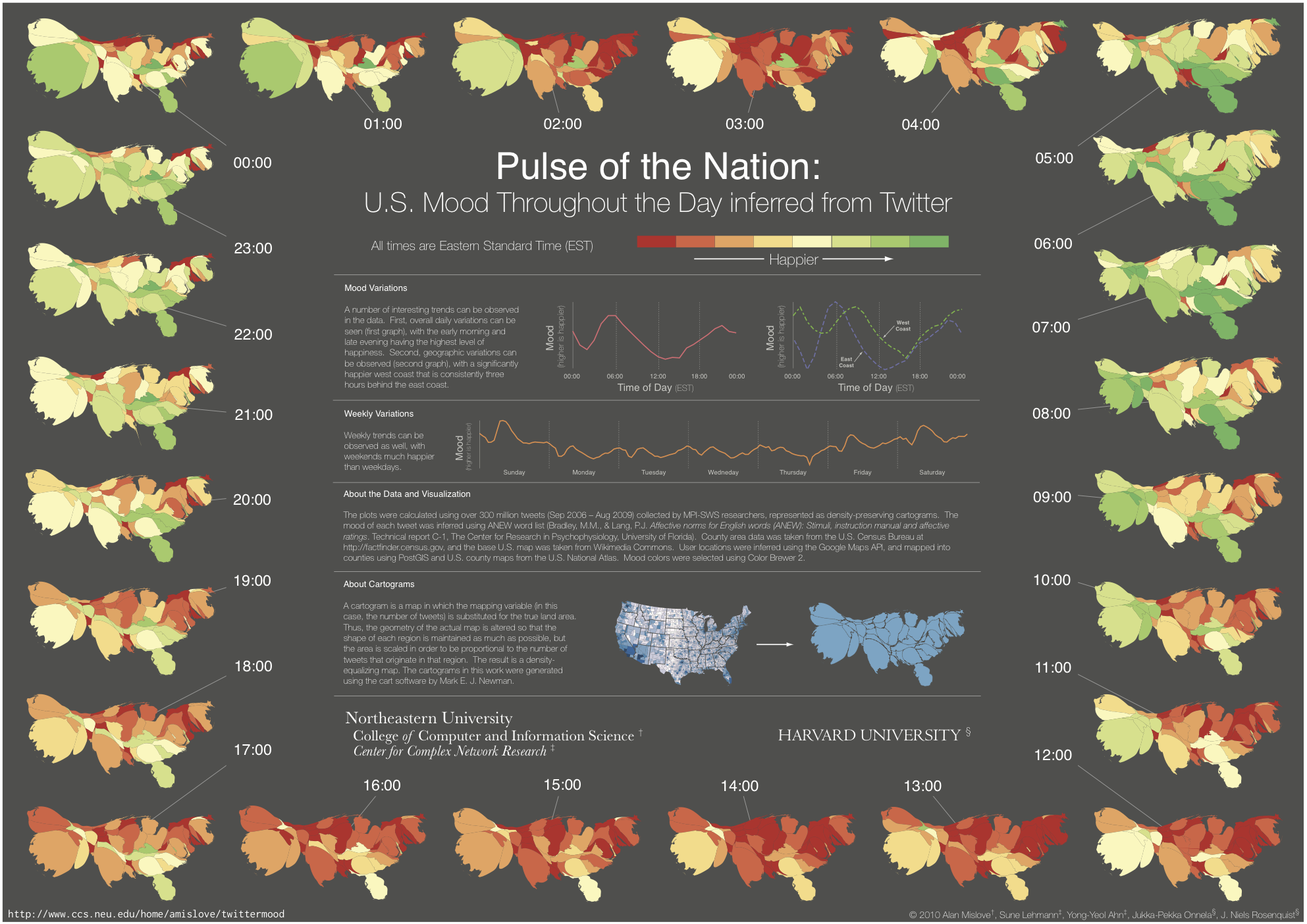
I love info graphics, and cool data analysis, so this is just brilliant:
Click for full size version.
Phil Plait's Bad Universe is coming to Discovery this fall. Can't wait.