June 27, 2010 · Technology
·
science
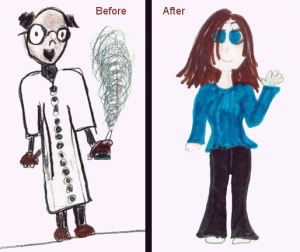
Recently a bunch of 7th graders were asked to describe and draw scientists before and after a trip to fermilab. The results are fascinating:
It's really worth checking out all the pictures and statements from the kids. It's really impressive how fixed the scientist archtype is fixed in people's heads, and you can see this from the before pictures.

Susan and I were out black raspberry berry picking this weekend when we can across a type of berry neither of us could readily identify. A camera phone picture, and some internet searching later and we figured out what it was.
Wineberries are an asian berry species that were brought here to cultivate with raspberries as they have hardier stock. They since went invasive. All the reading says they are edible, though you mostly want to strain out the seeds because they are quite hard. These are different than Thimbleberries (which I used to call Roseberries as a kid) mostly in their leaves looking more like raspberries and the berries are in this prickly sheath before maturing.
It looks like they are about 2 weeks away from being ripe, if my berry sense is any good. I wonder if they'd make for good ice cream...
June 27, 2010 · Technology
·
food

I'm always looking for good simple drinks that involve lots of real fruit and basic liquor that you've already got in your liquor cabinet. After coming home from picking 6lbs of blueberries, I eventually found a recipe for blueberry daiquiris that fit the bill.
Ingredients
- 1 cup frozen blueberries
- 1/2 cup light rum
- 1/2 lime, juiced
- 1/2 cup crushed ice
- 1/4 cup superfine sugar
Directions
In a blender, combine all ingredients and process for about 30 seconds. Pour into a chilled glass.
Yields 1 drink
Realize it's a big and strong drink. It is slightly more than 1 of our margarita glasses holds, and it's nearly 3 shots of rum per "drink". You could probably get away with about 2/3 as much rum (probably cut back the sugar if you did) for something less high octane.
Damn though, it's seriously tasty. This alone might be reason enough to best our season record of 21lbs of picked blueberries.
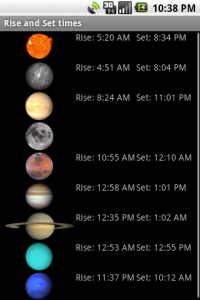
The last Where is Io release was a few weeks ago. That's because I've been working through a new chunk of math that I'll need for a few new features. One of the things I needed was rise and set times for Jupiter and the Sun, which quickly turned into all the planets (because it's basically no additional work to fill it in for everything else).
The application is evolving in it's own direction into a more general solar system almanac, which makes me wonder if a new name is going to be in order on the next release (probably called 2.0 because of so many changes). Name suggestions are welcomed.
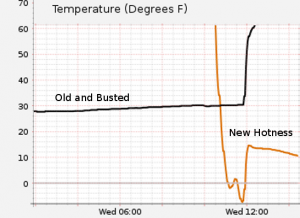
The last thing you want to hear at midnight is "the icecream has turned to soup" when your wife wanders to the downstairs chest freezer to get some home made icecream out. Granted, because it was boozy icecream, it was mostly a good early warning sign (everything else seemed frozen). Given that I've got a bunch of remote temperature sensors that my computer collects data on, Susan put one in, and I figured we'd see what things looked like in the morning.
As you can see, the trend line was not going in the right direction. 8 am this morning we realized we needed a new freezer by the end of the day if we wanted the contents of the old one to survive. We got it back to the house and installed by 10am. Susan moved everything over at noon, and the old one is no longer a freezer. So now we have an actual chest freezer again, and I've got a new project to figure out if the old one is fixable in any cost effective way.
June 22, 2010 · Technology
·
food
Baking powder and baking soda. Both of them are used so frequently in quick baking projects that unless you are a recipe developer, rarely do you consider what each of them actually does for your finished product. How come my scones call for baking powder, but my buttermilk biscuits call for a mixture of powder and soda? Is there an easy way to substitute one for the other if I don't have both on hand? And why do I have to bake my muffins right after mixing the batter?
This edition of the Food Lab is a quick and dirty guide to how they work, and how they affect the outcome of your recipe. For those of you who want an even quicker and dirtier guide, jump straight to the summary at the bottom of the page.
Great article, that includes a decent amount of science on how breads work.
The Ruby language has this great feature called Mixins. It lets you add methods to existing classes. Take this example from Ruby on Rails (which uses mixins heavily):
time = 2.days.ago
Yes, that's valid code and does what you think. The result is a DateTime object. It was accomplished by adding methods the Numeric and to DateTime. If you come from a strongly locked down language background, this sort of thing horrifies you. If you don't, you think it's awesome. Remember, this isn't inheritance, it's actually changing the fundamental classes. This makes it much easier to retrofit on existing code. The python folks call it Monkey Patching, which makes it sounds kind of dirty. I like Mixins better.
While Ruby has been my language of choice for personal time hacking, I'm doing a lot of Java recently due to working on Android things. This past weekend I remembered one of the things I dislike about strongly typed languages: type gymnastics.
If you've got a time as milliseconds in Java and you want it in a string you've got to first convert it to a Calendar, then to a Date, then give that Date to a DateFormat. You'd think that Calendar.toString() might actually give you something useful, but it doesn't. Oh, and also realize that every one of these objects has it's own internal notion of TimeZone, quietly gotten from the system, so if you are trying to do something in UTC, you have to manually force that on them all. This is the crux of type gymnatics, long changes of type conversion operations because to get from A to B (in my case A:long, B:string) you've got to go through C, D, and E in the right order. These conversions are error prone, and clumsy, and largely produce some part of your namespace called "util" that is largely static methods to convert between one thing and another.
This is because the authors of A never thought you'd have to get to B. What's so interesting about B? C is really nice this time of year, wouldn't you just like to stay there instead?
The real problem is that original authors of software rarely really understand what their software will be used for, and the more immutable languages don't let you fix things after the fact. In Java this means that any project ends up with a "utils" package which is used to do conversions between types that can't natively be converted. All that code is just boring boiler plate, which is where you are most often going to make a hard to find mistake. Nothing generates errors like boredom.
June 18, 2010 · Technology
·
scifi

How cool is that! (credit pu-sama on deviant)
There is a great piece up on the Common Wealth Club's podcast feed on How to DIY (no page yet, so the link is directly to the mp3). It's hosted by Adam Savage of MythBusters fame, and has the editors of Make Magazine on it. A big part of their inspiration was Popular Science and Popular Mechanics from the 1920s and 1930s, when those magazines were largely about making your own stuff in many different contexts.
It also let me find out that the World Maker Faire is coming to NYC in September, which I'll need to check out. There is also one in Detroit at the end of July, which I consider an inspired choice.
June 16, 2010 · Technology
·
ibm
One of the things that continues to inspire me about IBM is that we keep taking on some really deep research issues. There aren't that many organizations in the world that could go after something like this. I can't wait until the live competition actually happens.