Writings

Technology, open source, personal essays, and everything that isn't climate.

A weekend of astro camping

A Weekend Of Astro Camping

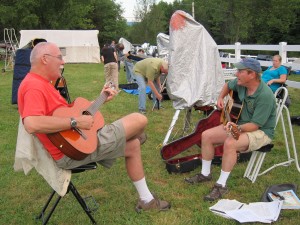
You know you are rusty at camping when the list of things you forgot, which you are just now remembering in your head as you are driving away from home, gets long enough that you actually turn around.  It has been at least 5 years since I was last camping, and that definitely showed in how I packed the car to head out to the Catskills for the AOS starfest.

I learned a number of things about the experience.  First, a critical list of Astronomy gear I don't have.  This includes a weatherproof scope cover, a 12v hair dryer (for dew elimination), and a portable deep cell battery for said hair dryer.  Being the odd one out I had to keep shuffling my scope back and forth between cover and not as we were dodging the storms that rolled through.

I also learned that most amateur astronomers are not campers.  We had at least a couple of inches of rain up there this weekend, and only a few tents stayed dry.  Rookie mistakes about how to setup the ground cloth were prevalent.  It's understandable as camping is a means to an ends (being where the skies are dark), but I was surprised that more people hadn't experienced this enough times to still be caught by that.  I tried to be helpful where I could, but didn't want to impose too much, being one of the new guys there.

I learned that I don't need to be too envious about other people's scopes.  Even though my 8" dob put me on the smaller size up there, I'm just very comfortable with the scope now.  I know exactly where to put my eye, how to tweak the focus, and with my astronomy chair can really relax with my views in the scope.  There are clearly things I can't dial in that Rudy and Rick could get in their 18 and 13 inch scopes, but for all around usability, I'm just really happy with this scope.  I saw the veil nebula in my scope via an O-III filter (which is the only high contrast one that I've got for viewing Orion), and realized there is a whole other set of things I can see in that scope with a dark site and some additional filters.  I'm definitely going to have to invest in those.

And lastly, I learned, the 3am sky is a different sky than I'd ever seen before.  Once civilization has gone to sleep things get darker yet again, as no place on the east coast is immune to at least a little light pollution.  I doubt the site we were at was much darker than my parents place in VT, but I realized I've never gone looking for stars after midnight.  With my new found dew management knowledge, I'm really looking forward to my next venture up there.

Even though we only got 1/2 a night of observing in (Saturday/Sunday after 1am it started to clear out), I had a really good time with some great people this weekend.Looking forward to doing more of this in the future.
Related: Amature astronomy night · Me and optics · Happiness is a clear dark night

Mostly Cloudy or Partly Sunny?

A good question came in from a friend today about what is the difference between Mostly Cloudy and Partly Sunny.  While I had a general sense that it had to do with cloud percentages, I didn't actually know the details.  10 minutes on google, and I got to the Weather Service Operational Manual (WSOM) Chapter C-11, Zone and Local Forecasts - section 8.6. In a more readable format:

Term Expected Predominant or Average Sky Condition
Cloudy 9/10 to 10/10 opaque clouds
Mostly Cloudy or Considerable Cloudiness 7/10 to 8/10 opaque clouds
Partly Cloudy or Partly Sunny 3/10 to 6/10 opaque clouds
Mostly Clear or Mostly Sunny A Few Clouds and 1/10 to 3/10 opaque clouds
Clear or Sunny 0/10 to 1/10 opaque clouds

Opaque means you can't see the sun, moon, or stars through them (so wispy clouds don't count). Terms like "Fair" are specifically deprecated (though defined), and there is even a list of words that "are viewed as hedge terms and should be used sparingly and with great discretion".

Related: Transit of Venus · The 10,000 Year Clock Under Construction · The real Trolley Problem in tech

Fish Custard and the year of Doctor Who

This year of Doctor Who has just been brilliant.  Upon rewatching the season, I'm pretty confident in stating that this has been the best year since the reboot, and that Matt Smith (should he decide to stick around for a bit) is going to become the new icon of what the Doctor is (this title is still currently held by Tom Baker).  Because I think everyone should be taken along on this ride, I'm not going to talk about anything past the first 15 minutes of the first episode.

Over the years I've found myself drawn to writers / actors that can use tempo as emotion, because there is a kind of power in it that nothing else delivers.  The canonical example of this is MASH.  Alan Alda would be chattering about at break neck speed about all manner of frivolity.  You would get into the rhythm and speed and be carried along for the ride.  And then, reality would hit, and he'd stop in an unexpected way in mid stride.  This created an emotional lurch, like when you're on a boat and it comes to a stop on the docks.  Not many can pull this off in a natural way.  Aaron Sorkin is the current American king of this, as embodied in Sports Night.  And now with Steven Moffat in charge, and Matt Smith in the drivers seat, we get this in Doctor Who.

The keystone moment of all of this is the fish custard scene that opens up the season.  Having just crash landed in 9 year old Amelia Pond's garden shed, he asks little Amelia to give him an Apple, as he's having a craving ("I think I'm having a craving.  That's new, I've never had cravings before.").  The moment he takes a bite he spits it out, and we end up with a brilliant montage through much of what's in Amelia's refrigerator, each with a slapstick like ending.  He finally settles on fish sticks and custard.  And then we get this:

Young Amy: I'm not scared! The Doctor: Course you're not, you're not scared of anything! Box falls out of the sky, man falls out of a box, man eats fish custard! And look at you... just sitting there. So you know what I think? Young Amy: What? The Doctor: ... Must be a hell of a scary crack in your wall.

Timed and delivered perfectly.  And that sets the stage for the whole season.

So if you haven't started watching Doctor Who yet, now is the time to start.  And do yourself a favor and make sure not to watch the "Next Time" bits at the end of the episodes.  They are now giving away far too much of the plot and ruining many of the surprises over the first half of each episode.  We stopped watching those half way through the season, and that was a great choice.

Related: The 11th Doctor · Doctor Hoo · Is Instant Reboot the new big thing in Hollywood?

Readability

Via twitter yesterday I found out about Readability, which is damn impressive.  It's a button for your browser that contains a bunch of javascript code that reforms the page you are looking at into something that's easy to read.  It's worked really nicely on many of the cluttered news sites that I end up on regular basis.

I'm sure this will end up in an arms race at some point, but for now, I'm really enjoying it.

Related: are you on twitter and/or delicious? · Things that make my week... · My own thoughts Google Chrome OS

Mozart Effect, Schmozart Effect

The newest issue of the journal Intelligence has the largest review ever of research on the so-called Mozart Effect, the popular idea that listening to classical music can enhance the intelligence of people in general and babies in particular. The review is titled "Mozart Effect, Schmozart Effect," which should give you some idea of its conclusion: there ain't no such thing. But even if listening to Beethoven won't make us smarter, the history of how the Mozart Effect ultimately became fashionable does have something to teach us. It's a story about careful science, less careful journalism, and of course, death threats.

And so kicked off a decade of people believing that Mozart makes them smarter because people jumped far too early to broad conclusions based on a very simple very specific investigation.

Related: Meetings · Our Planet · The Story of Hōkūleʻa

Did the Astronomy Revolution only happen because of a non granted patent

Ars Technica has a great article on the history of the telescope.  But there was something entirely non astronomy related that struck me:

In 1608, Hans Lipperhey in the Netherlands applied for a patent on a pair of lenses, one with a much shorter focal length than the other, arranged in a tube. He called it a "spyglass" as it allowed the observation of greatly distant events from a secluded retreat—Lipperhey noted that counting coins from afar was a suitable use. The patent was denied because the device was so very easily constructed. ... The big breakthrough came when Galileo was informed of Lipperhey's failure to secure a patent. He was certainly aware of the Venetian prowess in lens grinding, as well as work in optics that Kepler had done. Galileo decided to make such a device for himself, inspired by a mixture of Renaissance gung-ho and a desire to make his name. Presumably, he reasoned that a device able to magnify distant objects would also minimize the uncertainty in their position, providing an improved version of the wall quadrant.

That's a frightening thought, and one I hadn't known before.  Had that patent been granted, we may never have had the revolution in science in 1609, because Galileo wouldn't have jumped into the telescope manufacturing business.  That work is what sealed the fate of the geocentric solar system, and became a great leap forward for all physical sciences.

Related: This is what a real patent looks like · The end of the software patent cold war · Newegg Patent Victory

Most Awesome Science Teacher ever

Last year, high school science teacher Ron Dantowitz of Brookline, Mass., played a clever trick on three of his best students. He asked them to plan a hypothetical mission to fly onboard a NASA DC-8 aircraft and observe a spacecraft disintegrate as it came screaming into Earth's atmosphere. How would they record the event? What could they learn? For 6 months, they worked hard on their assignment, never suspecting the surprise Dantowitz had in store. On March 12th, he stunned them with the news: "The mission is real, and you're going along for the ride."

The full write up, the video and spectrographs they got, are all up on NASA's website.

Related: Why we need more focus on Science · Science Blog · XKCD on Science