Lemley gives example after example of this trend. Broadcasters opposed those rogue cable operators when they first appeared; now they demand carriage. The VCR, opposed as a "Boston strangler" of the movie industry, became a huge cash cow, one milked for decades by that same industry. Radio's free broadcasts would destroy recorded gramophone music; except that the radio actually became one of recorded music's most important publicity machines.
Lemley isn't trying to sell anyone false comfort. Things might not be all right for many established businesses. But creativity carries on.
The content industry "has a Chicken Little problem," he says. "It may, in fact, be the case that the sky is falling. But, if you claim that the sky is falling whenever a new technology threatens an existing business model, the rest of the world can be forgiven for not believeing you when you claim that this time around it's going to be different than all of the other times. Now, let's be clear, each one of these technologies changed the business model of the industry. They caused certain revenue streams to decline. But they also opened up new ones."
The whole Ars article is great, and it plays into my personal Munroe rule, which is any presentation of that includes an xkcd comic is a winner.
Via reddit:
If you are not paying for it, you're not the customer; you're the product being sold.
posted by blue_beetle
It nicely goes to the heart of a lot of web 2.0 economics, including facebook, twitter, google, etc. Related to the new pick two (in case the auto related filter doesn't catch it).
On the heals of my Cognitive Surplus review, I just found this TED talk by Clay Shirky that I didn't realize was out there. Great stuff.
http://video.ted.com/assets/player/swf/EmbedPlayer.swf
September 12, 2010 · Technology
·
books

Clay Shirky is one of those authors that I just can't get enough of. After seeing a talk of his on TED a few years ago I got his first book, Here Comes Everybody, and loved it. When I found out he had another book out, I immediately ordered it on Amazon.
Here Comes Everybody was largely a How book, exploring how people were using new forms of communication to accomplish things we never thought possible before. Cognitive Surplus is a Why book. Why, exactly, do we have Wikipedia? Why do we have Kiva? Why do we have Linux?
His proposition is because of we've got a cognitive surplus, which we've finally come to realize due to the new connectedness of the internet. The 20th century brought about a substantial amount of leisure time in the western world, but we were still very isolated. If you had a hobby, like model trains, odds were that very few people around you shared in that hobby, so you while you enjoyed it your basement or garage, it was something you often didn't have kindred spirits to share with. Lacking this kind of reinforcement for hobbies, we filled that time with things that did give us a shared experience: Television.
The internet let us find kindred spirits and help us unlock our desire to create by finding new communities that don't need to be within driving distance.
The book is a great romp through a set of stories about why certain communities have formed, and with bits of advice in energizing your own community. I highly recommend it to just about anyone, though I'd suggest reading Here Comes Everybody first if you haven't yet.
September 12, 2010 · Technology
·
systems
"Institutions will try to preserve the problem to which they are the solution." -- Clay Shirky
This was dubbed the Shirky Principle by Kevin Kelly. The blog post describing it is well worth checking out.
This hat trick of Shirky posts was inspired because the topic came up last night when we were over visiting with Chris and Susan.
September 10, 2010 · Technology
·
history
Today I learned:
The Play Station (as it was originally called) started out as a CD add-on for the Super Nintendo, until the deal was broken in a very public way and Philips entered into a similar partnership with Nintendo. The Philips and Nintendo combination ended with some terrible licensed games on the CD-i platform and nothing else. Sadly for Nintendo, Sony was infuriated by the double-cross and vowed to enter the gaming market. Rarely has revenge tasted so sweet.
Apparently spite is the step-mother of invention.
September 6, 2010 · Technology
·
science
From Brian Dunning's The Myers-Briggs Personality Test:
From the perspective of statistical analysis, the MBTI's fundamental premise is flawed. According to Myers & Briggs, each person is either an introvert or an extravert. Within each group we would expect to see a bell curve showing the distribution of extraversion within the extraverts group, and introversion within the introverts. If the MBTI approach is valid, we should expect to see two separate bell curves along the introversion/extraversion spectrum, making it valid for Myers & Briggs to decide there are two groups into which people fit. But data have shown that people do not clump into two separately identifiable curves; they clump into a single bell curve, with extreme introverts and extreme extraverts forming the long tails of the curve, and most people gathered somewhere in the middle. Jung himself said "There is no such thing as a pure extravert or a pure introvert. Such a man would be in the lunatic asylum." This does not support the MBTI assumption that people naturally separate into two groups. MBTI takes a knife and cuts the bell curve right down the center, through the meatiest part, and right through most people's horizontal error bars. Moreover, this forced error is compounded four times, with each of the four dichotomies. This statistical fumble helps to explain why so many people score differently when retaking the test: There is no truly correct score for most people, and no perfect fit for anyone.

This is not photoshopped:
That is the death of 2 stars that you are seeing, as they let off material in their 800 year orbit of each other. Phil Plait has lots more detail over at Bad Astronomy.
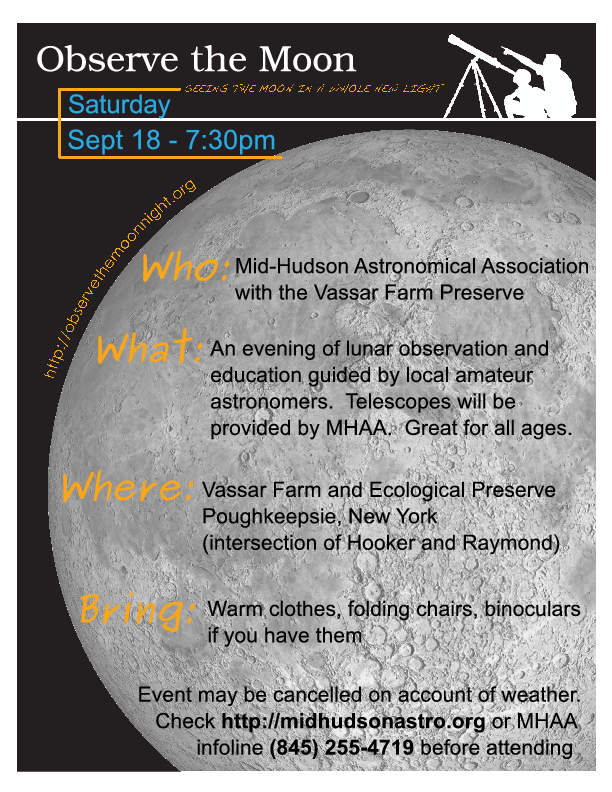
It turns out that while I was coming up with the idea of figuring out if we could do an astronomy outreach event at the Vassar Farm, Keri VanCamp (the Vassar Farm & Ecological Preserve manager) was developing a program of outings at the preserve to get more people out experiencing it. It worked out perfectly, so now we'll be celebrating International Observe the Moon Night as an event on Vassar's "Exploring a Sense of Space" at the farm.
Our event will take place on Saturday, September 18th at 7:30pm. I'm hoping for a clear night, because if it's fully cloudy there won't be much to see, so we'll have to cancel. Here is the flyer I managed to come up with (based on the template from the observe the moon team):
The overall list of topics going on at the Farm in their series is pretty interesting stuff. As I've not seen it online yet, I'll duplicate it here for anyone interested:
Exploring a Sense of Place
A series of guided walks and events on the Vassar Farm & Ecological Preserve
Wednesday September 8th at 3:30 PM: Walk led by Dr. Mark Schlessman and Keri VanCamp
Topic: Wildflower Walk *
Saturday September 18th at 7:30 PM: Program led by Mid-Hudson Astronomy Club
Topic: Astronomy: International Observe the Moon Night
Wednesday September 22nd at 3:30 PM: Walk led by Dr. Lucy Johnson
Topic: Native American Usage of the Preserve and Valley*
Saturday September 25th at 9 AM: Walk led by the RT Waterman Bird Club
Topic: Bird Watching
Wednesday September 29th at 3:30 PM: Walk led by Dr. Kirsten Menking
Topic: Glacial History of the Preserve*
Wednesday October 6th at 3:30 PM: Walk led by Hannah Clark and Jason Carter
Topic: Forest Ecology and Invasive Insects*
Wednesday October 13th at 3:30 PM: Walk led by Dr. Meg Ronsheim, Abby Falk-Rood, & Keri VanCamp
Event: Mushroom Foray and Basic ID*
Wednesday October 20th at 1:30 PM: Program led by Keri VanCamp & Emily Vail
Event: Wetland Buffer Planting*
Wednesday October 27th at 6:30 and 8 PM (Rain date October 29th): Program led by Hannah Clark, Jason Carter, & Dr. Glenn Proudfoot
Topic: Northern Saw Whet Owl**
All events could be canceled due to adverse weather. Please contact us if the weather forecast is questionable. Participants should meet in the parking area near the large red barn across from the community gardens at the Vassar Farm.
*A van will also bring people from campus to the farm. It will depart from the main circle 15 minutes before the program begins.
** Space for this event is limited. People must RSVP to Hannah or Keri. This event will be held at the Collin’s Field Station.
To RSVP or for additional information contact: Hannah Clark at hannah3890@yahoo.com or Keri VanCamp at (845) 437-7414.
September 4, 2010 · Technology
·
software
This rails guide on security is one of the most comprehensive that I've seen on that kinds of attacks that exist against web applications today. While the counter measures that are specified are rails specific, the explanation of the attacks and vulnerabilities are valid for any web stack. This is a must read for anyone that does web development now adays.