Angry Birds the Peace Treaty
Seriously funny.
Technology, open source, personal essays, and everything that isn't climate.
Marketplace Money this weekend was all about health care, with lots of great info in it. They did a puppet skit on The Too Informed Patient which was a quite funny take on the challenges presented by the WebMDification of the patient population. Hopefully both my friends that are doctors, and the ones that are hypochondriacs with both find is amusing.
I think Seth Godin gets to the heart of things around the TSA and the new scanners:
Smart marketers know how to pivot. I think it's time to do that. Start marketing the idea that flying is safe, like driving, but it's not perfect, like driving. If someone is crazy enough to hurt themselves or spend their life in jail, we're not going to stop them, and even if we did, they'd just cause havoc somewhere else. So instead of spending billions of dollars a year in time and money pretending, let's just get back to work. The current model doesn't scale.
Phoronix recently published an article regarding a ~200 lines Linux Kernel patch that improves responsiveness under system strain. Well, Lennart Poettering, a RedHat developer replied to Linus Torvalds on a maling list with an alternative to this patch that does the same thing yet all you have to do is run 2 commands and paste 4 lines in your ~/.bashrc file. I know it sounds unbelievable, but apparently someone even ran some tests which prove that Lennart's solution works. Read on!
More info, including the commands you need on Ubuntu, here.
I'm anti TSA back scatter scanner, but it's not because of the radiation, which is actually quite small. Coming in at a measure of 0.005 mrem, it's about 1/2 of what you get by eating a banana. If you live in a brick house you are getting at least 20x that radiation level every day.
I'm anti back scatter scanner because I think it's a 4th amendment violation, and that it's an incredibly expensive waste of money. That money could be better spent on kitchen safety, as kitchen appliances kill more people a year than terrorists do.
That's the somewhat provocative question asked by Radio Lab this past week. Want is really a stronger term here than is used, because this is really about the fact that ideas and technology evolve in much the same way that life does. I think the parallels between convergent evolution and simultaneous discovery is one of the most fun parts of this.
| The Daily Show With Jon Stewart | Mon - Thurs 11p / 10c |
| Missile: Impossible | |
| www.thedailyshow.com | |
| 🔗💀 Comedy Central video embed | |
Having learned nothing from Balloon Boy, apparently cable news was all over turning contrails into ICBMs.

A floating stage, resembled a giant book on Lake Constance in Bregenz, Austria can be considered as the biggest book on earth. However, the giant book of Lake Constance can only be seen during Quantum of Solace festival each year.
I can only say wow.
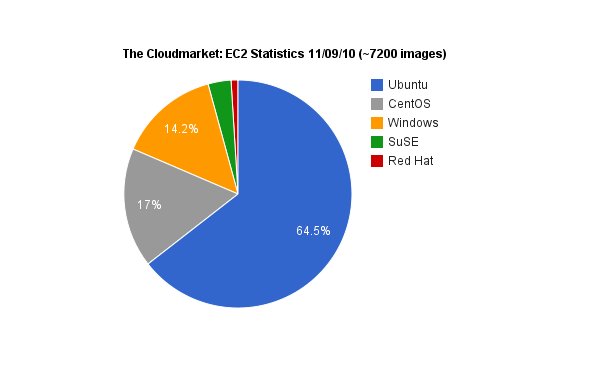
"We didn't go with them because they didn't support Ubuntu" is something that I wouldn't have expected listening to a cloud service creator talk about selecting cloud vendors. That is exactly what I heard when I was at CPOSC last month. I took it as a throw away statement, and didn't think much more of it.
Until today, when I saw this graphic posted by Steven O'Grady:
There is something very interesting happening in the cloud space, and it will be very curious to see how this evolves over time.
Problem: you want a fixed host name to connect to your home network on some residential ISP service. You don't have a static ip, so it could change at any time, and you want it to stay up to date.
There are a lot of services out there like dyndns and no-ip that do that for you for free, but it's on their domain names. If you are hosting some of your own domains on linode, you can use their DNS API to do the same thing, but with your own host names. This is a little script I banged out 6 months ago to do that. The ruby can be used as is, the config.yml will need to be tweaked to your own needs below.
#!/usr/bin/ruby

require "yaml"
require "rubygems"
require "linode"
require "pp"

config = YAML.load_file('config.yml')

domain = config["domain"]
host = config["host"]

@d_id = 0
@r_id = 0

l = Linode.new(:api_key => config["API Key"])

# Get the domain id
l.domain.list.each do |d|
    if d.domain == domain
        @d_id = d.domainid
    end
end

# Get the actual host resource id
l.domain.resource.list("DomainID" => @d_id).each do |h|
    if h.name == host
        @r_id = h.resourceid
    end
end

# Update that to the current remote record
l.domain.resource.update(
                         "DomainID" => @d_id,
                         "ResourceID" => @r_id,
                         "Target" => "[remote_addr]"
                         )
This assumes a config.yml that looks something like this:
API Key: from linode account
domain: adomainthatIown.com
host: myhostname