Writings

Technology, open source, personal essays, and everything that isn't climate.

Better ideas for a retreat

Seth Godin had a post on better ways to organize a retreat that had these as good points:

  • Create a dossier on each attendee in advance, with a photo and a non-humble CV of who they are and what they do and what their goals are
  • Never (never) have people go around a circle and say their name and what they do and their favorite kind of vegetable or whatever. The problem? People spend the whole time trying to think of what to say, not listening to those in front of them (I once had to witness 600 people do this!!)

I think the going around the room thing is really spot on.  I am here by banishing that from any gathering I've got.  Time to invest in more name tags.

Related: It's time to rethink the TSA · The Cloud vs. the Enterprise · More uses for your Foursquare data

Radio Lab: The Walls of Jericho

Given that I've told half a dozen people to go listen to this in the last week, it's probably worthy of posting.  Our friends at Radio Lab had a great piece a couple months back where they look at the Bible story where 7 trumpeters bring down the walls of Jericho.  They ask the question, how many trumpeters would it take to bring down a wall like that?  Along the way you learn quite a bit about acoustics, the science of sound.

It's about 15 minutes and available on their website.

Related: What does technology want? · What I'm listening to · Is the Sky Blue?

James Burke's Connections now on Youtube

Ok, it's time, gentle readers, to go directly to Youtube and start watching James Burke's Connections.  This is brilliant stuff, wonderfully written, and something everyone should watch.  The first series is by far the best, before Discovery got their hands on it, but the other stuff is worth while as well.

The entire thing has now been cut up into 10 minute segments, and put into playlists, and made easy to consume.  You have no excuses any more.

Related: James Burke on the future · James Webb increases the Awesome · A Short History of Nearly Everything

Noah Baerman: Know Thyself

About a year ago, Susan and I went out to our old stomping grounds of Wesleyan University and saw the premier of Noah Baerman's "Know Thyself".  Susan and Noah met back in grad school, and Susan was renting an apartment from Noah and his wife earlier on when we were dating.  Susan said Noah was premiering a new work at Wesleyan, and we should make the trip out to see it.  It was something different, and I'd never actually seen Noah perform, so it sounded like a good idea.

The piece premiered in the second half of the performance, after intermission.  It ran about an hour, during which time I was completely mesmerized.  I can best describe it as a Jazz symphony, though I'm sure those words don't do it justice.  I turned to Susan after the event and said "wow, I wish you'd told me in advance it was going to be this great, I'd have invited along some other folks".

Now, I can share it.  Noah's released a recording of the piece, which you can stream for free from his website.  I encourage you to take the time to check it out, I think you'll find it well worth your investment.

Related: Goodbye Naughts · End of term potpourri · End of an Era

Ed is the standard text editor

This is an old joke, but increasingly one that people haven't seen.  Given that I stuck a vi/emacs question at the end of the mhvlug survey, I thought it would be worth reposting for posterity.  The original version is here.

When I log into my Xenix system with my 110 baud teletype, both vi and Emacs are just too damn slow. They print useless messages like, ‘C-h for help’ and ‘“foo” File is read only’. So I use the editor that doesn't waste my VALUABLE time. Ed, man!  !man ed

ED(1)               Unix Programmer's Manual                ED(1)

NAME
     ed - text editor

SYNOPSIS
     ed [ - ] [ -x ] [ name ]
DESCRIPTION
     Ed is the standard text editor.

Computer Scientists love ed, not just because it comes first alphabetically, but because it's the standard. Everyone else loves ed because it's ED! “Ed is the standard text editor.” And ed doesn't waste space on my Timex Sinclair. Just look:

-rwxr-xr-x  1 root          24 Oct 29  1929 /bin/ed
-rwxr-xr-t  4 root     1310720 Jan  1  1970 /usr/ucb/vi
-rwxr-xr-x  1 root  5.89824e37 Oct 22  1990 /usr/bin/emacs

Of course, on the system I administrate, vi is symlinked to ed. Emacs has been replaced by a shell script which 1) Generates a syslog message at level LOG_EMERG; 2) reduces the user's disk quota by 100K; and 3) RUNS ED!!!!!! “Ed is the standard text editor.” Let's look at a typical novice's session with the mighty ed:

golem$ ed

?
help
?
?
?
quit
?
exit
?
bye
?
hello?
?
eat flaming death
?
^C
?
^C
?
^D
?

Note the consistent user interface and error reportage. Ed is generous enough to flag errors, yet prudent enough not to overwhelm the novice with verbosity. “Ed is the standard text editor.” Ed, the greatest WYGIWYG editor of all. ED IS THE TRUE PATH TO NIRVANA! ED HAS BEEN THE CHOICE OF EDUCATED AND IGNORANT ALIKE FOR CENTURIES! ED WILL NOT CORRUPT YOUR PRECIOUS BODILY FLUIDS!! ED IS THE STANDARD TEXT EDITOR! ED MAKES THE SUN SHINE AND THE BIRDS SING AND THE GRASS GREEN!! When I use an editor, I don't want eight extra KILOBYTES of worthless help screens and cursor positioning code! I just want an EDitor!! Not a “viitor”. Not a “emacsitor”. Those aren't even WORDS!!!! ED! ED! ED IS THE STANDARD!!! TEXT EDITOR. When IBM, in its ever-present omnipotence, needed to base their “edlin” on a Unix standard, did they mimic vi? No. Emacs? Surely you jest. They chose the most karmic editor of all. The standard. Ed is for those who can remember what they are working on. If you are an idiot, you should use Emacs. If you are an Emacs, you should not be vi. If you use ED, you are on THE PATH TO REDEMPTION. THE SO-CALLED “VISUAL” EDITORS HAVE BEEN PLACED HERE BY ED TO TEMPT THE FAITHLESS. DO NOT GIVE IN!!! THE MIGHTY ED HAS SPOKEN!!! ?

Related: Productivity Tip: Learn your tools · Selling my gaming gear · The switch from xemacs -> emacs

Getting feedback via survey, always eye openning

I used to try to solicit feedback about MHVLUG on our mailing list, that always went poorly.  What people were willing to tell me directly, if the opportunity came up, never would come up in a group.  The social dynamics of groups very quickly turn into hearing a lot from a few people, and not very much from others.  Those quieted voices often have really good pieces of feedback, and realistically are our audience.  The loud ones only make up 10 - 20% of who show up to a meeting.

A survey, if small enough, breaks that down.  People are really communicating 1 on 1 with you, and are very straight forward.  You can ask questions you are looking for answers, and get answers you never expected if you leave people with a comment box.

We're in the midst of this year's MHVLUG survey, with 24 responses so far.  The results are useful, and help enforce which talks people really like, and things people think they want to see more of.  A few things surprise me:

There is a small, but measurable, part of our group that have zero interest in web technologies.  For me, the web is like water, so I've been stacking the schedule a bit more in a web direction the last couple of years.  I'm not sure that this feedback changes how Ben is going to build the schedule for this year (it's still not quite sunk in that I managed to hand that task off), as no one is interested in everything, but it is interesting.

People really undervalue their knowledge.  I asked a question this year:  Would you be interested in presenting at MHVLUG, and if so what topic(s)?  For the people that responded to that, most people said some form of "I don't have anything interesting".  My experience is that that isn't true.  Most of the talks that I've scheduled have been by noticing something interesting that someone is doing, and saying, "hey, any chance I can get you to do a talk on that?".  In very few of the cases did people actually step up fully on their own.  Perhaps we can break this down with more lightning talks, which are less intimidating.

If you run a local group and haven't used a survey to figure out what your silent majority is thinking, you should.  It gives you some grounding on what's working, and what could use a change.
Related: How to keep a group vibrant · 100 MHVLUG Meetings · XKCD color survey

New MHAA Website

New Mhaa Website

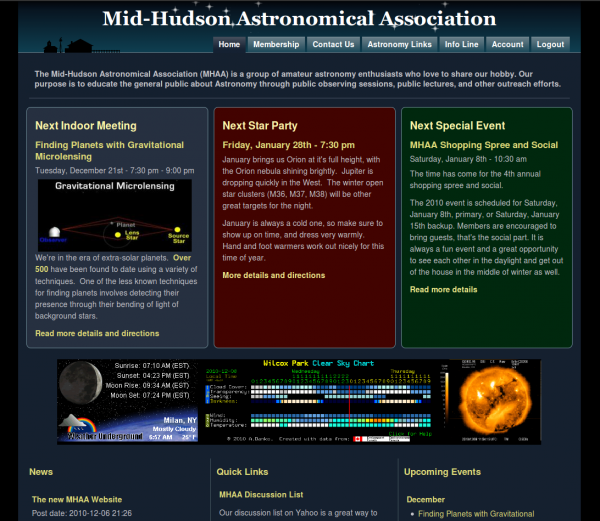
Over the past few weeks I've been redoing the Mid Hudson Astronomical Association website.  It looks like this:

Yes, it's dark, but that's when astronomy happens.  The site is built on Drupal, as I've gotten some experience there recently doing sites for the Poughkeepsie Farm Project and MHVLUG.  For people that want to know more about the tech side, I'll be giving a talk in January at MHVLUG.

I did come across one really odd thing in working on the three boxes (I was calling them chicklets, but they look less like that with content in them). Round corners in CSS are awesome (thank you w3c). IE9, at least the version in Adobe Browser labs, still doesn't support it (really Microsoft? I thought you were getting down with the standards). While a TD can have a round background, it's border is always square (I almost understand why, but it definitely limits what you can do. It also took me a while to realize this was happening as the round is subtle enough on the front page). Div height 100% doesn't work inside a TD (it seems like it should, but no one implemented it that way).

So the only way to get 3 columns that correctly degrade to 2 columns (50% of screen each) when one is missing (there will not always be a special event), have round borders, and be the same height is.... jquery. While on the one hand, it seems crazy, on the other hand, yay for jquery. You can view the source on the website to see how I did it.

Related: Upcoming Talk: Building a Community Site with Drupal · Mediawiki vs Drupal for a community site · Getting my head around Drupal: mhvlug.org version 4 a detailed guide

Android 2.3, all about gaming

The Android 2.3 SDK dropped yesterday, and if you look through the api changes you can see the entire release is about gaming. There are new sensors, that are pretty much only good for gaming, new hardware buttons, and a pretty substantially openning up of what you can do from native (C/C++) code.

I think Google came to terms with the fact that Game developers are held to their ways, if they don't have a compiler in their workflow they feel naked and exposed. If you can get on an OpenGL ES surface you can pretty much skip any java activities now. It actually makes me wonder if you could port stellarium whole sale to the platform, which may be something worth looking into.

For people that are less interested in gaming 2.3 was kind of a snooze. Strict mode looks interesting, where you can monitor yourself for aberrant behavior, but other than that nothing much juicy in there.

Related: Selling my gaming gear · Where is Io - v1.3 · Android Me