More as I actually figure out how to make any of this actually work.
Technology, open source, personal essays, and everything that isn't climate.
More as I actually figure out how to make any of this actually work.
I'm happy to say Lullabot featured Node Announce on Module Mondays:
Unfortunately, one of the most useful calendar applications can remain elusive: sending users an email when something is about to happen. That's where the Node Announce module comes in. It can use date fields on a node as cues to send out email to specified addresses -- notifying authors when their nodes will be published, attendees when events are about to occur, and so on.
Multiple friends pinged me yesterday about it, giving me congrats. Good thing that I fixed that critical Drupal 7 bug on Sunday when taking the new mhvlug.org live (fixed in 1.2). That would have been embarrassing to white screen everyone's websites on theme rebuild.
Feature requests and patches welcome.
Coming to your local PBS station this week:
We showed this at one of our [Mid Hudson Astronomical Association](http://midhudsonastro.org) events this year, and it's a great film. Hopefully it will make you rethink the lights we leave on outside, that do nothing more than pollute our night skies.Is darkness becoming extinct? When filmmaker Ian Cheney moves from rural Maine to New York City and discovers streets awash in light and skies devoid of stars, he embarks on a journey to America’s brightest and darkest corners, asking astronomers, cancer researchers and ecologists what is lost in the glare of city lights. Blending a humorous, searching narrative with poetic footage of the night sky, The City Dark provides a fascinating introduction to the science of the dark and an exploration of our relationship to the stars. Winner, Best Score/Music Award, 2011 SXSW Film Festival. Produced in association with American Documentary | POV.
Interesting new paper on the cost of Patent Trolls in the US.
In the past, “non-practicing entities” (NPEs), popularly known as “patent trolls,” have helped small inventors profit from their inventions. Is this true today or, given the unprecedented levels of NPE litigation, do NPEs reduce innovation incentives? Using a survey of defendants and a database of litigation, this paper estimates the direct costs to defendants arising from NPE patent assertions. We estimate that firms accrued $29 billion of direct costs in 2011. Moreover, although large firms accrued over half of direct costs, most of the defendants were small or medium-sized firms, indicating that NPEs are not just a problem for large firms.
For reference, $29 billion is more than NASA's budget ($19 billion in the same time period). This is a huge problem that has real impacts on our economy and our recovery.
Interested in how colors work? Read Color Wheels are wrong? How color vision actually works by @ASmartBear.
Bonus, this gives a pretty good explanation on how color is perceived that makes color blindness make a bit more intuitive sense.
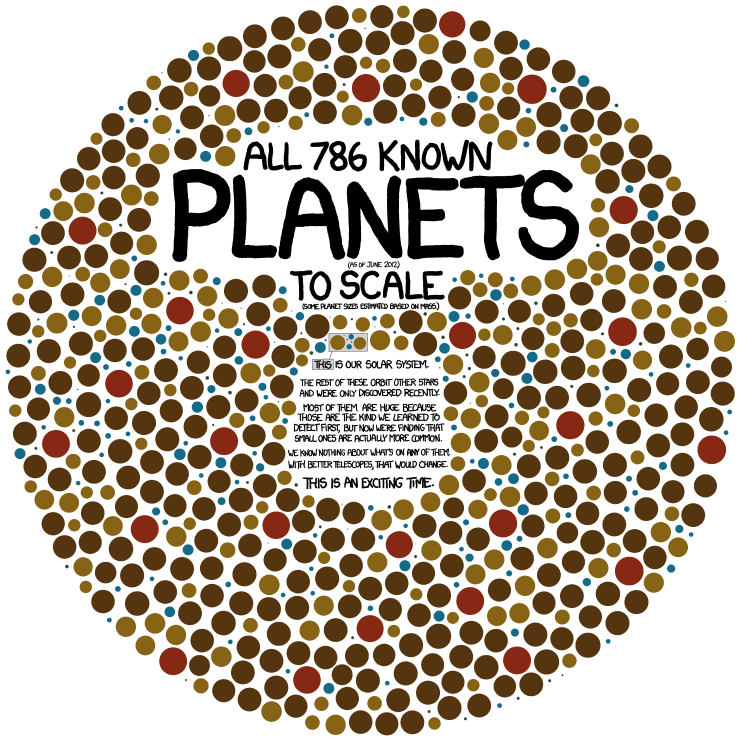
Now we just need to figure out how to get there.
It's a really interesting question, that isn't as obvious as you might think. It's wrapped up in the social construct of colors, and how color words emerge in languages. Radio Lab covered this recently in one of their best podcasts I've ever listened to. And there is another great look at color evolution here. I especially like that we're actually watching a color split emerge in modern Japanese language.
As I was packing up my telescope at midnight last night, calling it a night from our Star Party, I decided to take a short walk. And I did so looking up.
The milky way was rising, and as civilization was shutting down, it was getting darker and clearer. There was so much detail, so much horizon, so much beauty. And the universe just stopped, and stared back at me.
The kind of calm and quiet doesn't happen that often. And after a long and hectic week, it was exactly what I needed to recharge my batteries.
Yesterday I saw something with my own eyes that's only been seen by humans 7 times in human history, and won't happen again for 105 years: Venus moving across the face of the sun. That view, I'll remember for the rest of my life.
The Mid-Hudson Astronomical Association and SUNY New Paltz pulled off a big event yesterday, with 250 - 300 guests showing up to see the Transit. While we had some clear skies at 5pm, by 5:30 there were clouds. As people streamed out from Dr Amy Forestdell's talk at 5:45 we pointed people back inside to catch the NASA stream of fist contact.
Of course, 2 minutes before first contact, the NASA stream hung. We jumped instead to the Google Plus Hangout that Fraiser Cain and Pamela Gay were hosting, which included views from 4 amateur astronomers from around the US. I watched first and second contact virtually as the clouds had us pinned in.
But I roamed out afterwards and saw we were getting thinning sections. I ran back to my scope and waited patiently as the clouds shifted. About 20 minutes later we got a quick hint of shadows, and I nearly got my scope aligned. From the crowd our club VP yelled out "I got it!", and then the clouds were back in. But they were thinning, and I was ready. A few minutes later shadows started showing up again, I dialed in my scope quickly, stuck my eye in to see if it was there. And... Bam! It just hit me like a load of bricks. There was the orange disc of the sun, which I'd seen so many times in my solar scope, and it had this giant hole in it. A big black hole, so much bigger than anything I've ever seen on it. So much more distinct. So very cool.
I quickly started to have people come through the line. There was one high school kid who'd been hanging out for a long time talking with me, so I made sure that he got to jump the line and get a view. We had about 15 - 20 minutes of these thinner clouds, and I think I managed to get about 30 people through on my line in that time. The new tracking mount helped, as I didn't need to keep adjusting things. Then the clouds came back in, and we waited for another shot, which never came.
But for those brief minutes we saw it, with our own eyes. And it was amazing.