* personally guilty of this one
Technology, open source, personal essays, and everything that isn't climate.
* personally guilty of this one
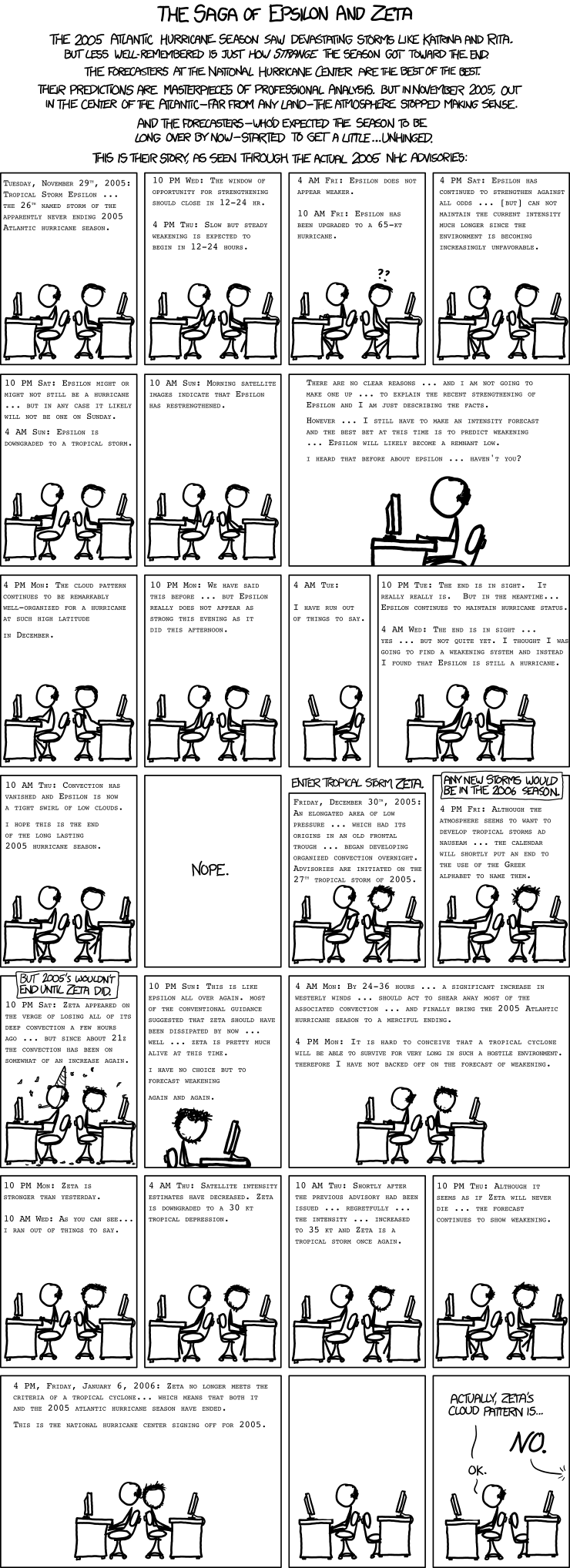
xkcd today takes the actually Hurricane Center Advisories from 2005 (when we ran out of letters) and draws the narrative. The results are hilarious.
When you are learning how to program, you think that most of your time is going to be spent writing code. The reality is most of your coding time is actually spent reading code. Other people's code. Code with comments that lie. Code with bizarre short cuts. Code whose original authors are long gone or unresponsive.
And that's the real skill of a good programmer, the ability to read this kind of code, and make sense of it. Maybe even make it a little better as you come across it.
As reported by Ars:
On Friday, a group known as the Tesla Science Center at Wardenclyffe, formerly known as Friends of Science East, purchased 16 acres on eastern Long Island to create a Tesla museum and science center. Matt Inman, creator of the Web cartoon The Oatmeal, encouraged his readers to contribute to the non-profit’s purchase, calling its goal, "a simple feat… only expensive." Inman set out to raise $850,000, but ended up raising close to $1.4 million for the establishment of what will be America’s first museum dedicated to scientist Nikola Tesla.
I donated to this effort, and am very excited to see this going forward. This is just the first step though, as it gets the land. There is still a tremendous amount of work that will need to be done to rehabilitate this into a museum, but at least it's no longer going to be bulldozed to build a shopping plaza.
Can't wait for the next steps on this project.
What I learned from watching the Revolution pilot:
When the power goes out all planes immediately go into a flat spin and kill everyone in them, but cars nicely stop, and no accidents.
15 years in the future no one has figured out how to make a steam engine or a windmill, but there are plenty of brand new skinny jeans, leather jackets, freshly pressed t-shirts, and hair product. The grand tradition of distilling is still alive though.
Bullets require electricity, so everyone is using muskets. Except pistols, those are fine.
There are giant old growth forests (with RVs in them) a couple days walk from Chicago.
Magically USB keys not only power computers after the crash, but also cause near by light bulbs to come to life. And apparently the ham community is still running and eagerly awaiting with their own magical USB key somewhere else eagerly typing at their keyboard.
Yes it's just a TV show, but there was so much laziness in the story telling that any promise of their being a real payoff to this story seems very low. The throw away "physics went crazy" is just a cop out to explain any of this stuff. That level of laziness means there never is going to be payoff on the actual story. And the characters are pretty flat. Having been along for the ride with Lost, and then getting the steaming pile that was the sideways universe in Season 6, I'm not giving J J Abrams the benefit of the doubt here.
For a much more interesting, and less intellectually lazy, take on what a post power fail future looks like, check out Jericho. The bonus being the pilot episodes end with basically the same scene in front of a computer.
Interesting data point on whether 2 GB / month of data is enough on cell plans. At our MHVLUG meeting the local wireless wasn't working, so I instead just turned on the wifi access point on my phone for my laptop and tablet so I could do a little bit of live demo. It was on for 2.5 hours, with a total data usage of 46MB (which is about 15% of what I've used total this month).
Yes, bandwidth caps basically kill mobile streaming as a business (mobile pandora, hulu, netflix, are definitely being hurt by this), but for non streaming interactions, 2GB is way more than I'll use in a month.
On Wed, Sept 5th, I'll be giving the talk on OpenStack at MHVLUG. The last six months working on the project have been really spectacular, great learning curve, really good community members, and a very exciting potential for where the project is going to go. I'm quite looking forward to going back to work next week after this summer holiday, because I can't wait to get back into the code.
I'll provide my personal take with current trends in cloud computing, and hopefully create a lot of in room discussion. We'll go from that industry lens, to a deeper look at OpenStack. I'm a big believer that like operating systems, web stacks, and virtualization, the essential infrastructure of cloud computing needs to be open source.
If you are in the Mid Hudson Valley next Wed, come check out my talk.
I'm fortunate to be working in a field and an area where the people around me are mostly swimming in the same direction. While there may be disagreements from time to time, those are mostly ones where you can see their point of view, and realize some times there isn't enough data, so you'll get different opinions.
Earlier today I found myself in a confusing situation around facilities. We were trying to do something the facilities folks didn't directly support. I responded helpfully that that wasn't an issue, we'd gotten our own equipment to handle the deficiency. What I thought was helpful instead turned out to be threatening. Because now we were bypassing the system. I finally caught on and just shut up until the interaction ended.
What's more amusing? I was working on my OpenStack presentation. One of the big drivers of cloud adoption has been routing around local IT departments for similar reasons.
Via channels I can't now remember, I came across this presentation about the very unsolved issue of how Computer Science as a field of study relates in any way to creating software.
With so many colleges in the area, and having a number of friends that are CS professors, and other IT staff at colleges, it continues to amaze me how disconnected these worlds are. All made the stranger by coming into the field sideways from a physics degree.
Plus, I love the term software carpentry.
In late 1999 I claimed my last name as a domain, and have had various email and web solutions hanging off of it ever since. This past weekend I migrated off of self hosted email to Google Apps for Domains. My email address remains the same, but the infrastructure is Google's. There were 3 main converging trends that drove me there: spam, client innovation, and protocol integration.
Because most people host email on one of the big three (Google, Yahoo, Microsoft), spam fighting techniques for the little guy have largely stagnated. If you are big enough there are other algorithms you can apply to patterns affecting your millions of subscribers at once. For individual filtering, especially with an email address that's been constant for over a decade, the best you can do is spamassassin, which last released in 2011, and realistically hasn't done anything innovative in the last 3 years. So recently my false possitive and negative pool have been overlapping in a way that means a lot of manual work. Thunderbird's bayesan filtering is quite good, and makes up for some of this. So when my laptop is running while I'm getting mobile email, my spam rate in mobile is low. When it's not, about 80% of what gets to my mobile inbox is spam.
Spam by itself wouldn't have pushed me over the edge, but Mozilla deprecating new development on Thunderbird was another blow here. Email is powerful because it is universal, can be accessed by any device at any size, multiple clients interacting with the same data, at the same time. Desktop email has gotten the short end of the stick in recent years, again because most people are hosting with the big 3, but Mozilla was still making a valiant attempt to keep email open. They've now decided it's more interesting to chase Chrome than provide value here. That's their call, but it's sad to see desktop email take that hit.
Lastly, there are lots of quite interesting tools growing up to integrate with email in a new social world. Give you profiles of your contacts via social networks, make it easy to convert email into tasks. All great stuff. None of it works with IMAP or Desktop email. All the innovation around email right now is using the GMail API and Chrome extensions to modify GMail web interface.
So the migration is on, I've nearly got my email history dating back to 2000 into Google now. In the process I found I'd actually lost 2008 and 2009 archives, which I've mostly restored via backup. That would explain why some things weren't showing up in search that I expected. Already, the spam filtering is a huge win, and eventually I'll get used to the web UI for some things (still going to keep using Thunderbird in combo for a while).
The biggest challenge in this whole process is that because of how Google has wedged Plus into everything, having both a gmail and an apps email causes some real confusion on the Plus side, because there is no way to tell Google they are the same. That's just going to be confusing for a while, and if anyone has best practices around that, let me know.