Writings

Technology, open source, personal essays, and everything that isn't climate.

Nook Simple Touch as an Astronomy Tablet

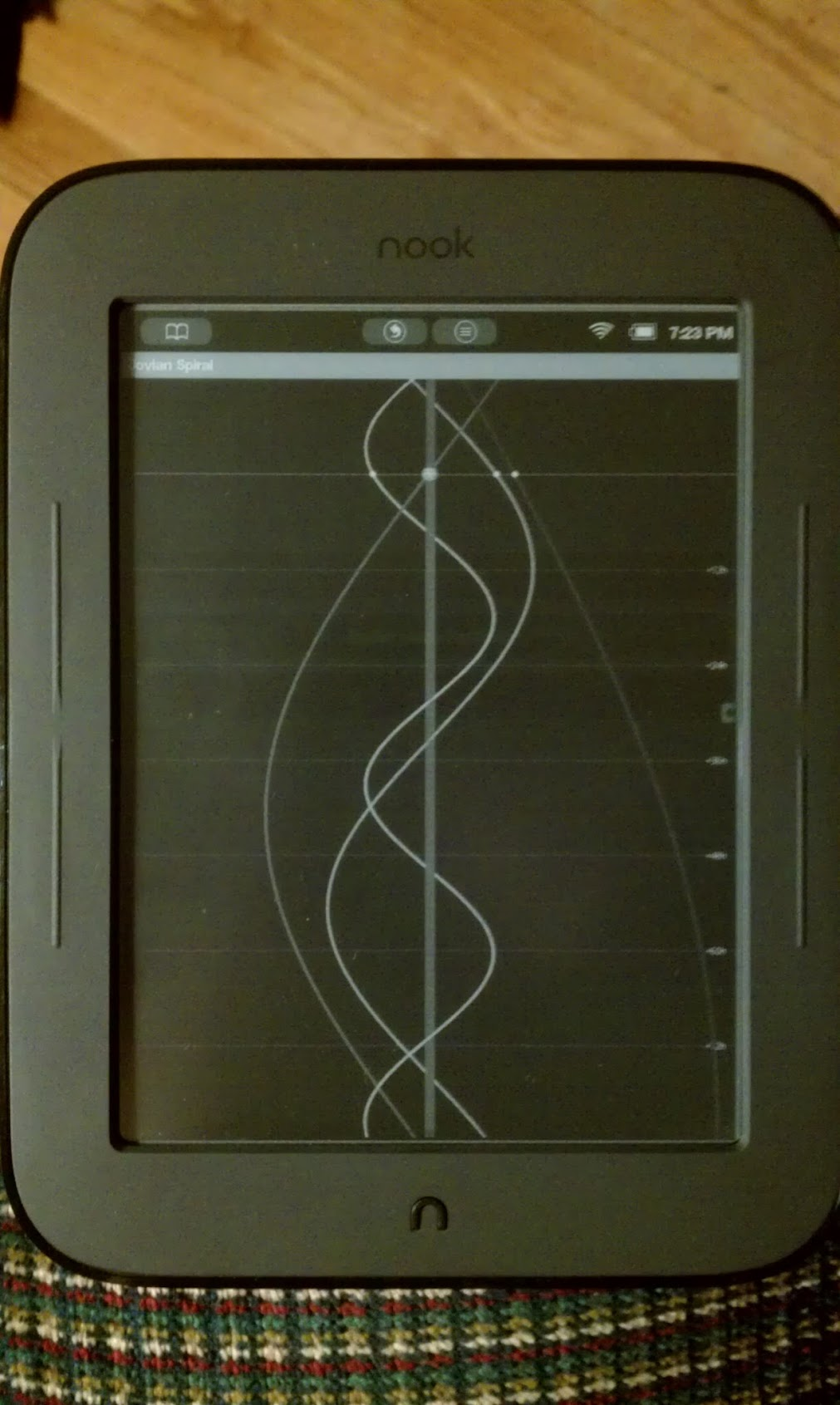
This weekend I bought and rooted a Nook Simple Touch. The reason? I've been looking for an eink platform that one could make astronomy applications and data available for. Eink is ideal for a hobby where stray light destroys your ability to see anything. The "Where is Io" astronomy app running on a Nook Simple Touch, showing the Jovian Spiral screen

Having written an astronomy application (albeit one that needs a lot more polish) I pushed it over. There are a few rendering issues with the buttons (which completely confuses me), and the fact that there aren't any real location services means rise / set times are completely off, bother are fixable in software. Computational speed seemed on par with my HTC Evo, which means this is something I can work with.

Sadly, both B&N and Amazon have equivalently limited imaginations when it comes to making Apps for their e-ink platforms (my Amazon knowledge comes from email exchanges with the Kindle team), and don't see the other possibilties for e-ink.

Fortunately, B&N seem to be lacking on having a crack security team, so the Nook ST can be wedged open to an open platform pretty easily. I'll be making Where is Io optimized to run on it, and look at what it would take to get Google Sky Maps over there (now that it is open sourced). And, I'll hold out a small amount of hope, that B&N one day figures out it might be useful to provide this additional value to their customers. Based on email exchanges with Amazon, I've completely written them off.

Key Takeaway: don't let your own limited imagination, and need for control prevent your creations from meeting their full potential.

Update: now that the Android Market finally activated, I pulled down a number of apps to see how they all worked. The Mobile Observatory UI is actually really useful on this size and type of UI, and I think is worth the price of the Nook Simple Touch even if you only decide to run it.

Related: A plea for an open android eink tablet for Astronomy · Kindle Interupted · Simple thought for today

CiviCRM and the Poughkeepsie Farm Project

Every year since I first started volunteering for the Poughkeepsie Farm Project we've had a pow wow in the fall about what would be the right task list for me to try to get ready by the start of the season in May. For the past couple of years all my focus has been on the website.

This year, things are different. While there are still a few things I'm going to do to the website, I'm diving into a brand new space. The PFP, like many organizations it's size, is largely run by lots of disconnected spreadsheets. A for instance, asking a question about who attended both key fundraising events last year requires hours of effort, as those attendee lists are in completely different formats in different places. So the focus is going inwards, and we're going to see how much better we can make this with CiviCRM.

CiviCRM is an open source customer relationship manager that attaches to an existing Drupal (or Joomla or Wordpress) installation. It can handle donations, membership management, event planning and ticketing (including online payment). It was not where I started the investigation, but when I finally came across CiviCRM, and ran it through it's paces, I was quite happy with what I saw. I'm also really impressed by the development community, who has been super helpful. I've gotten a couple of minor patches in already (and working on some more major ones).

This is going to be a really interesting journey at many levels. To do this right I'm really learning how the internals of a small non-profit works, and how we map the concepts across. We've got some good check points in place, and I think reasonable goals on what functionality I can get online this year. It's probably a 2 year journey before we really take full advantage of what it can do for us. I'll be writing about this journey here, and also talking about it very regularly at our Hudson Valley Drupal Meetup. So if you are in the area and are contemplating implementing CiviCRM, or have and could share, come out and find us.
Related: The new Poughkeepsie Farm Project site is live! · Poughkeepsie Farm Project · Things we sometimes forget

Stop and Pay Attention

stop and pay attention

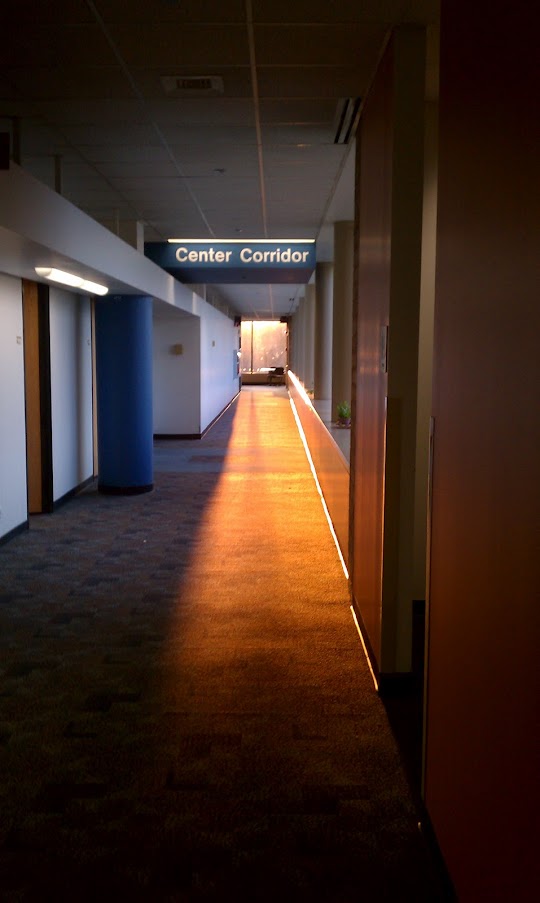
During a late afternoon bathroom break on Feb 27th, I came across this:

As the sun was setting it nearly aligned with the hallway on our building, creating this column of light almost all the way across the building (the next day we got there). I was the only person who noticed, though I did drag a few other folks out to see it.

Cool things like this are happening all the time, but you have to stop and pay attention otherwise you'll completely miss them as you are rushing your way out of the office, onto the next thing in your busy schedule.

Related: Will you pay for news on the web? · You've Probably Read Enough · Stop Online Privacy Act

Stop the Presses

I had an interesting conversation earlier this week with a co-worker about our local paper, the Poughkeepsie Journal, having thrown up a paywall on their website. He's a good decade plus older than I am, and we're bother Poughkeepsie Journal subscribers, which means we both have unlimited access to their digital content.

I think the current PJ approach is a disaster. Not because making people pay for digital is a bad thing, but because of the way they are doing it. They've spent all this money on a "virtual paper", this goofy web app that makes it look like an actual paper. I thought it was aweful, my colleage quite liked it.

And that's the point. The people that want the digital paper to act like a physical paper, are all older than 40, and are aging out. Anyone younger than that has had the Web for their adult life, and wants their information in a digital first state. You want people in their 20s and 30s to buy your product, you need to make it native to them. Not doing so is just a going out of business strategy.

Where's my clean, responsive website, that seemlessly works in mobile, tablet, and desktop? Where's my urls to articles that work forever, so if I want to link something in a blog, twitter, or facebook, I don't generate a broken link after 7 days when you shuffle it off to a different archive site, or loose it forever after 30 days. Where's my setting to turn off advertising on the digital site as a subscriber? Where's my kindle version?

And the answer is, no where. And that's why most of the friends I have that are younger than me completely scoff at paying for a Poughkeepsie Journal subscription. Want to see this stuff done right? Got check out the Boston Globe, and read about what they did. That's worth a digital only subscription.

There are solutions out there, and I actually think that if you make a compelling digital product, people (especially people in their 20s and 30s) will pay for it. But digital has to be the first priority of the organization, and right now, for Gannett (the PJ parent company), it seems like it's about 15th priority. The one bright spot I've seen is the Poughkeepsie Journal is really doing a good job with twitter. I suspect that's because they are doing that independent of Gannett (who uses the same antiquated CMS backend for all their papers, compare Poughkeepsie Journal to Burlington Free Press some time). So I think the folks at PJ might actually get it, but they are hampered by a parent company that doesn't.

Here's to hoping they make the leap past this very broken digital attempt and into something digital native, while there is still cash in the bank. I want the Poughkeepsie Journal to still be around in 10 years, and that's not going to be true based on the path they are currently on.

Related: Adblock fixes for Poughkeepsie Journal · My Father makes the paper · The future of scientific papers

What Raspberry Pi's launch day tells us

Raspberry Pi, the $25 / $35 Linux ARM computer, launched yesterday, with 10k units through 2 distributors. The distributors were crushed within minutes, their websites down for hours. There is now just sign up forms to express your interest. This did not surprise me. For months RP has been a topic of conversations in my tech circles. The statement is typically how many units you'd buy, not whether or not you'd buy one. The moment I can buy 3, I will. I'm hoping, but not entirely optimistic, that I can do that this year.

At $35 this is still $30 less than an ethernet connected arduino, which is impressive. It also makes me wonder if they are adding enough to their unit cost to actually cover the people it takes to make getting these units out to the public possible. Even at double the price, they would have more demand then they knew what to do with.

But I think a more important thing can be said from this, how mainstream the hacker/maker world has become. RP is a DIY platform, and lots of people want it. If they can ever get their supply chain to meet demand they will sell more units than iPhones. Just think about that for a minute. And every one of these running Linux, though every one of these doing something slightly different.

I hope the RP foundation fully embraces the Arduino model, their closest comparator, and make the hardware fully open as well. The community around RP will only be fully unleashed when everyone can manufacture these boards. Given the RP foundation's goals, this should align very well. A version of these with GPIO would be incredible, because the closest thing is the Beagle Bone, which comes in at $90.

Related: Arduino-palooza · Arduino-palooza · Weather Station Progress

Time is Saved

The Electronic Frontier Foundation just won the most important legal case you didn't know about this year, and protected the existence of the Olson Time Zone Database.

San Francisco - The Electronic Frontier Foundation (EFF) is pleased to announce that a copyright lawsuit threatening an important database of time zone information has been dismissed. The astrology software company that filed the lawsuit, Astrolabe, has also apologized and agreed to a 'covenant not to sue' going forward, which will help protect the database from future baseless legal actions and disruptions.

Surprisingly enough, the world's timezones aren't kept by an inter-government committee, but by a few intrepid volunteers. This was really important to protect, and you should consider becoming a member of the EFF to protect these kinds of things in the future.

Related: So much for checks and balances... · Products for the Police State · From the Archive: When will then be now? Soon.

The Future of Libraries

The metafilter comment that's been circling about what the massive cut to library funding in California really means:

Every day at my job I helped people just barely survive. Forget trying to form grass roots political activism by creating a society of computer users, forget trying to be the 'people's university' and create a body of well informed citizens. Instead I helped people navigate through the degrading hoops of modern online society, fighting for scraps from the plate, and then kicking back afterwards by pretending to have a farm on Facebook (well, that is if they had any of their 2 hours left when they were done). What were we doing during the nineties? What were we doing during the boom that we've been left so ill served during the bust? No one seems to know. They come in to our classes and ask us if we have any ideas, and I do, but those ideas take money, and political will, and guts, and the closer I get to graduation the less and less I suspect that any of those things exist.

I'm a big supporter of libraries. We give annually to our local library (both financially and books and DVDs). I think Librarians are some of the few folks that really get what Copyright should be, and are very reliable advocates for sane copyright policy.

But at the same time I've got substantial frustration with parts of our libraries. I'm involved with multiple organizations that create really high quality educational content (MHLVUG and the Mid-Hudson Astronomical Association being the topic examples). For 9 years we used the Mid-Hudson Library System space (for a fee) with MHVLUG. It was a great space, but there was a huge missed opportunity, as our relationship with MHLS was always just that of a tenant. At the end, MHLS cutbacks meant we had to find another space, where we moved to Vassar College.

Contrast this with the Astronomy events I've led at Vassar College's Farm Preserve. Not only were we given space, but we were wrapped into their series of events on the Farm Preserve, with joint advertising by the College. That led to huge turn out, and lots of positive feedback for both the College and our group.

The Library could be this kind of thing. And if it was, it would have the Hubble effect, where the citizenry were so invested in the organization that they wouldn't let it get cut. There are some libraries that are thinking about, and embracing these kinds of ideas. The Fayetteville Free Library is doing some amazing things with setting up a Fab Lab. Lauren Smedley is an inspiration to what the future library could be, and lots of kudos to FFL for hiring her to try to make this happen.

I'm hopeful by nature, and I think our libraries will transform, eventually. But I do think it's going to take a new generation of librarians to think past just books, and think about community at a broader level.

Related: Observe the Moon at Vassar Farm · How to keep a group vibrant · Poughkeepsie Farm Project

Tech Volunteerism

Twice in the last month I've been contacted by friends I've made in the local tech community with questions about tech volunteering they are doing, or planning to do for local non-profits. I, hopefully, was able to provide them with some pointers and info to help them out.

I find that awesome. Not the me helping them out part, but the fact that they've gotten engaged and are giving back some of their vital skills to local organizations in need.

Over the past couple of years, through my work with the Poughkeepsie Farm Project, and the IBM year of service, I've realized that tech volunteerism is quite a rare thing. While there are a lot of techies in our area, when most of them volunteer, they do so in a non tech role. They are board members, and program leaders, which is good and important, but the very real technology needs are often overlooked.

Those conversations, plus a few other in the last month, have made me really start thinking about more ways to encourage and nurture more of this in our area. I'd love to have a peer group where I could share these experiences, and learn from others. This is a whole other master plan.

So, if you are a techie of any sort (developer, designer, it guru), consider giving those skills back to your local community. It's something very few can give, and very many need.

Related: Thoughts on a new Era of Service · A tale of two tech teams · IBM's Day of Service at the Poughkeepsie Farm Project

Open Source Tractor

NPR did a piece this morning on the Open Source Ecology project:

Jakubowski moved to Missouri, where he eventually bought 30 acres in the town of Maysville. He grew wheat, raised goats and tended a fruit orchard. But then one day, his tractor broke. "I came from an institution of higher learning, so I had no practical skills," he says. "I picked up a welder and a torch and started using it." Jakubowski actually made a tractor from scratch, using square steel tubing that he bolted together. "A tractor is basically a solid box with wheels, each with a hydraulic motor," he says. "So, conceptually, it's actually very simple. And when I first did it, it was like, 'Wow, a tractor' ... I was amazed to find this actually works."

It's a pretty amazing effort to identify the 50 most critical machines to modern existence, and create open source versions of them that can be built from raw materials.

Related: Upcoming Talk: Getting Involved in Open Source · Source Forge Open Source Again · Getting Involved in Open Source

Centers of Gravity

The past couple of years something interesting has been happening with the Linux Users Group, it's growing. After a long number of years of lulling in the low 20s and sometimes teens in meetings, we're now regularly in the 30s and ran up past 40 folks twice last year. Our last meeting had 34 people in the room for the lecture, and 19 come out to dinner afterwards (and this is all in a new location that's slightly harder to find). I've had various theories as to why, but another one cropped up last night after the Hudson Valley Drupal Meetup: Telecomuters.

There is a new reality out there, with a very large chunk of the population telecommuting. But giving up an office means giving up lunch with colleagues, and the small talk and hallway chatter that gets the brain juice flowing. These things are really important for a healthy psyche, and a healthy business, so people are reaching out for new face to face venues to get those interactions. This has taken the form of coworking spaces, regional conferences, and users groups. These are becoming new centers of gravity for the tech world.

Last night, after the Hudson Valley Drupal Meetup, some really cool connections were made between local folks, and I'm really excited to see what comes out of it. None of it would have ever happened without this growing constellation of face to face technical communities we've got in the Hudson Valley: MHVLUG, Squidwrench, and emerging so, the Drupal Meetup.[1] I am really fortunate to be a part of this, and to have great peer Organizers in Sean Swehla and Ben Stoutenburgh that are equally dedicated to fostering this. While each of these entities are distinct things, they feed into each other very strongly, which is becoming a great virtuous spiral.

If you haven't checked out your local technical community, you are missing out. Start with Google and Meetup and see what's going on, because you might be really surprised and impressed with what's in your own back yard.

  1. I play favorites here because these are the groups I'm actively involved with, but we've got a more comprehensive list at the HVSTEM Calendar.
Related: Drupal Meetup Events Module · Node Announce · Mediawiki vs Drupal for a community site