Writings

Technology, open source, personal essays, and everything that isn't climate.

Skills for the 21st Century

Maybe the real missing skills for a 21st century leader are buiding a house:

I agree that a liberal-arts education provides those intangibles. But maybe it's time that instruction—at least at some colleges—included more hands-on, traditional skills. Both the professional sphere and civic life are going to need people who have a sophisticated understanding of the world and its challenges, but also the practical, even old-fashioned know-how to come up with sustainable solutions. The problems that today's college-going generation will face in the future are enormous—and the stagnant economy is just the beginning. Climate change, fossil-fuel constraints, rotting infrastructure, collapsing ecosystems, and resource scarcities all loom large. Meeting those challenges will require both abstract and practical knowledge. For example, some scientists have fretted over the world's limited supplies of rock phosphate, which is used in agriculture. Because we live in a country that has more people in prison than in farming, most people could not tell you that phosphorus is one of the three vital nutrients needed to grow food crops, nor could they name the other two, potassium and nitrogen (the latter of which is produced mostly by burning finite fossil fuels). Even if students never work in agriculture, such knowledge could help them as aspiring businessmen, future policy makers, or mere citizens.

This isn't about going back to the land, but about a merger of the skills of our grandfathers and the skills of our emerging world. Understanding a range of these skills is important to navigating the complex world we live in.
Related: I never thought that one of the skills I'd need to have as a farmer is PHP · What Citizens' Climate Lobby has Meant to Me · Thoughts on a new Era of Service

Economist on Labor in China

Via Mike Daisey's blog I was led to the following bit by the Economist:

Anyway, that's one angle: sweatshops are awful, but working a tiny rice farm is clearly worse, judging by the workers' own preferences. However, the stance one takes on this depends on the question one is asking. An article on hardships in the garment industry in New York in 1909 might have elicited the response that things couldn't be too bad since people were still immigrating from eastern Europe by the millions to take these jobs. Clearly they were better off working in a sweatshop in Manhattan than leading a miserable existence of poverty and repression in a shtetl in Poland. But at the same time, these workers were angry enough at the conditions they were subjected to that they staged the massive shirtwaist strike that year. Needless to say, that kind of politically free labour organisation is much harder to conduct in China because the state bans the formation of independent unions not controlled by the Communist Party. There's a sequence in Mr Daisey's piece where he describes seeing Foxconn's perfectly open blacklist of employees who are to be immediately fired and not accepted at other factories because they are "troublemakers"; Mr Daisey notes that in a fascist dictatorship, you don't have to resort to euphemisms the way management does in democracies. And that, too, rings true from my talks with underground Vietnamese labour activists. It's hard to say how big the discount is on the manufacturing price of an iPhone due to the Chinese state's ability to repress the formation of labour unions, but it's not zero.

And I think that really hits an important point. Manufacturing in a totalitarian state means that there is an extra pressure against wage increase because labor organizing is a punishable crime.

There is some other great stuff in the article as well, so you should read the whole thing.

Related: Everything is hand made · NYTimes: The New Sputnik · Dubner, do some research next time.

Tip of the Day: Google Maps styling

Tip of the day: If you are trying to embed Google Maps in a website, and things look horribly wrong, make sure that the following css style rule exists for your map div:

#whateveryourmapdiviscalled img {
   max-width: none;
}

Google maps makes really interesting abuse of width for it's layout. I've got img max-width at 98% for the rest of the site so that images scale down correctly in the responsive design, but for google maps, that just causes chaos.

Related: Google Maps snapshot in time · Microsoft 1-ups google on map detail · How to Use Free GPS Hiking Maps on Android Without Cell Coverage

Evolution has a speed limit

From physorg, a statistical analysis of the velocity of evolution from the fossil record, looking for an upper limit:

Large evolutionary changes in body size take a very long time. A mouse-to-elephant size change would take at least 24 million generations based on the maximum speed of evolution in the fossil record, according to the work of Alistair Evans and co-authors. Becoming smaller can happen much faster than becoming bigger: the evolution of pygmy elephants took 10 times fewer generations than the equivalent sheep-to-elephant size change.

Now that computational cycles are becoming cheaper, some really interesting statistical analysis can be done in science to ask questions we never could before. Very cool.

Related: Size of Africa · Statistical Zombies · Is the Sky Blue?

Simon Phipps on Ebooks

If the e-book stores had framed their business as a super digital lending library (with prices to match) I might be an avid customer by now. Instead, by saying I am buying the book, and charging prices that are a delta on the cover price rather than a delta on the cost of a lending library, they draw my attention increasingly to all the things I can’t do – lend, share, resell, bequeath – and I usually order the paper version. Perhaps it’s time for some reframing? Maybe for app stores too?

Simon is in much the same mindset I am here, and it really makes me wonder how much money the publishers are leaving on the table because they don't understand that ebooks are to books as radio is to records, at least as implemented. Time to make these things actually property, so I can lend, resell, and donate. Or change the pricing to rental pricing.

Related: Ebook pricing · The Ugly Business of Books · Ebook pricing

The Ugly Business of Books

There is a pretty interesting look at the CEO of Barnes & Noble this week in the NY Times. It shows how much of a David and Goliath fight B&N is in for, with 1% of the valuation of Amazon who they are trying to compete with.

I have very mixed feelings about Amazon, and continue to have mixed feelings about my kindle, and the closed nature of the device. But I'm becoming less and less a fan of the book publishers. They seem to just be missing the point that their old pricing model, and scarcity model, doesn't work any more.

Their insistence on pricing control dramatically makes me buy less ebooks. An unlendable ebook has an intrinsic value of $5 or less to me. They are priced typically at 3 times that, which has made me a frequent buyer of used hardcover from ... Amazon, where no one other than Amazon is making any money on it.

If ebooks came without DRM, so I was sure I'd still be able to reread it in 4 decades, or could lend my mom & dad the book once I was done with it, then the current $10 - $15 range would be something I'd be fine with. Though I expect I'd still purchase more dollars worth of books over all if they were priced closer to $5.

And then, there is the scarcity issue. Richard Wiseman, an established author, couldn't get his book Paranormality published by any of the american publishers because it says ghosts aren't real. American publishers are so focused on cranking out supernatural to their readers, that they block out anything that calls that into question. Failing to get an american traditional publisher, he self published on Amazon and Apple in ebook form.

All of which makes the book publishers look, feel, smell, a lot like other big media, and completely out of touch with what their paying audience is interested in.

Related: Ebook pricing · You don't need to suck · Ebook pricing

Things we sometimes forget

Last night I was reading though the CiviCRM documentation, which is actually incredibly well written for tech docs. I came across the following, which stopped me in my tracks.

Data storage jurisdiction

As mentioned before, CiviCRM can be run from the server or from the cloud. When working with issues around human rights, or if an organisation is gathering sensitive information about a country's government or its officials, it is quite important to know where your data is stored. This is especially important when data is stored "in the cloud", when it's not obvious where the data is physically stored. Not getting into details, it might be good to have detailed information about where the servers are physically located, and which country's jurisdiction is used in case of governmental requests for information.

Other security concerns

It should be remembered that many successful attempts of unauthorised access don't have too much to do with IT systems security. It's often social engineering, physical access to server and client machines or using violence against people who have authorised access to data that are responsible for break-ins. Therefore, making sure that data is secure requires also extensive, on-going training of system users and making sure that they are familiar with all the necessary precautions.

Right. This software is getting used by organizations in countries where governments are actively trying to get this data to stomp out political unrest. While I'd still have to worry about security for my deployments, I don't have to worry about the worst of this. But for many people, in many parts of the world, this is a real and present danger.

That's important not to forget.

Related: CiviCRM and the Poughkeepsie Farm Project · 2 Gigs of Data · The importance of getting government data online

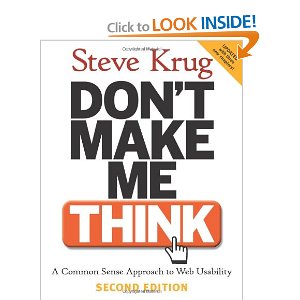
If you have a website, read this book

if you have a website read this book

If you have a website, or have any creative input into a website, this is a book that is a must read. When people come to your website, they are looking for something. And the number one lesson is don't make them think, make it obvious.

Through repeated examples, Krug will show you sites that look nice, but that completely confuse their users, and how he would correct them. You will immediately want to redo your site navigation after reading this. And you'll have a much cleaner overall look once you are done. Buy this book, read it, and make your little corner of the inter webs a better place.

Related: You don't need to suck · What if... the book · What have you changed your mind about?