Writings

Technology, open source, personal essays, and everything that isn't climate.

A generation makes such a difference

The last bit of media that was playing as we came in for approach to JFK from Berlin was an episode of Mad Men.  This was an original configuration 767, so there was just the big central screens in coach, and everyone was watching the same thing.  Neither Susan nor I we watching with head phones, but from time to time we'd see the pictures going by.  At some point the family was out for a picnic, and they "cleaned up" by throwing their beer can into the woods, and just flipping everything off their blanket and onto the ground.

I turned to Susan and said "ah, the 50s, how amusing you were".  Her response was "...or horrifying".  50 years ago communing with nature meant throwing you trash on the ground.  It took a generation to realize that trash isn't taken away by magical fairies.  It just remains, and leaches into the ground water, and causes all manner of problems for generations down the road.  It makes for a good TV moment because the entire audience understands how egregious the act was.  2 generations will do that.  When you are in the middle of a change, it's a lot harder to see that perspective.

They didn't even have cucumbers

Our trip to Europe was primarily for Clemens wedding, in Berlin.  (We got there via Switzerland, but that's a different story).  The wedding was small (by US standards), with about 50-60 people there, but the mix was amazing.  Americans, Germans, and Turks, all with quite interesting backgrounds, and all great people.  It was my first time to Berlin, and I realized how lacking my history was, so crammed a bit out of the guide book and asked some questions of the folks there.  For Clemens, who grew up in the city, I got some great responses at times that showed how matter of fact the second big moment in history for me was (the first being the challenger explosion).  "What's up with that tower."  "So there was this wall around the city..."

On the last night of the trip we went out to dinner with a student from Susan's MFA program who is a German native, and living in Berlin now.  At some point the whole unification question came up and she started retelling her remembrances from childhood.  The one thing she remembered most was how the news kept saying "They didn't even have cucumbers" of the East Germans, when trying to show how bad off they were.  This wasn't actually true, in East Germany they had food when it was in season.  So no tomatoes or cucumbers in January, when they are shipped in from Argentina, picked green, and taste like styrofoam.  But this was the height of the 80s.  Western civilization's peak got symbolized with any thing, any time you want it.  Much like the beer can in the woods, it doesn't matter the impact, or the quality.  So when unification happened, one of the much lauded benefits was this any time culture.

We're hopefully starting to leave that wastefulness behind.  In another generation I think we'll see tomatoes in January no less quaint than throwing our garbage out the car window.  Food miles do matter, both for flavor and for impact to the world around us.  Once we got home we had friends over and had some fresh farm tomatoes with mozzarella, basil, and balsamic vinegar.  Amazing flavor.  Yes, we don't do this in January, but once you've tasted what a tomato is actually supposed to taste like, you wouldn't want to either.


Related: End of term potpourri · From the Archive: When will then be now? Soon. · Fruit is in the eye of the beholder

Resolving a star as something other than a point of light

resolving a star as something other than a point of light

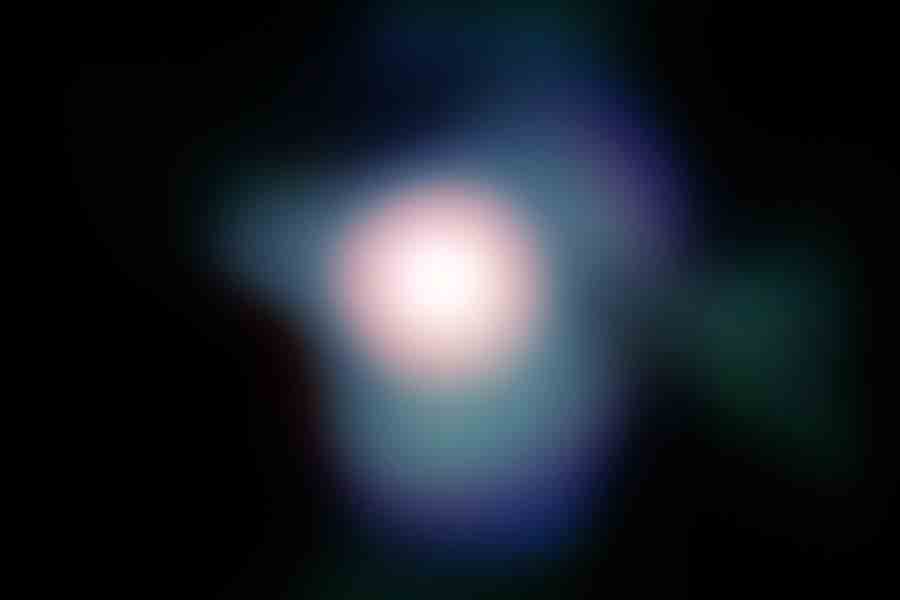
This is Betelgeuse, which is one of the brightest stars in the night sky (9th brightest over the entire sky).  It is the shoulder of the constellation Orion.  Betelgeuse is notable for a number of reasons, the first of it is one of the biggest super giants you can see in the night sky.  The radius of Betelgeuse is thought to be roughly twice that of the orbit of mars.  It would fill up the entire inner part of our solar system.  So even though Betelgeuse is 640 light years away, in the largest telescopes we've got you can see it as something other than just a point of light.  (Previously hubble did this at much less resolution).

This latest image shows the extremely curious fact that Betelgeuse is not symmetric.  It is known that it is in the death throws of the stellar life cycle (which takes tens of millions of years), blasting out bits of it's atmosphere, however up until this point, that was not directly visibly observable, and thought to be a more symmetric thing.  This image is amazing for a number of reasons, not least of which is both confirming, and putting a new spin on, the process by which a star dies.  And it's just gorgeous.  What amazing wonders the night sky holds.

Related: We can now see this... 600 Light Years away · The part of our Sun will be played tonight by a single pixel · Astronomy Picture of the Day - The Sun

OpenSim moves to git

Yesterday we completed the transition of OpenSim from subversion to git as our primary source code system.  This had actually been kicked around as an idea for nearly a year and a half, but our gating factor had always been that git support on windows was lacking.  Recent dramatic improvements with TortoiseGit took away that blocking element.

One of the reasons for this move is to make it easier for more people to participate in the project (I've written about this in the past).  The OpenSim core team has now grown past 20, and even coordinating changes among ourselves has become challenging.  Subversion is fine as long as only a couple of people are working in a particular area, past that it doesn't do you any favors in merging in complex changes.  A number of complex refactorings in the OpenSim tree have been on more or less perpetual hold because of some of these svn challenges.  Hopefully this will help grease the wheels there.

With git the hope is to give us some tools that help us in a number of ways.  The first is to make it easier to collaborate on more complex work.  The second is to make it easier for non core contributors to contribute substantial work.  The ability to have an opensim clone with changes in it staged for upstream inclusion, and have a core member be able to directly pull those changes, should be a big help.

All changes come with challenges.  The most visible is the lack of a monotonically increasing version number.  Git changes are stored differently, so the version identifier is a SHA1 hash.  That's going to be the first big mental change people will need to get past.  It seems like a deal breaker before you've used it, but don't worry, it will be ok once you have gotten used it to.  It's just different.

We've got an ever evolving set of instructions at the OpenSim wiki.  I also expect we'll spend a lot of time in the OSGrid Office hours discussing the transition.

Related: OpenSim Infrastructure Updates: fresh os, git mirror, and automated release building · The next stage in OpenSim community growth - OpenSim Forge · A Git epiphany, a journey in 3 acts

A Short History of Nearly Everything

I've been listening to Bill Bryson's "A Short History of Nearly Everything" for the last couple of weeks, and this book is amazing.  Bill Bryson, most known for various humorous travel books, turned his eyes on the history and progression of science.  It's a journey about what we know about the universe across many disciplines (astronomy, physics, chemistry, biology, geology), and how we came to know that information.  The narrative is very compelling, and often similar in style to James Burke's Connections (so if you loved that, you'll love this.)

He uses big questions to drive the narrative.  The first of which is something that seemed like a simple question, "what is the age of the earth?".  It's somewhat surprising to realize that our current answer of 4.5 Billion years wasn't figured out until the 1950s, and that that discovery was intertwined with the discovery of a massive cover up in the lead production industry on the health effects of lead, and would lead to the banning of the substance for fuel and paint.

You get to see how the chains of science build upon one another, where a new better answer is made based on what came before, and how over time our methods continue to refine themselves.  The stories on the feuds in the dinosaur hunting communities are incredible.  It also goes to show that individuals shape history much more than they are often given credit for.  This is even more true in the fields of science, where a new discovery or insight often opens up massive new industries or fields of study.  None of modern gene sequencing and DNA analysis would be possible had not a curious researcher decided to take samples from Yellowstone's hot springs and on a lark see if anything was alive in the boiling sulfuric waters.  This is even more amazing given that conventional wisdom at the time assured that no life was possible there.  Decades later we discovered that one of those microbes has a curious ability to crank out DNA copies, thus opening up the modern science of genetics.

I can't say enough good things about this book.  It is a perfect, digestible, approach to science literacy.  Your understanding of the universe will be greatly enhanced in the process, and you'll never quite look at a lump of dirt, a wispy cloud, or the night sky again.

Related: The 4% Universe · James Burke's Connections now on Youtube · James Burke on the future

Black Holes don't suck

Last night I learned quite a bit about super massive black holes at the Mid Hudson Astronomy Association month meeting in a great presentation by Dr Barry McKernan.  His overwhelming theme of the evening was that "Black Holes Don't Suck", as he wanted to break that myth.  Everything you've seen in science fiction on black holes is pretty much wrong.

A black hole is just a dark star, so small (relative to mass) that the escape velocity from it's surface is faster than the speed of light.  If you converted the earth into a black hole, it would be the size of a grape.  It would still have the mass of the earth.  The moon would still orbit it just the same.  But you'd be unable to see the thing you were orbiting.  The moon wouldn't fall into the earth, as the celestial mechanics don't change.

A very recent (last decade) discovery is that the hearts of most galaxies contain super massive black holes.  The one at the center of the milky way is 2 Million times the mass of the Sun, though only 10s of times as physically large.  That actually makes it smaller in radius than a lot of the brightest stars you can see at night, like Sirius and Betelgeuse.  Barry started the evening with a movie made of 10 years of observations of the center of the galaxy in which you could see stars moving around in arcs.  Zooming in on the data showed one star in particular whipping around something invisible, like it was a planet going around the sun.  This is part of the data that proved the existence of the super massive black hole in our galaxy.

A subset, less than 1%, of these galactic black holes are consuming dust.  Because dust clouds interact with themselves they effectively slow down over time (converting energy into light and heat).  This creates what are called Active Galactic Nuclei.  They are huge beacons of light at the center of galaxies.  Previously we call these things Quasars, Masars, Magnetars.  In the telescopes of 2 decades ago they look sort of like stars (they are point sources of light), but their light curves are all wrong to a be a star.  Now we can actually see both the "star" and the galaxy they are the center of.  If we get to see the disc top down, they outshine the rest of the galaxy by as much as 1000 times.

I asked the question, "if they outshine the rest of the galaxy, what would they look like if you were in their galaxy".  I saw the speakers eyes light up when I asked the question, so I knew I'd hit on a good one.  The answer, there is so much dust in the discs of galaxies that all that optical, uv, and x-ray light would get absorbed, then re-emitted as infrared.  You'd see a big infrared glow in the direction of galactic center.  You'd also probably see radio jets shooting out like spikes perpendicular to the plane of the galaxy.

All in all this was one of my favorite talks at the group to date.  Very informative, and presenting some great science.  If you have any interest in the stars, and are in the Mid Hudson Valley, you should come check out the group.  Friendly folks, spreading science, what could be better.

Related: Deck Holes Approved, full steam ahead · Resolving a star as something other than a point of light · We can now see this... 600 Light Years away

Microsoft and Linux

A curious thing happened yesterday, a thing that had been feared for years, Microsoft code started down the road to be included in the Linux kernel.  But, unlike the fears of old, it wasn't slipped in in the middle of the night as a secret time bomb.  It was presented at the front door, going to LKML directly.

Well, maybe it was the side door.  As it wasn't actually a microsoft.com post to LKML, it was actually Greg K-H doing the heavy lifting, as Microsoft is working it's patches in via Novell.  Greg is one of the harshest reviewers out there, so in working through him, these should actually be well up to community standards now.  It also shows some street smarts in not running the gauntlet directly.

I'm still not sure what to make of all of this, as earlier this year Microsoft sued TomTom, and forced crippling of the Linux vfat driver to dodge MS patents.  That being said, I'm also of no illusion that MS speaks with one voice.  Big organizations don't do that, and breaking in lawyers to understand open source principals takes a good few years (I know, I've done it before).

It will be curious to see if these drivers make it in to upstream.  There are plenty of good reasons, and many bad, why they wouldn't.  Far more useful features have managed to not make it mainstream in the past, and nothing draws the lightning like Microsoft.  I look forward to seeing how this will play out.

Related: Microsoft's Inclusive Design Manual · Rambling thoughts on C# on Linux · Microsoft 1-ups google on map detail

The Quest for the Wolfram Query Language

When I played with Wolfram Alpha a while ago I was really struck by the fact that it's search box was really useless.  There is a lot of guessing involved to try to get the engine to give you any real information that you didn't already know.  It seemed like it would be far more useful if they just published a Wolfram Query Language that would let you define what you wanted to get out of the system, and how you wanted it to be related.  I'm clearly not the only one with these thoughts.

I was reminded of this lesson by a brief perusal of Wolfram Alpha, the hype machine's latest gift. Briefly: there is actually a useful tool inside Wolfram Alpha, which hopefully will be exposed someday. Unfortunately, this would require Stephen Wolfram to amputate what he thinks is the beautiful part of the system, and leave what he thinks is the boring part.

WA is two things: a set of specialized, hand-built databases and data visualization apps, each of which would be cool, the set of which almost deserves the hype; and an intelligent UI, which translates an unstructured natural-language query into a call to one of these tools. The apps are useful and fine and good. The natural-language UI is a monstrous encumbrance, which needs to be taken out back and shot. It won't be.

The full post is well worth the read.

Related: Stephen Fry on Language · Fluidity of Language · Gerrit queries to avoid OpenStack review overload