1999 was probably one of my worst years. It included lots of friends moving away, a rather awful breakup, and 2 funerals, one of which was for a friend from college. I was very happy to be done with that year.
New Year's 2000 was celebrated with a few friends from Wesleyan hanging out in my apartment in Beacon for the weekend. We play some video games, and went and saw Galaxy Quest on a lark after the new year. That turned out to be one of my favorite movies.
My future game plan on Jan 1 2000 was pretty much 2 fold. #1 go to the Sydney Olympics on IBM's dime (I was on the olympics.com team already at that point). #2 leave IBM as soon as I got back and join another tech company in either Boston or SF. My friend Trey and I had some tentative plans to collectively move to one of those cities and be roommates. The one thing I could have said with certainty in January 2000 was that I would not be at IBM 10 years later. Man, predictions are hard. :)
The 2 events that most shaped my decade happened in 2001. In January 2001, I made a decision to stay at IBM. I had an offer on the table from another company that would have taken me to Cambridge, but staying at IBM meant moving to the Linux Technology Center, which I really wanted to do. In June 2001 I met my future wife, Susan Tveekrem. We met at my parents house in Vermont, and I can still remember sitting next to her on the ramp up to the deck chatting with her. 5 years later she would be escorted by her father down that ramp in a beautiful white dress.
The other 2 events that get honorable mention for the decade both happened in 2003. In March 2003 the first MHVLUG meeting was held. I consider creating and maintaining that group to be one of my major constructive accomplishments. I learned a lot about people, group dynamics, and community building through that. I also made an incredible number of friends through that group. In September 2003, through some encouragement by Susan, I went back to school. 6 years later I'd graduate with a Masters Degree in Computer Science from Marist College. Working on that degree defined a lot of the decade as homework and exams were often constraints on many aspects of our lives.
Susan and I celebrated the end of the naughts at our house last night, with about 10 friends, many made through or because of MHVLUG, playing games till about 2 in the morning. Lots of great fun, and a good way to start off the Teens.
December 31, 2009 · Technology
·
personal

I cleaned up the alignment from a version of this I found online. Enjoy.
December 29, 2009 · Technology
·
personal
I couldn't have said it better myself.
December 26, 2009 · Technology
·
science
According to an Associated Press report,
a state legislator from Maine has introduced a bill that would attach a
warning label to cell phones. The proposed warnings would feature bold
red text warning of the danger of brain cancer, and feature an image of
a small brain. There's one small problem with all of this: there's
little evidence that cell phones increase the risk of brain cancer.
I think Ars hits the nail on the head with this point:
As with any scientific consensus, there are dissenters, and the AP
article features them prominently. These include the retired director
of a cancer research institute, who bases his claims on unpublished
data, and a report from an organization called the BioInitiative
Working Group, which includes scientists who research this topic. The
AP reporter, however, didn't appear to have bothered to evaluate the
Bioinitiative document; doing so would have revealed a selective and,
in some cases, misleading view of the current biomedical literature. In
short, the report doesn't appear to be a reliable guide to the
scientific literature, making its conclusions suspect.
Although the National Cancer Institute is given the final say (no
apparent risks at this time), the article highlights one of the
weaknesses of traditional reporting. In attempting to provide a sense
of balance, it uncritically provides space to those who dissent from
the prevailing consensus, which is likely to confuse those who haven't
dug into the scientific literature.
(Presumably in an attempt to humanize the report, it also presents the
opinion of a Maine cell phone user, even though there's no indication
that the individual is in any way especially informed about the topic.)
The whole article is here.
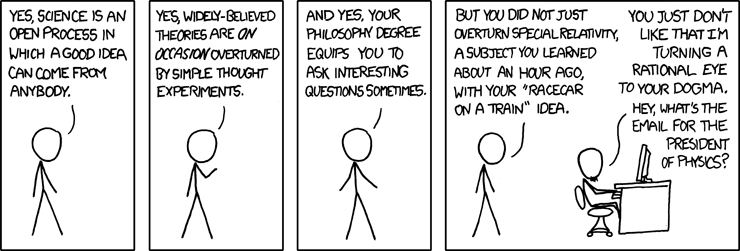
Science reporting is just plain different than politics or human interest reporting, because one side has a preponderance of evidence, and the other has some well meaning, but often really uninformed folks. The Daily Show probably drove this point home best with Walter vs. the Large Hadron Collider. I know, people get uppity when you bring out the term scientific consensus and start talking about the conspiracy of science. After 400 years of scientific concensus that the Earth revolves around the Sun, 1 in 5 Americans still believes that's a conspiracy of science.

Our christmas tree this year. Everything on the tree (minus lights) is edible, as per tradition.
December 17, 2009 · Technology
·
systems
There is a news story out there today about insurgents in Afganistan being able to use $26 worth of equipment to capture and record predator drone video reconnaissance. At first I was pretty aghast by the following:
The potential drone vulnerability lies in an unencrypted downlink
between the unmanned craft and ground control. The U.S. government has
known about the flaw since the U.S. campaign in Bosnia in the 1990s,
current and former officials said. But the Pentagon assumed local
adversaries wouldn't know how to exploit it, the officials said.
But then I thought about it a bit more. By the time Bosnia happened the internet was just a fledgling thing. The spread of information and cheap wireless tech was still pretty limited, and beyond that I'm sure these were designed well before that time. Having no encryption on the video signal was an oversite, but given the state of tech, and the risk, probably a reasonable call.
However the article ends with:
Today, the Air Force is buying hundreds of Reaper drones, a newer model, whose video feeds could be intercepted in much the same way as with the Predators, according to people familiar with the matter. A Reaper costs between $10 million and $12 million each and is faster and better armed than the Predator. General Atomics expects the Air Force to buy as many as 375 Reapers.
Even before finding laptops full of predator video in Afganistan, it's pretty clear that in this day and age you can't put any manner of sensitive information unencrypted through the air. Point to point wireless, cellular tech, and even Satellite TV have all gone encrypted in the mean time. It's a bit disconcerting that DishNetwork has better security than new drones that we are about to put out into the field.
December 14, 2009 · Technology
·
science
As part of our contribution to the Great American Hack-a-thon, MHVLUG will be sponsoring our own local hack-a-thon at SUNY New Paltz tomorrow, Dec 12. Full details and a map with parking locations are available on our website.
This is a casual event where you are encourage to bring your laptop and some project that you've been meaning to spend more time on. For those looking for projects, we'll highlight some of the Open Government initiatives over lunch, as well as what projects people are working on.
If you are in the Mid Hudson Valley, please come and join us.
December 1, 2009 · Technology
·
science
Sometimes, even as a person pisses you off, they make a point that you can't ignore. In a recent forum discussion that I was involved in, scientists were accused of making pronouncements from on high. The argument was that scientists jump to a conclusion that seems desirable to them, and then treat it as an infallible truth.
Of course, my initial reaction was to pronounce that I, as a practicing scientist, never make pronouncements. But, looking at my articles from the perspective of someone who really knows absolutely nothing about science—as a practice or as a body of knowledge—I can see how one could see little beyond a list of assertions. The truth is more complicated, of course, but it's a truth that science writers find challenging to convey. Science is impossibly broad, and the leading edge sits, precariously balanced, on a huge, solid, and above all, old body of knowledge. To illustrate this problem, I am going to tell you the story about how the speed of light came to be the ultimate speed limit for the entire universe.
Thus begins Ars's latest article on Science, and how something becomes a scientific fact. This meshes quite nicely with my blog post from last week.
November 30, 2009 · Technology
·
science
The young specialist in English Lit, having quoted me, went on to lecture me severely on the fact that in every century people have thought they understood the universe at last, and in every century they were proved to be wrong. It follows that the one thing we can say about our modern "knowledge" is that it is wrong. The young man then quoted with approval what Socrates had said on learning that the Delphic oracle had proclaimed him the wisest man in Greece. "If I am the wisest man," said Socrates, "it is because I alone know that I know nothing." the implication was that I was very foolish because I was under the impression I knew a great deal.
My answer to him was, "John, when people thought the earth was flat, they were wrong. When people thought the earth was spherical, they were wrong. But if you think that thinking the earth is spherical is just as wrong as thinking the earth is flat, then your view is wronger than both of them put together."
The basic trouble, you see, is that people think that "right" and "wrong" are absolute; that everything that isn't perfectly and completely right is totally and equally wrong.
However, I don't think that's so. It seems to me that right and wrong are fuzzy concepts, and I will devote this essay to an explanation of why I think so. ....
The entire essay by Isaac Asimov is really worth a read, as it provides a very nice look at what wrong means in science, which is often different than how it is used in common language. It might be another case where part of the confusion between science speak and common language is the words don't quite mean what we think they mean.