Writings

Technology, open source, personal essays, and everything that isn't climate.

Anyone that thinks they are good at Multitasking, are bad at getting anything done

I recently came across this study recently that really drove home how totally bogus multitasking in people is.  It turns out that people that tell you they are good at multitasking, are actually worse at it then people that tell you they aren't.  Also, people that think they are good at multitasking, are worse at accomplishing anything, multitask, single task, anything, then people that don't think they are good at it.

It turns out the one skill people that "are good at multitasking" have, is to delude themselves that they are productive. :)

Puzzled but not yet stumped on why the heavy multitaskers weren't performing well, the researchers conducted a third test. If the heavy multitaskers couldn't filter out irrelevant information or organize their memories, perhaps they excelled at switching from one thing to another faster and better than anyone else.

Wrong again, the study found.

The test subjects were shown images of letters and numbers at the same time and instructed what to focus on. When they were told to pay attention to numbers, they had to determine if the digits were even or odd. When told to concentrate on letters, they had to say whether they were vowels or consonants.

Again, the heavy multitaskers underperformed the light multitaskers.

"They couldn't help thinking about the task they weren't doing," Ophir said. "The high multitaskers are always drawing from all the information in front of them. They can't keep things separate in their minds."

The researchers are still studying whether chronic media multitaskers are born with an inability to concentrate or are damaging their cognitive control by willingly taking in so much at once. But they're convinced the minds of multitaskers are not working as well as they could.

"When they're in situations where there are multiple sources of information coming from the external world or emerging out of memory, they're not able to filter out what's not relevant to their current goal," said Wagner, an associate professor of psychology. "That failure to filter means they're slowed down by that irrelevant information."

The entire article can be read here.

Related: Agile Resistance · The Good and Bad of Open Source Desktop Apps · Home Owner Task: replace the iron filter

Want some tasty E. Coli with that Ground Beef?

The NY Times has a pretty incredible article on why E-Coli keeps showing up in ground beef.  The whole article is worth reading, but this bit gives you the flavor of it.

The frozen hamburgers that the Smiths ate, which were made by the food giant Cargill, were labeled “American Chef’s Selection Angus Beef Patties.” Yet confidential grinding logs and other Cargill records show that the hamburgers were made from a mix of slaughterhouse trimmings and a mash-like product derived from scraps that were ground together at a plant in Wisconsin. The ingredients came from slaughterhouses in Nebraska, Texas and Uruguay, and from a South Dakota company that processes fatty trimmings and treats them with ammonia to kill bacteria.

Using a combination of sources — a practice followed by most large producers of fresh and packaged hamburger — allowed Cargill to spend about 25 percent less than it would have for cuts of whole meat.

Those low-grade ingredients are cut from areas of the cow that are more likely to have had contact with feces, which carries E. coli, industry research shows. Yet Cargill, like most meat companies, relies on it suppliers to check for the bacteria and does its own testing only after the ingredients are ground together. The United States department of Agriculture, which allows grinders to devise their own safety plans, has encouraged them to test ingredients first as a way of increasing the chance of finding contamination.

Unwritten agreements between some companies appear to stand in the way of ingredient testing. Many big slaughterhouses will sell only to grinders who agree not to test their shipments for E. coli, according to officials at two large grinding companies. Slaughterhouses fear that one grinder’s discovery of E. coli will set off a recall of ingredients they sold to others.

While none of this surprises me, since I've been listening to the Omnivore's Dilemma recent, it definitely adds weight to getting your meat local, fed by what the animal evolved to eat, from farmers you trust.  It costs a bit more, but then again I tend to like my meat as free of feces as possible.

Related: The Omnivore's Dilemma · 23 and maybe me? · Companies as Organisms

NYTimes: The New Sputnik

A quite interesting Op-Ed from Thomas Friedman a couple weeks ago that I missed makes the point that China is starting to shift their economy hard in the direction of green endeavors.

Well, folks. Sputnik just went up again: China’s going clean-tech. The view of China in the U.S. Congress — that China is going to try to leapfrog us by out-polluting us — is out of date. It’s going to try to out-green us. Right now, China is focused on low-cost manufacturing of solar, wind and batteries and building the world’s biggest market for these products. It still badly lags U.S. innovation. But research will follow the market. America’s premier solar equipment maker, Applied Materials, is about to open the world’s largest privately funded solar research facility — in Xian, China.

I suspect that the effort to clean up Beijing for the 2008 games is part of what spurred this notion there.  They had to basically shut down the city for months to get the air quality to levels that the long distance runners would compete.  That probably brought some of the environmentalists to the forefront of the party.

On an unrelated front, I thought nytimes was going to get rid of their stupid sign in form.  Get with the 21st century nytimes.

Related: Economist on Labor in China · NYTimes: Who owns that science data · NYTimes on Bard's Citizen Science

The Openning of the Walkway Over the Hudson

the openning of the walkway over the hudson

The Walkway Over The Hudson is an amazing thing.  A 1.3 mile bridge that spans the Hudson River here in Poughkeepsie, which just opened this past weekend after decades of effort.  We were lucky enough to participate in the lighting ceremony on Friday night, which involved sending up these Sky Lanterns. Yes, they are powered by fire, which makes them even more awesome.

http://cdn.smugmug.com/ria/ShizVidz-2009090604.swf

If you live anywhere near Poughkeepsie, you really owe it to yourself to come check the walkway out. The scale of the thing is so different than anything you've been on before that it doesn't really feel like a bridge (at least not to me), but more of a mythical sky way.

I've got a bunch of other photos up at my smugmug site, take a look if you are interested in the walkway.

Related: Walkway Over the Hudson at Sunset · Nature's Fireworks on the Walkway · Walkway Balloon Launch

Ohio Linux Fest 2009

If you had told me the biggest community Linux event in the United States took place in Columbus Ohio, I don't think I would have believed you before this last weekend.  But Ohio Linux Fest blew away all my expectations, with 1100 in attendance, it was a truly phenomenal event.  There were many great stories from the event, but I'll just drop in a few highlights.

OpenSim Presentation

My main reason for being out there was giving a technical presentation on OpenSim.  I've done this presentation in a few other places, so this information I was quite comfortable with, and even had a bit of live demo.  Because I had a last minute tech issue with my laser pointer I wasn't really paying attention with how full the room had become once I got started.  I must have had at least 200 people in that room, and 250 is probably not an unreasonable guess.  Compare that with the 15 I had a Linux World last year, and you get a sense of how much more committed people are here to the tech agenda.

I had intentionally kept the content light and short, as I'd always run over in the past, and the OLF folks are very strict on time keeping (which I highly appreciate as both an attendee and speaker).  With my talk going from 4:00 - 4:55, I had slides, then a live demo, then figured I'd open up with questions.  The slide portion went over ok, but it was hard to guage where the audience was at, when I got to the live demo at 4:25, things seem to perk up, and as I'd already gotten a quick audience question when starting up OpenSim I decided to go for broke, and just end the demo after 10 minutes and open up the floor for questions.  Leaving a 20 minute question gap was a gamble, because I'd been in a few other presentations that only got 1 or 2 questions at the end, but I figured I could always go back to playing with things if it got really quiet in the room.

It didn't.  I had questions from all over the floor, must have answered at least 10 of them in that 20 minutes.  That even included a question from Doug McIlroy, the evening's keynote speaker.  After the talk I had another half dozen folks follow me out and ask more questions out in the hallway, always a great sign.  I couldn't have asked for a better audience, and really appreciate what the organizers of Ohio Linux Fest are able to pull off year after year.

The Guys from NOOSS

Before I left for the event I was found internally at IBM by on of the guys from the Northern Ohio Open Source Society to do an interview with them on OpenSim for their live all day podcast.  That was a great time.  Even though I'm becoming less active in the OpenSim project now, I'm hoping this push to get the word out on the project helps further grow the community.

As we wandered out from the after party the NOOSS guys had moved their recording setup to the lobby, and enticed us with some Great Lakes Brewery beer and Scotch to hang out on the NSFW portion of the podcast.  Don't go and listen to that unless you are a brave soul.  It did however let me put in a plug for my Brother In-Law, Andy Tveekrem, who has recently left as brew master of Dog Fish Head, once was the brewmaster of Great Lakes Brewery, and is planning on setting up a Brew Pub in Cleveland next year.  I'll have to get word out to the NOOSS guys once they open, because their impecable taste in beer means I'm sure they'll find a home there. :)

It's worth the 11 hours in the Car

There were so many other good times, too many to retell here.  Joe, my driving companion, took some video on the trip, which we may manage to cut down to something reasonable for posting online.  It took us 11 hours each way to get there and back.  Before the trip I was really concerned that it was going to be a lot of driving for not much.  But this event was definitely worth the drive, and I'm already planning on going back next year, speaker or not.  It was a really great event.

Related: Talking at Ohio Linux Fest · Speaking at Linux World on OpenSim · My Thoughts on the Central PA Open Source Conference

Amazing Night of Sky Watching

After a quite full day yesterday, I pulled out my telescope for the first in months (since Vermont in July actually), helped in part by the nudging by Jeremy during the week about when I would next do some observing.  The observing forcast looked great, it was a new moon, good transparency and good seeing were predicted, so it was definitely the night to do it.

The neighbors were having a party, so the yard was not nearly as dark as I was hoping.  When I got started at 10, I started with Andromeda Galaxy, which is now up in the east, and a very easy target.  It's always good to have familiar targets after a couple of months of down time to re-remember pointing and finding strategies.  The two smaller galaxies around Andromeda were quite distinct as well, the seeing and transparency forecast seemed to be accurate.  To give that a test, I went looking for the Ring Nebula.  My off hand memory for it's location turned out to pretty off.  Eventually I pulled out a book, and realized I was looking in the wrong section of Lyra, and found it quickly enough.  It was magnifiable up to 240x with reasonable clarity, which definitely prooved the night sky was quite good.  At that point I got a call from Jeremy, told him I was out observing already, and he came over.

With Jeremy in transition, and Jupiter nicely moving into the small strip of southern sky I can see from the deck, I decided to give it a shot.  When introducing someone to astronomy, it's always good to start with a planet, preferably Jupiter or Saturn.  It's bright, you can see the moons, and is one of the objects that most obviously is different from the naked eye to under magnification.  I put my 48x eyepiece in, and swung the scope around to see what I could see.

I was floored.  Jupiter was more clear than I'd ever seen it.  Every time I'd looked at Jupiter in the past in my telescope the banding in Jupiter had bee quite fuzzy, more hints of shade than anything else.  This time they looked like they were inked in.  Incredibly distinct and crisp.  I didn't even bother to put in intermediate lenses, but just jumped straight to the 240x one to see how much this would hold.  At that magnification you always get some shimmering in the atmosphere, but that was relatively minor.  The detail on Jupiter was just amazing.  You could see bits of structure inside the think dark bands, and the number of bands you could make out was far more than I'd ever seen with my own eye.  It was enough that I managed to get Susan out of bed to come and take a look.  It was truly the most amazing view of Jupiter I've ever had.

Once Jeremy showed up we looked through a few things in the sky, Jupiter, obviously, my previous targets, and some open clusters.  Sadly, no globular clusters were in the view that I had.  Over the course of the evening we each saw 4 or 5 shooting stars (not always the same ones).  Given that I was out there for 2.5 hours, that's about on par with my 1 per 30 minutes on any given night.  I explained a lot about what we see and why we see it, and had a great time.  That view of Jupiter is something I'm still remembering this morning, the image is just burned into my brain now.  The skies look great again tonight, so I'm going to have to give it another shot.  GIven the clarity, I'm curious if I can make out the red spot with the equipment I've got.

I hadn't realized how much I missed spending time under the sky (due to our totally weird weather) until last night.  It's great to get back out there.

Related: It's not a UFO... it's Jupiter · Jupiter · An incredible night of observing

Moving on from OpenSim

This has filtered a number of places, but I figured I should post it out on my blog as well, which will hit the OpenSim planet in the process.

I'm moving on from the OpenSim project, for now.  I got involved a little over 2 years ago as part of my role in the Linux Technology Center at IBM.  Over the past 2 years I've made incredible friends, and seen the OpenSim project grow from seeds and ideas to wondrous function.  A really community exists around this project, one that is unquestionably going to change the world.

My official daytime activities are changing to something very unrelated.  You'll still see other folks from the IBM team working actively in the community, Kurt, Rob, Arthur, Alan, Suzy, Zha, Dirk, but for now I'm going to disappear as I deep dive into my new work, and stop being such a slacker on some of the volunteer work I've let slide the end of this summer.

Good bye's are weird on the internet, because no one every really goes very far.  But given how visible I've been at times on OpenSim, I figured I owed it to folks to say something instead of just disapearing into the ether.  As I've learned in working with other open projects, good bye's are never final, so I hope to get engaged again in the future.  Until then... keep on planting those virtual worlds and letting them bloom.

Related: The next stage in OpenSim community growth - OpenSim Forge · Planet OpenSim Gets a Facelift · OpenSim Planet Updates

gwbn - goto window by name in Linux

Years ago when I was using the Ion window manager.  Ion had many very nice features, not the least of which was goto window by name, which you could do from an interactive console or script into other tools.  I created an "e" command, which loaded the file in emacs, then moved you to the emacs desktop window.  This was a great minor productivity boost.

Ion went off the rails for me in a number of ways, so I left, and started using stock gnome in ubuntu.  Using a combination of tilda, superswitcher, and devilspie you can get very close to the functionality that I missed, with the added benefits of all the modern bits of the gnome desktop, like dbus, nautilus, and hardware just working and doing the right thing when you plug it in.  But I never got goto window by name back.  I played with libwnck for a while 2 years ago, and never could figure out what I was doing wrong.

Yesterday, with an hour of idle time in the morning waiting for people to get back to me, I decided to look at the problem again.  This time I started with the libwnck perl bindings, because getting rid of the compile time meant I could experiment a lot more in less time.  After about 20 minutes of guessing on the API I figured out what I had probably missed before, the screen object needs a second stage initialization.  After 20 minutes more, I had gwbn, a perl program that took a regex on the command line and moved my desktop to the first window that matched.

The code is available on github now, and probably on cpan or a ppa for ubuntu before too long.  Now I have my "e" command again, and am a very happy camper.

Related: On returning to Gnome · more experiments with Ion · How to put the window buttons back to the right on Ubuntu 10.04

Talking at Ohio Linux Fest

As it turns out I'll be giving 2 talks at the Ohio Linux Fest, coming up on Sept 26th in Columbus Ohio.

OpenSim: Open Source 3D Worlds

For OpenSim folks seeing this in the planet (or elsewheres), I'll be giving an overview of OpenSim at Ohio Linux Fest.  A little bit of history, a little bit of architecture, and hopefully some live demo (if the wireless holds out).  I've done this before, and it's quite a bit of fun, especially when folks in the audience figure out the build tools for the first time, and the in world presentation gets a bunch of random things building in and around you.  If you are within driving distance of Ohio Linux Fest, you should come out for it.  And if you do, please come up and introduce yourself afterwards.

A Decade of Linux at IBM

I was asked today to fill another slot, with a talk that's become called a Decade of Linux at IBM.  I've been part of the LTC for 8.5 years now, since near the inception, and part of some of the underground Linux movement at IBM before that.  Starting in early 1999 I began running Linux as my primary desktop inside the firewall, and never looked back.  I managed to sneak Linux into the Sydney 2000 Olympics, and was lucky enough to move into the LTC as it was starting to spin up in early 2001.  This talk will be a mix of history and tech, with hopefully a couple of fun annecdotes from the early days of Linux at IBM, through to modern day, highlighting a lot of what we've accomplished as a group along the way.

Now I just need to work on my slides... as it's only 15 days away!

Related: Ohio Linux Fest 2009 · Speaking at Linux World on OpenSim · The Year of The Linux Desktop?

Galileo's Telescope

galileos telescope

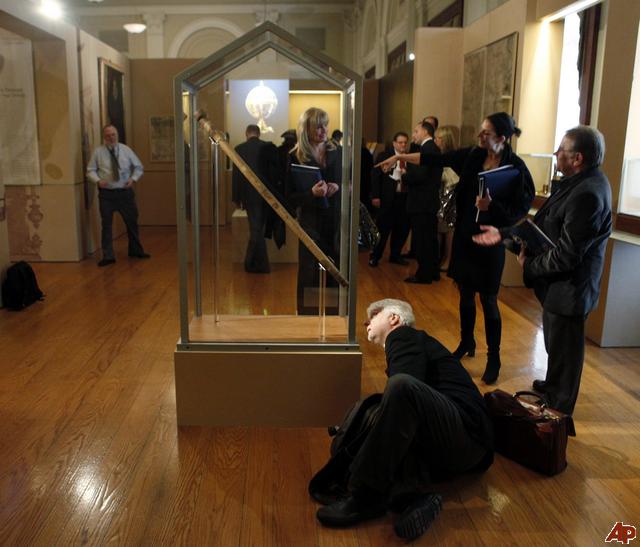
When I found out that this weekend was the closing weekend for the Galileo exhibit at the Franklin Institute, I made some quick plans to go down and see it.  The exhibit was about the age of science and discovery at that time (400 years ago), with the center piece being 1 of the 2 surviving telescopes that Galileo made.  No pictures were allowed, but I found this one on the internet which must have been done as part of a press bit.

That's it.  That wooden tube with a lens no larger than a quarter (and even a smaller aperture) is what discovered the moon wasn't a perfect sphere, and that Jupiter had moons.  The publishing of those discoveries put the nail in the coffin of the heliocentric theory of the universe, and started to open our eyes to the wonders of what is out there.

As you can see, they set up the case so you can look through the telescope yourself.  You aren't getting anywhere near the focal plane, so you can just see a bit of light, but it is still something to be able to look through the same lenses that created such a scientific revolution.  Later in the exhibit they had telescopes that had recreated lenses, and light projections of Jupiter and Saturn on a wall, so you could see what it looked like.

We stayed in the exhibit for 2 full hours.  I must have spent nearly 30 minutes milling around the telescope itself, chatting with, and listening to Frank, the museum staff that was manning the exhibit and telling great stories of it.  I hadn't realized how much of an entrepreneur Galileo was, much like Ben Franklin.  After his discoveries, he got into the telescope making business, as owning a telescope (whether or not you knew how to use it) became high fashion for nobles of the day.   I also found out that our president made a point to come to the exhibit and see the telescope, which I appreciated.

One last thing that Frank said really stuck with me.  The telescope is insured for 7 million dollars.  But he said "a dollar or a billion dollar's, what's the difference.  Once this is gone it can't be replaced."  The fact that the Italian government has managed to preserve 2 of Galileo's telescopes for 400 years is a truly impressive feat.

The exhibit closes on Monday, and the telescope goes back to Italy.  It was only allowed to leave the country for this special International Year of Astronomy exhibit at the Franklin.  I'm very happy that we took the time to get down there, images of that telescope will be burned into my brain for a very long time.

Related: Me and my telescope · How Galileo proved we aren't the center of the universe · New Toy for the Telescope