"Oh my god. I can see the Rings!"
-- 50 different people last night
Last night was awesome. Last night was the Mid-Hudson Astronomical Associations observing event at the Vassar Farm Preserve, titled Saturn Watch 🔗💀. This is the second public outreach event we've done at the Preserve, folking our wildly successful Observe the Moon Night back in September.
We had at least 10 telescopes on the fields brought by members, and at least 60 - 80 visitors there (as I keep hearing about the various groups of 5 - 10 that came, I'm starting to think that might actually be a low estimate). For nearly an hour I had a steady stream of folks coming to my scope to take a look at Saturn.
The first time you see Saturn through a telescope is a magical and visceral experience. That emotion was spilling out through out the field, as you could hear gasps and exclamations as they brought their eye up to the eyepiece.
Talking with folks through the evening, I answered questions about Saturn, telescopes, and astronomy in general. I also let everyone know about our other observing events throughout the year. I think we got at least 2 new members, and I know we managed to get a lot of kids excited about astronomy as well.
Now I'm eagerly looking forward to the North East Astronomy Forum 🔗💀, and the April star party 🔗💀.
There was a really great piece this week on the freight train that is Android:
So here is the kicker. Android, as well as Chrome and Chrome OS for that matter, are not “products” in the classic business sense. They have no plan to become their own “economic castles.” Rather they are very expensive and very aggressive “moats,” funded by the height and magnitude of Google’s castle. Google’s aim is defensive not offensive. They are not trying to make a profit on Android or Chrome. They want to take any layer that lives between themselves and the consumer and make it free (or even less than free). Because these layers are basically software products with no variable costs, this is a very viable defensive strategy.
His final comment is spot on:
In Silicon Valley we like to make light of industries that are facing digital disruption such as newspapers, the record industry, and the movie industry, suggesting that their executives “just don’t get it.” Perhaps now we are witnessing the disruption of not just analog businesses, but also formerly interesting digital businesses as well.
March 28, 2011 · Technology
·
science
I was recently reading a NY Times article about the new gold rush going on in Silicon Valley which included the following statement: "Nationwide unemployment among computer scientists and programmers is higher than in other white-collar professions - around 5 percent". Ok, that seems interesting, and not what I expected, so I wanted a citation.
Years of using Wikipedia has developed a very good set of habbits in actually looking at all the references someone links to in an article. Just because someone writes a thing down, doesn't make it true. In the era of the internet you can't hide behind your endnotes.
So I went trying to find this fact. Maybe they paid the $20 for the IEEE report on unemployment? Though I doubt it for an article that was basically about crazy perqs that were being given. All the freely available pieces of data cited on blogs are from October 2009, 18 months ago. I'm sure that 18 months in no way changed that number. The Bureau of Labor Statistics data that is broken down by job family is older than that, dating back to May 2009. And it doesn't actually address unemployment, but employment. And when it break it down by job family, you start to realize how difficult it would be to figure out those rates anyway. If anyone has a better way to find these numbers, please let me know.
As the NY Times is about to put itself behind a paywall, I'm starting to wonder if one of the lessons old media really needs to learn from new media is heavily footnote. Trust is no longer given to an organization, they've all been too wrong too often. But trust can be given on a piece by piece basis if it has enough supporting material. And providing people good links to good primary sources is really valuable, as an hour on google will attest to. If the NY Times actually started doing that, I'd jump on the digital subscription bandwagon. It's one of the reasons I pay for Ars Technica, they actually spend time getting good citations.
March 24, 2011 · Technology
·
science
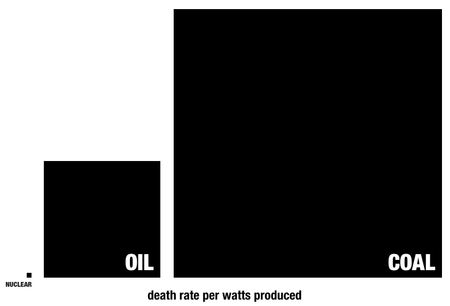
The folks at Next Big Future did an analysis of deaths per unit energy produced back in 2008, which was republished recently due to the media's focus on the Japan reactor. (There is also a many eyes visualization of the data.) World wide Coal kills 4000 times as many people each year as Nuclear. In the US things are a bit better than world wide, and it's only killing about 1/2 as many as Oil, but it is still a big killer.
I think people are reacting to this safety issue much like they do flying vs. driving. Flying on an airplane is far safer than driving, but if it goes wrong a lot of people all die in one place at one time. The real killer takes us in ones and twos every day in every corner of this country.
(Image courtesy of Seth Godin)
March 24, 2011 · Technology
·
books
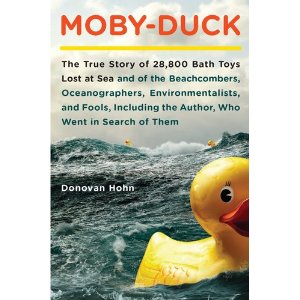
A couple weeks ago I went to a lecture by the author of Moby Duck, Donovan Hohn. I was interested in this because of a story that I remember reading a few years ago. The story was about a flotilla of 1000 ghost rubber ducks, bleached by the sun, about to invade the coast of the UK.
That story turns out to have been false, part of the growing myth surrounding the Friendly Floatees. Much like the white whale, a figment of the collective imagination.
This book tells the story, as best can be reconstructed, of these toys. They weren't made of rubber, and the ducks only accounted for 1/4 of the toys (lost in the creating of the myths were the turtles, frogs, and beavers).
The story is incredible. In an attempt to find the full lifecycle of these toys Hohn goes up and down the Alaskan coast looking for the toys cast upon the rugged north Pacific beaches. He goes to sea, many times, including joining scientific expeditions looking at the plastic content of the Pacific, meso scale currents in the North Atlantic, and crossing the North West Passage (now possible due to a rise of 5 degrees C at the poles) all exploring the possible tracks these toys could have taken. He even goes to China to find the birth place of these toys, and crosses the Pacific on a container ship not unlike the one the Floatees fell off of.
His style is very much like that of Bill Bryson, though his mind drifts and wanders in a really interesting way that gives you a sense of the drifting and wandering of these toys at sea. It's an incredible lens to look at our Oceans, a largely unexplored part of our earth, the impact we are having on them, as well as the dangers that still lie out to sea.
Highly recommended.
One of my favorite new tools in doing websites is the new Google Font API. Using various hooks that exist in modern browsers, as well as really ancient versions of IE, Google is building a huge library of Open Licensed fonts. With a single css include, you can use any of these on your site, and be assured that the bulk of the internet will see what you see.
My current favorite of the new fonts is Cabin, which I've found works incredibly well on headers. There are now many dozen fonts in their API, and it is growing all the time.
In addition to using them on the web, you can download these fonts for local use. There is also a donate button when you download so you can give some money to the font creator, which will ensure more fonts under open licenses get released. I did this for the author of Cabin, as I love his eye for typography and want to see more of that out there.
With technology like this, HTML 5, brand new releases of Firefox and Internet Explore, the promise of the web a good as native, or even better than native, is really starting to take form. Very cool stuff.
March 20, 2011 · Technology
·
science
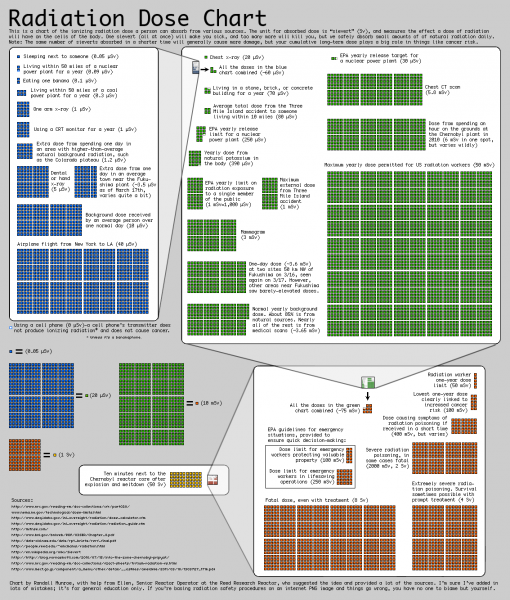
Thanks to XKCD for making this Radiation Chart available on the web. This will help you visualize and understand the various levels of radiation. Simple things to know, you get 3x the amount of radiation by living 50 miles from a Coal plant than you do from living 50 miles from a Nuke plant.
March 18, 2011 · Technology
·
science
I think the thing we've definitely learned about this is having one of the top 10 earthquakes ever recorded is a really bad thing.
-Chad Orzel
As we discussed many things post the Mid Hudson Astronomy meeting on Tuesday, the earthquake came up, especially some conversations around the nuclear reactors, as our speaker, Chad Orzel, is a physicist. Fortunately generosity seems to be overpowering blame at the moment in helping Japan recover from this act of nature.
Our local public radio station is doing a one day fund drive for relief to Japan. They did this with Katrina and Haiti, and it has become a fabric of WAMC, which I'm proud to support.
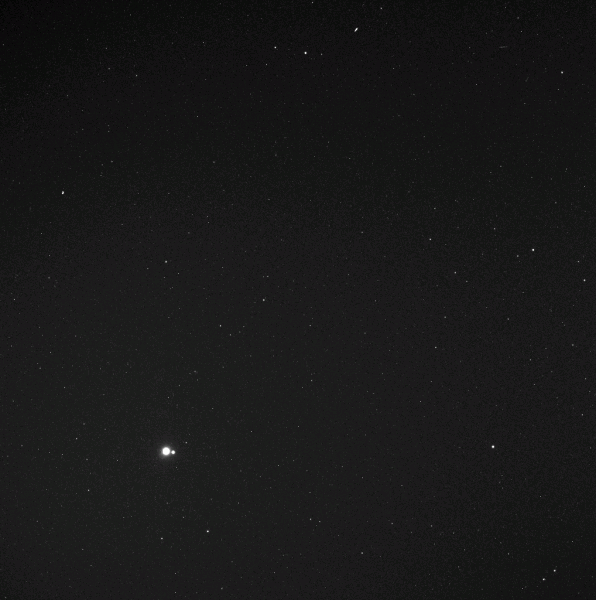
That is Earth and Moon taken from the Messenger probe last year, though it's been wandering the blogosphere this week as Messenger successfully entered Mercury's orbit. It's a little brighter than the Pale Blue Dot, but equally cool.
Quoting from Carl Sagan:
Look again at that dot. That's here, that's home, that's us. On it everyone you love, everyone you know, everyone you ever heard of, every human being who ever was, lived out their lives.
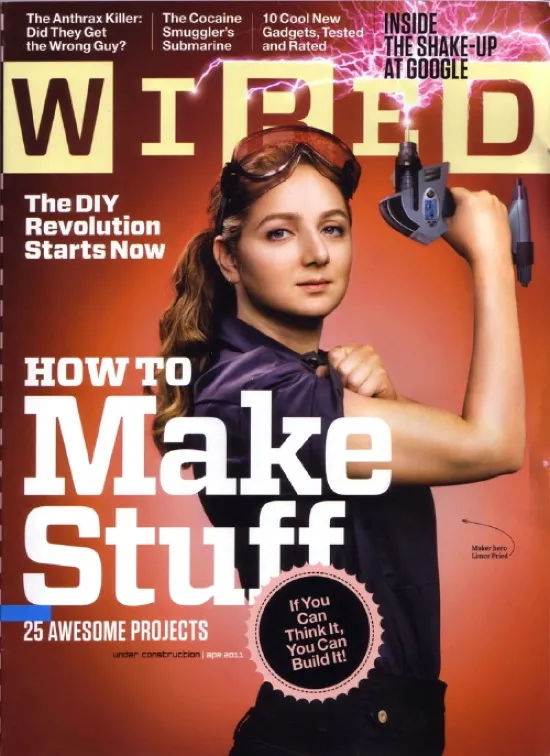
Wired magazine has not been know for women on their covers, and when they are, they were somewhat problematic. At least this month, things are different, and they chose a really spectacular female engineer for their cover.
Limor is the creator of Adafruit Industries, and online store / community for DIY open source electronics. She and her team specifically work on simplifying the electronic designs so they are more approachable by the average person with a soldering iron. She's been one of the big proponents and drivers of the current Arduino craze, which is vastly expanding the ranks of the people that can make basic interactive electronics.
I love the callback to Rosie the Riveter, for those gentle readers outside the US.