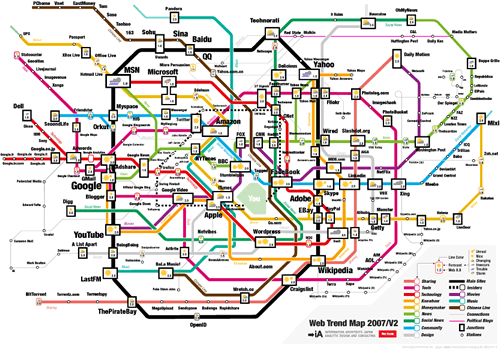
Pictures are worth 1000 words. Follow the link to learn more about how this visualization was made.
Technology, open source, personal essays, and everything that isn't climate.
Pictures are worth 1000 words. Follow the link to learn more about how this visualization was made.
These days my car stereo functionally has three modes: WAMC (our local NPR station), XM 84 (Electronica), AUX in for Drunk & Retired podcast (I've gotten into the 40s on the backlog of episodes). Usually when I have other people in the car, I have it on WAMC or XM 84, but turned down, so it's not that audible.
Yesterday, I drove for lunch. One the way back, while sitting at a light, I heard the following very quietly through the radio.
I love Linux! I love Open Source!
Well that's an odd thing to hear on NPR, so I turned it up. The speaker then started talking about virtual worlds, which is also not the kind of thing you tend to hear randomly on NPR. We had to make a quick stop, so once I was back in the office I looked up the program.
What I was listening to was Word for Word's broadcast of the Big Ideas Conference from Aspen. If you pull these week's podcast, and jump to 03:00 in, you'll hear the same bit. It's only 5 minutes long, as they had 10 speakers in an hour, but it is an interesting perspective on the power of virtual worlds for a less tech savy audience.
For those that had not previously heard, NYCCCP (aka "the space") is coming to an end. The space was the idea of Porkchop and Mike, based on hacker spaces that existed in Boston and Phili. The idea is relatively simple. Rent a reasonable sized (in our case 50' x 20') location, set up desks for all people that are interested in joining. Build a server room, and get a pretty decent synchronous DSL line in. Cost for the space is distributed among it's members, all of whom pay a monthly membership fee to keep the place running. I wasn't originally part of the space, but did join up a year later, and it was a good place to host some Xen test servers.
The space has been running for 3 years, but over the last year people were going there less often, and interest had definitely waned a bit. A few members were lost as they moved a bit further away. Two weeks ago, the overall financials went from self sustaining, to dropping at a relatively sharp pace. In 3 years, the dynamics of the group changed. A lot of us met through the LUG, but became friends outside of it. Originally we only had computers in common, and the space was a good gathering point. But now we do scifi night every week at my house, see each other for lunch a couple days a week, and do plenty of things on the weekends (like biking and hiking).
So, Mike, Porkchop, and I agreed it was time to call the space a grand experiment, that was a good thing, but whose time had passed. The space will shutdown the end of September, and we're in process of getting everything/one sorted out there and out of the building (there are a bunch of other folks with servers there that will need to move as well).
It's a sad thing to see go, but times do change.
In an effort to wrap my head around some of the code for OpenSim, I took a detour and started adding C# support to autodia. Autodia was originally written as something to create dia UML diagrams from perl code, but extended from there to support many languages, and many output formats. Unfortunately, C# is not yet one of those, yet.
Right now I've got class and attribute parsing pretty well under control (except for generics). Autodia definitely evolved on less object oriented languages than C#, as one of the things I'm most interested in knowing is the contains relationships in the codebase, which isn't supported in the current version (though I know know how to add it, just need a couple of hours). One of the things I'm trying to expose is one of the gotchas of object design: the inbreeding that can come from having parents and members all be the same base class. I'm sure there is some good banjo joke in there, but I'm a cup of coffee short of finding it.
The results, are quite pretty:

Once the work is in a more finished state, I'll be pushing it back upstream, so others can benefit as well.
Something funny occurred to me the other day. I was one of the last folks locally to switch from Mozilla to Firefox (I still call it Mozilla). The big "complaint" everyone had with Mozilla was "it's so big and bloated, has all these features that I don't need in it like email. Who wants that in a web browser". This made Mozilla Suite a more or less dead project, with little innovation left on it.
Jump forward a couple of years, and the people that were most vocal about moving to Firefox early on, all seem to be running Thunderbird. So now instead of having 1 application open that does both things (presumably a bit more efficiently as it shared a lot more code), they have 2. I'll admit to firing up Thunderbird from time to time to check news groups, but my use of news groups dropped pretty dramatically once it wasn't in my browser already.
Irony, you are a cruel mistress.
For the past six months, Verizon has been spending a lot of time in our neighborhood. I was as likely to spot little tented trucks with big spools of cable spilling out, as deer on my way to work. Every day this last week there were Verizon trucks working on poles. And, as I suspected, it was because they were bringing in fiber.
Yesterday morning the Fios Internet flier went up on every mailbox in the neighborhood. The offer for our area is the enhanced deal, so 10 Mbs down / 2 Mbs up for the lowest level of service, and 20 Mbs down / 5 Mbs up for the next level. Given how often the cable modem falls over, and how while they increased the downstream recently, they decreased the upstream, which is annoying for things like NX sessions to work, photo uploads, and a host of other bits.
I'm still trying to figure out what the phone quality is like, before I make the plunge, but I'll probably look at switching some time this summer.
Last week was the first week of cucumbers from the Poughkeepsie Farm Project. There is nothing quite like a vine fresh, picked that day cucumber. Cucumbers are one of the few vegetables that Jay will eat, so we gave him one with dinner.
The scifi night crowd is group of folks that love pedanticness and being right, more than most. It only took a minute for the statement "well, a cucumber is actually a fruit" to come out. The whole group was a bit fuzzy on the definition, though later wikipedia gave the most succinct one I've seen so far: a fruit is the ripened ovary—together with seeds—of a flowering plant (and yes, cucumbers, squash, and even nuts are fruit by that definition). We got pretty close to this definition by group think, which led to inevitably less appealing descriptions of what folks were eating, which I'll leave to your imagination. Pedanticness aside, fruit is sweet, vegetables are savory, is probably as good a division as any. By this measure I'd still put tomatoes on the fruit side of the line, but then again, the definition is so loose that it's about as useful as defining planets.
Cucumbers have almost no nutritional value, as they are mostly water, and they grow in about 7 days. Part of the reason that vegetables have such high contents of nutrients is because they take time to grow, and those nutrients take a while to fixate. There was recently a lot of news about that fact that modern vegetables are way less nutritious than those of 60 years ago, which isn't entirely surprising given mass production in the industry, and the market incentives for speeding up production of vegetables for market.
But on the slow vegetable side of things, we've got the Poughkeepsie Farm Project, where Susan and I were picking cucumbers, lettuce, and beets this weekend for the Saturday pickup. After our work shift was over, we picked our own strawberries at the farm (if I wasn't sold on the slow and organic approach to things, the taste of these strawberries would have made me a believer), and then headed off to a wild black raspberry (and apparently black berry) patch I found last year, that no one seems to pick. 2 quarts of black raspberries later, and a quick stop at the local farmers market for local wine, cheese, and blueberries, and we were home, with an incredible harvest of goods to eat.
As we were sitting out on the porch, nibbling on some berries, I started thinking about raspberries, black raspberries, and black berries. Most fruit is incredibly cultivated. Apples, for instance, are all clones, as it is the only way to ensure the same flavor. The precursor to corn is pretty incredible looking, and you'd never recognize it as such (there is a good Scientific American article about it from 3 years ago). But berries, especially wild berries, seem to be an exception. While there is some cultivation in strawberries, blueberries, and raspberries, the wild varieties still exist and thrive, if you know where to look. I've got wild strawberries in my lawn, wild blueberries are easily found along many of the local hiking trails, and raspberries... well, they are out there, but I won't tell you where, because we like picking them so much, and we are fortunate enough to live in an area where picking wild berries seems to be foreign to the minds of most people here. :) Updated: better link on the vegetable nutrient decline.
Just listening to NPR (I'll link in the story later once it is in the archive), where they were discussing people not drinking enough and getting dehydrated. Towards the end of the piece it said that while drinking caffinated drinks isn't as good as water, it isn't as bad as you might have thought, based on some new research. If you drink a litter of water, you may retain about 800 mils. If you drink a litter of tea, you may retain more like 700 mils. I'm curious where this research actually comes from, but it is interesting. Water is still better, but even coffee seems ok to keep you from getting dehydrated.
Things you'd rather not hear your wife say first thing in the morning:
We don't have any water in the house. None of the faucets work.
2 hours later, we have a new well pump, and we have water again, as the old one was burnt out. Not cheap, but given all the other issues that it might have been, at least it was relatively quick and straightforward to fix.
From sogrady's daily links post (which I tend to find one new gem in every other day), I found that Google has a set of online repositories for just about every Linux distro out there. What a great way to make sure you've got the latest google earth, or any of their other apps you like. (Update: Apparently the repo only contains 2 packages, picassa, and google-desktop-linux. Boo google for not putting google earth in there, which is the only app I really care about at the moment.)
Through sogrady's links I also came to the drunk and retired podcast, in which cote (another Redmonker) discusses current trends in technology, as well as dives into some technical topics in depth. The discussion of parsers, and Domain Specific Languages recently was surprisingly coherent for trying to explain something like that with audio only. While this isn't MIT lectures by any stretch of the imagination, it's a pretty good place to get exposed to technology trends that might be outside of your normal day to day environment.