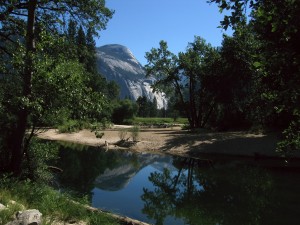
But as a preview for pictures to be uploaded once we get back, Yosemite is definitely spectacular.
Technology, open source, personal essays, and everything that isn't climate.
But as a preview for pictures to be uploaded once we get back, Yosemite is definitely spectacular.
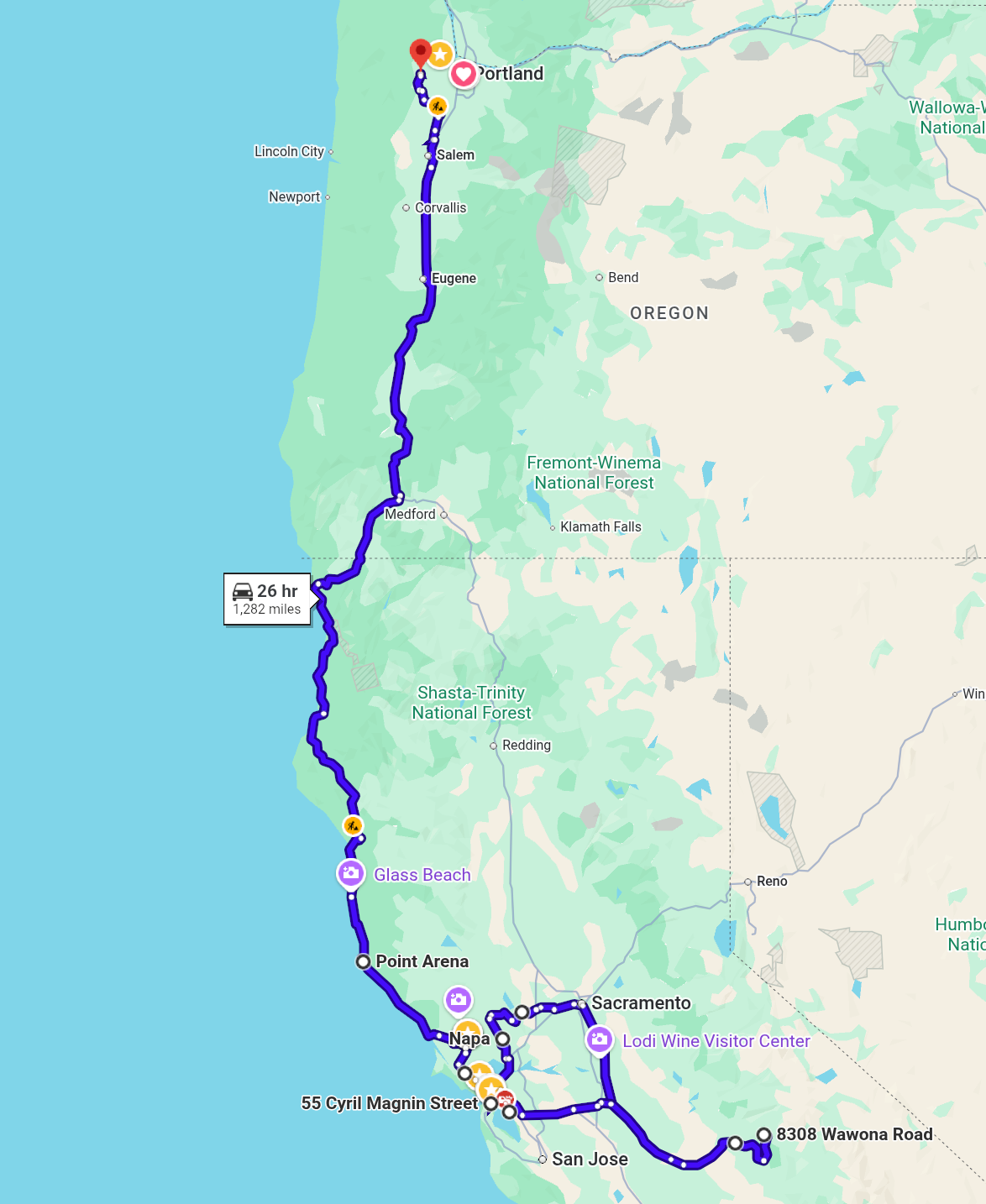
For those interested, this is roughly the vacation path we're taking (we're currently at E).
I've been talking about it for years, and spending the last 2 weekends staring up at the stars with binoculars on our deck made me realize that I now had a place to use this that was only 25' from hot coffee. Not so important now, but that will be clutch in the winter.
One of the constant tensions that exist is the new media age is between preservation of culture and copyrights. Personally this doesn't get summed up any better for me than the fact that Schickele Mix is now lost to us.
Peter Schickele produced 175 episodes of a radio show that explored concepts in music in a very accessible way. I heard it by accident on our local NPR station 7 years ago, and fell in love with it. This was already during one of it's many encores, as new shows had stopped being produced the last 90s. Even though I possess no real musical talent (or perhaps because of that), the show was facinating, and taught me incredible amounts about music. I only wished it was still running somewhere.
Because the show was about music, it played full length songs. The royalty rates for those on broadcast radio were something that was payable at the time, but those rates are substantially higher for online distribution. Hence, there are no archives, and a big piece of culture, one that could get people really excited about music, is now unpublishable due to copyright.
When I was in college, I was always fascinated by the fact that all that still remained of Ancient Greek Theater were 40 some odd plays. How could culture like that get lost? In a digital age it seems incredible that it would be possible to loose important parts of our culture.
The OpenSim community is one of the most vibrant open source communities that I've had the pleasure to be a part of. We've got an active set of core committers, an active set of more casual developers constantly providing bugs and patches to the project, and an incredible active set of users that are testing nearly every checkin out there. This kind of community is really too big for one project. Many of things things the community is interested in doing around OpenSim, like alternative grid servers, or admin web interfaces for opensim, are great things, but don't really make sense in the scope of the main OpenSim source tree. Many of these early efforts set up sourceforge projects, but it was sometimes difficult to find they existed.
Welcome OpenSim Forge!
Adam brought up the idea of setting up a gforge instance for OpenSim a few weeks ago, and things started rolling from there. Adam did all the leg work on this one, so many props to him and his team.
OpenSim Forge is a site for hosting OpenSim related open source projects. All projects must be under an OSI approved license. BSD license is encouraged, as that's the license of OpenSim, but it isn't required. The point is really to just be a one stop shopping for opensim related code, and to make it very easy for anyone that is interested in adding to this community to have a place to stick their project and get visibility.
In the 10 days since the site went live, we've got 10 public projects already registered, plus a few more in the queue. Now, I don't think the 1 new project a day pace is going to keep coming, but as can clearly been seen the OpenSim community is bigger than just the OpenSim project. Here's what we've gotten already up on OpenSim Forge:
It's a very powerful thing once a community grows beyond it's initial boundaries, when it truly takes on a life of it's own. I think the quick uptake on OpenSim Forge shows we are definitely at that point. I see this as a new stage of growth in both the community and the project, and what an exciting stage that is.
There has been a lot of work in the last few days in different directions for OpenSim / SL browsers.
I started playing around with Hippo Viewer, which has very nicely let me convert a bunch of my test environment to mega prims. So much nicer than large link sets. In the process I started thinking about all the ways in which people are making changes to the SL client to suit their needs. A non comprehensive list of items people seem to want to change are as follows:
If you start looking at these you see a theme. All of these are decisions that the server really wants to make (so it gives the control to the grid opperator), but that today are hard coded into the client. So much of what exists in the Second Life viewer today is a shared construct between the server and client. An understanding.
But as we extend past the 1 use case of Second Life (or the 2 if you include Teen grid), we find that the policy created for that one use case falls pretty short when creating different use cases of the underlying technology. By default, it means that users are having to dive in and change the client if they want to do something different. Fundamentally they are gutting the Second Life (tm) use case out of the Second Life open source client code. As a side note, we've tried really hard in OpenSim to keep the use cases out of the platform so that many conflicting ones can be implemented. While not always successful, the multitude of uses that you can see on Planet OpenSim show we're doing at least fair to middling on that front. A few features of My Ideal Viewer So, back to a few thoughts on my ideal viewer, and what it would do. I have no allusions we're going to get there any time soon, but it doesn't hurt to write down a few thoughts:
These are by no means a comprehensive list of what I'd like to see, but it is a flavor. The power of the technology with a viewer that is that flexible would be incredible, and the number of use cases it would be applicable to would be way what can be supported today without digging in and modifying the code yourself.
Comments always appreciated, even if you think I'm just a moron for what I've said here. I'll be traveling a bit over the next few weeks, so if I don't get back to you quickly, it's not you, it's me being on the road. And, as a reminder, these views by no way represent my employer, they are mine alone. :)
I found that Liferea (my rss reader) was starting to get really slow. Hitting space bar to go to the next article was getting somewhat painful levels of delay.
The Fix
Liferea uses sqlite to store it's information. Over time, when you delete from sqlite, the db gets pretty unoptimized (lots of tombstones). This can be fixed with the following command (make sure Liferea is NOT running before doing this):
sqlite3 ~/.liferea_1.4/liferea.db vacuum
(adjust the directory if running a different version of liferea.) It both made my liferea.db 1/2 as big, and now everything is snappy again.
If you are in the San Francisco area in early August, I'll be giving a presentation on OpenSim at the Linux World Conference. Our local linux users group got a preview of that talk this past week. For the talk I started up an OpenSim instance on my laptop and let everyone with wireless and a capable video card connect to it, with much hilarity ensuing. It worked so well, that I'm definitely going to include that portion in my talk at Linux World.
If you are going to be around there, let me know. I'd also love to meet up with OpenSim folks in the SF area during my trip out.
I've been thinking a lot about the way the implementation of SecondLife has created a very specific culture in that environment. One of the issues SecondLife is currently having in expanding scope, is that culture makes some things easy, some things hard, and other things impossible. The technology is never impossible, but meeting the needs of the residents of can be. I'm going to start posting some of these "what if" bits on the technology here under the opensim and secondlife tags, please feel free to jump in and discuss.
The Permissions System
The SecondLife permissions system is a curious thing:
The model provides the ability to let people create modifiable, but un resellable goods, or prevents a good from propagating. What it doesn't really do though is encourage Creative Commons content. Most creators that create "full perms" objects, find that someone takes a copy removes some of the permissions, then sells it elsewhere.
There has been a lot of arguments that a CC model for content creation can't work on grid scale, but I don't think it's been given a fair shake. If you really wanted to try this experiment, you'd need another bit (at least one more) which was:
Doing so would let you put content into the environment that has the Modify / Copy / Transfer bits enabled, and no down stream person could turn them off. "I gave away this thing, and want it to be part of the commons. Anyone can have it, but also has to keep it in the commons." To support this kind of model building content on the main grid, Linden could even remove the upload cost for NDP content, making it a richer world for all.
The recent trend to do public works projects in SecondLife, paid for by the Lindens, means there is definitely some need for a commons space. Perhaps expanding the permissions model to keep free content free would do some of this on it's own.