Writings

Technology, open source, personal essays, and everything that isn't climate.

Air marshal arrest rates

Via Bruce Schneier:

Air marshals are being arrested faster than air marshals are making arrests.

Actually, there have been many more arrests of Federal air marshals than that story reported, quite a few for felony offenses. In fact, more air marshals have been arrested than the number of people arrested by air marshals.We now have approximately 4,000 in the Federal Air Marshals Service, yet they have made an average of just 4.2 arrests a year since 2001. This comes out to an average of about one arrest a year per 1,000 employees. Now, let me make that clear. Their thousands of employees are not making one arrest per year each. They are averaging slightly over four arrests each year by the entire agency. In other words, we are spending approximately $200 million per arrest. Let me repeat that: we are spending approximately $200 million per arrest.

Related: Seriously underwhelmed by Adobe AIR on Linux · Cable news needs to go back to science class · Encryption, or lack there of, in military drones

New tires make the car

This past year I finally got a set of Blizzack snow tires for my 2007 Honda Civic, and was blown away by how well it performed in the snow and ice.  I actually made a point to go out in the nasty weather just to test it out.  When March rolled around I swapped out the tires for my old all seasons, and came to a realization.  I hated my all season tires.

Up until shopping for my snow tires my standard model for getting tires was showing up to a tire place and saying I wanted good tires.  I was the ignorant consumer, assuming the guy over the counter understood what I meant by good.  It actually worked out quite well on my old civic the second time I replaced the tires, but I suspect that was just dumb luck.

My snow tire shopping experience was different.  I went to Tirerack and read a lot of reviews and ratings on tires, asked a few friends for opinions, and picked something that had the trade offs I liked.  The end result was excellent.  So I decided to do it again for all season tires.  The end results were again... excellent.

I picked the Bridgestone Turenza Serenity tires (and not just because they are named after my favorite spaceship), and I picked right.  They are super quiet, I no longer have any tire noise at all, which is hugely different from my last set.  I woke up Tuesday morning excited to get in the car and drive, it didn't matter where.  No results on wet traction yet, given that we're having freakishly (35 degree above average) hot and dry weather right now, so that second criteria hasn't been tested yet.

The whole experience made me realize I really need to be a more educated consumer, even on areas of my life where I'm less interested.

Related: End of an Era · The coolest Civic that I'll never be able to buy · Snow Fighting, the Alaskan Way

Sean Cast

Last week I started using Read It Later again, which I really like.  It occurred to me what I also really wanted was a Listen to it Later, which would automatically get things onto my Android phone so that it would come up in rotation in my driving around.  It was on that list of things I'd get around to eventually, until I came across a 1.5 hour Douglas Adams talk that I had to listen to.

The net result is Sean Cast, another wordpress instance where I'll be posting audio I want to listen to later that isn't in one of my regular podcast feeds.  You might want to listen as well, in which case you are welcome to subscribe to the podcast, or just look at the site from time to time.  No promises other than it's stuff that is interesting to me.

Related: What I'm listening to · A Year in Podcasts · New dague.net site

The future of open source

Last Wednesday, at the kind invitation of the folks from Eclipse, I had the opportunity to sit with more august company – Justin Erenkrantz (Apache), Mårten Mickos (Eucalyptus), and Jason van Zyl (Maven/Sonatype) – on a panel charged with debating the future of open source. Among the questions posed to us was this: is the future of open source going to be based on communities such as Apache and Eclipse or will it be based on companies that sell open source? My reply? Neither. It’s Github.

Stephen O'Grady does a great job of articulating why github is fundamentally changing the nature of open source development.  It meshes well with my own thoughts on the matter.

Related: Source Forge Open Source Again · Software in the era of drive by contribution · Upcoming Talk: Getting Involved in Open Source

First crack in the gene patent industry

NEW YORK – Patents on genes associated with hereditary breast and ovarian cancer are invalid, ruled a New York federal court today. The precedent-setting ruling marks the first time a court has found patents on genes unlawful and calls into question the validity of patents now held on approximately 2,000 human genes. The ruling follows a lawsuit brought by a group of patients and scientists represented by the American Civil Liberties Union and the Public Patent Foundation (PUBPAT), a not-for-profit organization affiliated with Benjamin N. Cardozo School of Law. "Today's ruling is a victory for the free flow of ideas in scientific research," said Chris Hansen, a staff attorney with the ACLU First Amendment Working Group. "The human genome, like the structure of blood, air or water, was discovered, not created. There is an endless amount of information on genes that begs for further discovery, and gene patents put up unacceptable barriers to the free exchange of ideas."

I'm sure this is going to end up in the supreme court eventually, but for today I'll take this as a small victory for sanity when it comes to intellectual property.

Related: Newegg Patent Victory · When Patents Attack · This is what a real patent looks like

Earth Hour 2010 in Pictures

Earth Hour 2010

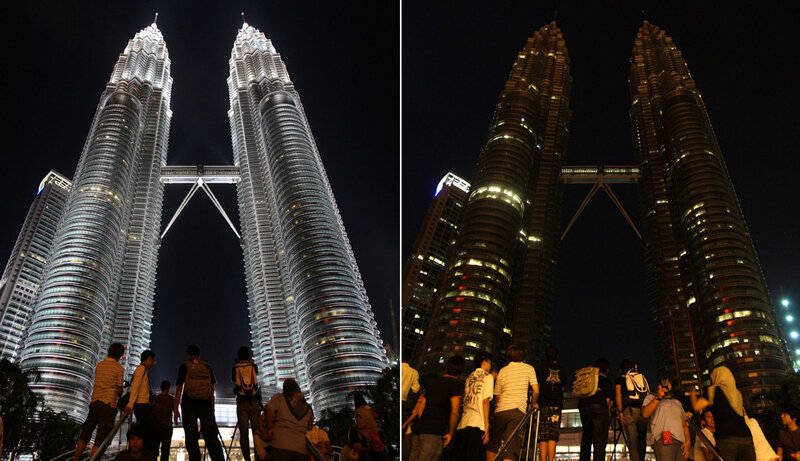
The Big Picture has another great photo essay on Earth Hour 2010, with some of the big cities that decided to turn off their lights for one hour on Saturday.  Some of the images are amazing, as you can actually see the stars start to show up (like on the acropolis). Light Pollution has taken the stars and the milky way away from a majority of Americans, as well as becoming a health hazard.  Hopefully this creates some more awareness on the issue.

Related: The Blizzard of 2010 in Pictures · Timeline of the far future · All hail the super earth!

Go see the Hubble IMAX show... right now

Go See The Hubble Imax Show Right Now

Last night I was fortunate enough to get out to a free screening of the Hubble IMAX movie out in Norwalk, Connecticut, which also included both an engineering and a science lecture up front about the Fine Guidance Sensors, which were designed and built (along with a lot of the other parts of the telescope) in Danbury, Connecticut.  This was all put on by Western Connecticut State University as part of their 20 years of Hubble celebration this year.

It was a really neat evening.  There were a lot of folks in the audience who were engineers that worked to build the Hubble in Danbury, at least a dozen folks were called out by name and stood up to roaring applause by the crowd for all their hard work.  The engineering talk on the FGS probably was more than I ever thought I'd know about interferometry, and did go through some of the basics the challenge of building the Hubble.  The FGS are effectively the star tracking sensors that ensure the hubble can stay stable and pointed as it's moving between -100 C / +45 C temperature swings every 90 minutes as it flies around Earth.

The science talk followed which specifically talked about some of the extra science they got out of the FGS, including finding planets, doing atmosphere analysis of Neptune's moon Triton, and allowing for the Hubble Ultra Deep Field view, one of the most amazing pictures that has ever been taken.

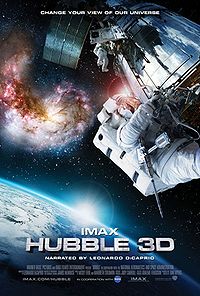
After the talks, we went straight into the Hubble IMAX film.  It was 2D only, but totally immersive none the less.  The entire film is incredible, get out and see it if you can.  One part at the beginning is going to stick with me forever though, which is the fly out to the Orion Nebula.  Because Hubble has taken such detailed measurements of the Orion Nebula they were able to construct a 3D fly through of the stellar nursery there.  Except for the very last part on the forming solar system, this isn't a simulation, this is images brought to life.  It's completely breath taking.

The Hubble is a great instance of the things we can create, and the discoveries we can make, when we come together with open minds trying to ask a seemingly simple question, what's out there in the universe, and how does it work.  The Hubble turns 20 in April, and because of this final servicing mission it hopefully has many great years ahead of it.

Thanks again to WCSU for pulling the night together, and Paul Granich from the Mid Hudson Astronomical Association for letting us know about it and organizing the dozen of us to make our way down.
Related: Hubble vs. the James Webb in Rap · Orion Nebula - care of astronomy picture of the day · Timeline of the far future

Viacom's schizophrenic relationship with youtube

From the youtube blog:

For years, Viacom continuously and secretly uploaded its content to YouTube, even while publicly complaining about its presence there. It hired no fewer than 18 different marketing agencies to upload its content to the site. It deliberately "roughed up" the videos to make them look stolen or leaked. It opened YouTube accounts using phony email addresses. It even sent employees to Kinko's to upload clips from computers that couldn't be traced to Viacom. And in an effort to promote its own shows, as a matter of company policy Viacom routinely left up clips from shows that had been uploaded to YouTube by ordinary users. Executives as high up as the president of Comedy Central and the head of MTV Networks felt "very strongly" that clips from shows like The Daily Show and The Colbert Report should remain on YouTube.

Viacom's efforts to disguise its promotional use of YouTube worked so well that even its own employees could not keep track of everything it was posting or leaving up on the site. As a result, on countless occasions Viacom demanded the removal of clips that it had uploaded to YouTube, only to return later to sheepishly ask for their reinstatement. In fact, some of the very clips that Viacom is suing us over were actually uploaded by Viacom itself.

This is so absurd you'd be hard to come up with a better "who's on first" plan yourself.

Related: Viacom: "All your Creative Commons are belong to us!" · Dague History on Youtube · Big Media vs. Google TV

Building ruby projects with newgem

Over the weekend I was working on revamping a whole set of older ruby projects, some having to do with my Proliphix Thermostat.  I had this crufty Rakefile from the icalendar project that I'd been copying and modifying for new projects, and it was slowly degrading.  I thought that there had to be a better way.  There is, it's called newgem 🔗💀.

Newgem is like h2xs in the Perl world, something to stub out a new module with all the right files and structures.  But, as the Ruby folks tend to do, it ups the ante in the process.  In addition to the basic build, packaging, testing, and coverage results you'd expect, you also get a targets for: creating you rubyforge website, publishing your gems to rubyforge and gemcutter, posting release announcements on rubyforge, and even posting blog posts about your release (though I haven't configured that one yet).

The release cycle is now:

rake release
rake website
rake post_news

The Rakefile created is loading these features from base modules, so it's only ~ 30 lines, a heck of a lot easier to maintain than the 300 line Rakefiles I had which provided about 1/2 these features inline.

If you are doing Ruby development, you should really check out newgem.

Related: 700 Ruby Hobos · Publishing my first gem: thermostat 0.0.2 · Monitoring and Controlling your Proliphix thermostat with Ruby

Monitoring and Controlling your Proliphix thermostat with Ruby

Monitoring And Controlling Your Proliphix Thermostat With Ruby

It's been 2 years since I got my Proliphix thermostat, and while I did some early hacking on it, largely the whole effort just sat around for the last 2 years.  However, with the fun of connecting up my weather sensors, I went back in this weekend and beat the code into a much more sane interface.

Thermostat.rb 🔗💀 1.1.1 was released yesterday.  It provides a concise interface to the Proliphix web services API.  An example of the usage is something like:

  thermostat = Thermostat.new("hostname", "admin", "password")

  # get the current temperature
  current_temp = thermostat.temp

  # get the current setback heat value
  current_target_temp = thermostat.heat_to

  # set the thermostat to 69F (units are set in the thermostat)
  thermostat.heat_to = 69

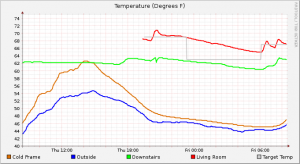
I've got support under the covers for everything in the Proliphix API. I've only mapped about 1/2 of it to the user visible interface, starting with all the functions I've tended to need or use.  I was a good little agile developer and built unit tests for everything here.  Using the new module, I added the thermostat to my homegraph code, with some pretty reasonable results:

All this is released under the MIT license.

Related: Early working thermostat code · Publishing my first gem: thermostat 0.0.2 · Thoughts on a smarter home